We take a sample of size n=16 for a quality of life (QoL) measurement from a...
We take a sample of size n=16 for a quality of life (QoL) measurement from a population with a normal distribution with m=9 and s=6.
a) What is the expected mean and the standard error for a sample size of n=16?
b) What is the probability that the sample mean will be greater than 10?
Homework Answers

Add Answer to:
We take a sample of size n=16 for a quality of life (QoL)
measurement from a...
We take a sample of size n=16 for a quality of life (QoL) measurement from a...
We take a sample of size n=16 for a quality of life (QoL) measurement from a population with a normal distribution with m=8 and s=6. a) What is the expected mean and the standard error for a sample size of n=16 b) What is the probability that the sample mean will be greater than 10?
A. Suppose you take a sample of size n from a population and calculate a statistic...
 A. Suppose you take a sample of size n from a population and calculate a statistic from that sample. The statistic could be a sample proportion p, a sample mean x, or another statistic. Then suppose we repeat this process over and over again until we find all possible samples of size n from the population (this is a theoretical idea) and we calculate the same statistic from 1. each sample. The collection of all of the statistics calculated is...
A random sample of size n = 347 is taken from a population of size...
 A random sample of size n = 347 is taken from a population of size N = 7,200 with mean μ =-70 and variance ơ2-151. Use Table 1. a-1. Is it necessary to apply the finite population correction factor? Yes O No a-2. Calculate the expected value and the standard error of the sample mean. (Negative values should be indicated by a minus sign. Round "standard error" to 2 decimal places.) Expected value Standard error b. What is the...
Week 7 1) The population from which a sample is drawn is: a) Always Normal in...
 Week 7 1) The population from which a sample is drawn is: a) Always Normal in shape b) Bigger in size than the sample size (N is greater than ) c) A large number of subjects or people d) None of the above 2) The probability of 2 heads when we flip a coin twice is: a) 1 b).5 C) 25 d).75 e) Unknown 3) How many possible values of the variable "# of heads when a coin is flipped...
A random sample of size n = 32 is taken from a population with mean μ...
A random sample of size n = 32 is taken from a population with mean μ = −6.1 and standard deviation σ = 2. [You may find it useful to reference the z table.] a. Calculate the expected value and the standard error for the sampling distribution of the sample mean. (Negative values should be indicated by a minus sign. Round "expected value" to 1 decimal place and "standard error" to 4 decimal places.) Expected value Standard error b. What...
A random sample of size n = 124 is taken from a population of size N...
A random sample of size n = 124 is taken from a population of size N = 3,835 with a population proportion of p = 0.63. [You may find it useful to reference the z table.] a-1. Is it necessary to apply the finite population correction factor? Yes No a-2. Calculate the expected value and the standard error of the sample proportion. (Round "expected value" to 2 decimal places and "standard error" to 4 decimal places.) b. What is the...
A random sample of size n = 87 is taken from a population of size N...
A random sample of size n = 87 is taken from a population of size N = 847 with a population proportion p = 0.75. [You may find it useful to reference the z table.] a-1. Is it necessary to apply the finite population correction factor? a-2. Calculate the expected value and the standard error of the sample proportion. (Round "expected value" to 2 decimal places and "standard error" to 4 decimal places.) b. What is the probability that the...
We will take a sample size n=46 from a population with mean u = 4.3 and...
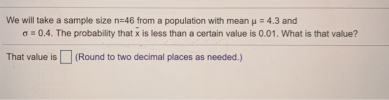 We will take a sample size n=46 from a population with mean u = 4.3 and o = 0.4. The probability that x is less than a certain value is 0.01. What is that value? That value is (Round to two decimal places as needed.)
Suppose we use iid sampling to obtain a sample of size 16 from a normal population...
Suppose we use iid sampling to obtain a sample of size 16 from a normal population with standard deviation, sigma = 10. What is the probability that our sample mean will be within 2 of the population mean?
25 Anormal population - 0 - 8. A random sample and scores from 54 Wurthe-wore for...
 25 Anormal population - 0 - 8. A random sample and scores from 54 Wurthe-wore for this sample is population has a mean of 24. A random sample of 4 scares is obtained from a mal population with probability of obtaining met greater than 22 for this sample! - 20 and a t West - 20 the following samples is deur likely to be obtained For normal perelation with a Band for a sample of n = 4 X- 5...
 A. Suppose you take a sample of size n from a population and calculate a statistic from that sample. The statistic could be a sample proportion p, a sample mean x, or another statistic. Then suppose we repeat this process over and over again until we find all possible samples of size n from the population (this is a theoretical idea) and we calculate the same statistic from 1. each sample. The collection of all of the statistics calculated is...
 A random sample of size n = 347 is taken from a population of size N = 7,200 with mean μ =-70 and variance ơ2-151. Use Table 1. a-1. Is it necessary to apply the finite population correction factor? Yes O No a-2. Calculate the expected value and the standard error of the sample mean. (Negative values should be indicated by a minus sign. Round "standard error" to 2 decimal places.) Expected value Standard error b. What is the...
 Week 7 1) The population from which a sample is drawn is: a) Always Normal in shape b) Bigger in size than the sample size (N is greater than ) c) A large number of subjects or people d) None of the above 2) The probability of 2 heads when we flip a coin twice is: a) 1 b).5 C) 25 d).75 e) Unknown 3) How many possible values of the variable "# of heads when a coin is flipped...
 We will take a sample size n=46 from a population with mean u = 4.3 and o = 0.4. The probability that x is less than a certain value is 0.01. What is that value? That value is (Round to two decimal places as needed.)
 25 Anormal population - 0 - 8. A random sample and scores from 54 Wurthe-wore for this sample is population has a mean of 24. A random sample of 4 scares is obtained from a mal population with probability of obtaining met greater than 22 for this sample! - 20 and a t West - 20 the following samples is deur likely to be obtained For normal perelation with a Band for a sample of n = 4 X- 5...
Most questions answered within 3 hours.
-
Where is the error in this code sequence?
String s1 = "Hello";
String s2 = "ello";...
asked 11 months ago -
Financial data for Joel de Paris, Inc., for last year
follow:
Joel de Paris, Inc.
Balance...
asked 11 months ago -
Consider this reaction:
Al2(SO4)3 (aq)+ BaCl3
(aq) Al2Cl6 (aq)- +
3BaSO4(s) . What is the...
asked 11 months ago -
Suppose that Savneet is considering increasing her
recent random sample from 20 car rentals to 40...
asked 11 months ago -
Trucks arrive at an unloading terminal at an average rate of 120
per hour.
Trucks arrive...
asked 11 months ago -
Why are methanol and ethanol completely soluble in water while
octanol is not very little soluble....
asked 11 months ago -
A facilities manager at a university reads in a research report
that the mean amount of...
asked 11 months ago -
When the CuSO4 is rehydrated by adding water to the anhydrous
compound, is this an endothermic...
asked 11 months ago -
A ray of sunlight is passing from diamond into crown glass; the
angle of incidence is...
asked 11 months ago -
A block of mass 0.249 kg is placed on top of a light, vertical
spring of...
asked 11 months ago -
how do the kidneys compensate in the presences of acidosis
a) trigger hyperventilate
b) reserve acid...
asked 11 months ago -
Question 501 pts
The rental rate of capital to the firm increases. Which of the
following...
asked 11 months ago