Calculate 1. 25 *10-1* (-4.5 * 10-1+ 12.5 * 10-2) by hand, assuming each of the...
Calculate 1. 25 *10-1* (-4.5 * 10-1+ 12.5 * 10-2) by hand, assuming each of the values is stored in a single precision format. Show all your steps,similar way to the examples you took in class,and write your answers in both the single-precision floating-point format and in decimal.
Homework Answers
1.25 *10-1* (-4.5 * 10-1+ 12.5 * 10-2)
= 1.25 *10-1* (-45-1+ 12.5 * 10-2)
= 1.25 *10-1* (-45-1+ 125-2)
= 1.25 *10-1* (-46+ 125-2)
= 1.25 *10-1* (79-2)
= 1.25 *10-1* (77)
= 12.5-1* (77)
= 12.5-77
= -64.5

Add Answer to:
Calculate 1. 25 *10-1* (-4.5 * 10-1+ 12.5 * 10-2) by hand,
assuming each of the...
Calculate 1.666015625 x 10° (1.9760 x 10⁴ + - 1.9744 x 10^) by hand, assuming each...
 Calculate 1.666015625 x 10° (1.9760 x 10⁴ + - 1.9744 x 10^) by hand, assuming each of the values are stored in the 16-bit half precision format IEEE 754-2008. IEEE 754-2008 contains a half precision that is only 16 bits wide. The left most bit is still the sign bit, the exponent is 5 bits wide and has a bias of 15, and the mantissa is 10 bits long. A hidden 1 is assumed. Assume 1 guard, 1 round bit,...
Assume all values are stored in a single precision IEEE-754 format. Calculate 2.5*10-1 divided by: a....
Assume all values are stored in a single precision IEEE-754 format. Calculate 2.5*10-1 divided by: a. 1.25*10-1 b. 0 Show all your steps and write your answers in both the single-precision floating-point format and in decimal.
Question: Calculate the sum of 2.6125x101 and 4.150390625 x 10⁻¹ by hand, assuming A and B...
Question: Calculate the sum of 2.6125x101 and 4.150390625 x 10⁻¹ by hand, assuming A and B are stored in the 16-bit half precision described in Exercise 1. Assume 1 guard, 1 round bit, and 1 sticky bit, and round to the nearest even. Note: show all the steps for your calculation. Exercise 1: IEEE 754-2008 contains a half precision that it is only 16 bits wide. The leftmost bit is still the sign bit, the exponent is 5 bits wide...
3.30 [30]<$3.5> Calculate the product of-8.0546875 X 10° and 1.79931640625 X 10⁻¹ by hand, assuming A...
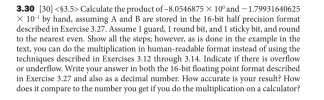 3.30 [30]<$3.5> Calculate the product of-8.0546875 X 10° and 1.79931640625 X 10⁻¹ by hand, assuming A and B are stored in the 16-bit half precision format described in Exercise 3.27. Assume 1 guard, 1 round bit, and 1 sticky bit, and round to the nearest even. Show all the steps; however, as is done in the example in the text, you can do the multiplication in human-readable format instead of using the techniques described in Exercises 3.12 through 3.14. Indicate...
1. Compute the decimal value for the following bit pattern, assuming it is a single-precision floating...
1. Compute the decimal value for the following bit pattern, assuming it is a single-precision floating point number (show major steps): 1100 0011 0001 0010 0100 1001 0010 0100 2. Convert the decimal -2118.75 into single-precision floating point number (show major steps). 3. Assume -75 and -122 are signed decimal integers stored in 8-bit sign-magnitude binary format. Calculate -75 + -122. Is there overflow, underflow, or neither?
6. The exponent in IEEE format floating point numbers are not represented in 2's complement format....
 6. The exponent in IEEE format floating point numbers are not represented in 2's complement format. Why not? What number is indicated if the value stored in the exponent is zero? What exponent and fraction are used to represent "not-a-number"? 7. This question deals with two numbers in IEEE format (A - 0x3F400000, B 0x3DB00000 (a) Calculate A+B using the floating-point addition procedure discussed in class. Determine the single precision result and express your answer in IEEE floating-point format. Convert...
4. (5 points) IEEE 754-2008 contains a half precision that is only 16 bits wide. The leftmost bit...
 4. (5 points) IEEE 754-2008 contains a half precision that is only 16 bits wide. The leftmost bit is still the sign bit, the exponent is 5 bits wide and has a bias of 15, and the mantissa is 10 bits long. A hidden 1 is assumed. Write down the bit pattern to represent-1.09375 x 10⁻¹ assuming a version of this format, which uses an excess-16 format to store the exponent. Comment on how the range and accuracy of this...
(2 pts) Express the base 10 numbers 16.75 in IEEE 754 single-precision floating point format. Express...
 (2 pts) Express the base 10 numbers 16.75 in IEEE 754 single-precision floating point format. Express your answer in hexadecimal. Hint: IEEE 754 single-precision floating-point format consists of one sign bit 8 biased exponent bits, and 23 fraction bits) Note:You should show all the steps to receive full credits) 6.7510 Type here to search
Problem 4 (10 points): 1. Consider the numbers 23.724 and 0.3344770219. Please normalize both 2. ...
 please help
Problem 4 (10 points): 1. Consider the numbers 23.724 and 0.3344770219. Please normalize both 2. Calculate their sum by hand. 3. Convert to binary assuming each number is stored in a 16-bit register. Half-precision binary floating-point has: sign bit: lbit, exponent width: 5bits and a bias of 15, and significand 10 bits (16 bits total) 4. Show cach step of their binary addition, assuming you have one guard, one round, and one sticky bit, rounding to the nearest...
please help
Problem 4 (10 points): 1. Consider the numbers 23.724 and 0.3344770219. Please normalize both 2. Calculate their sum by hand. 3. Convert to binary assuming each number is stored in a 16-bit register. Half-precision binary floating-point has: sign bit: lbit, exponent width: 5bits and a bias of 15, and significand 10 bits (16 bits total) 4. Show cach step of their binary addition, assuming you have one guard, one round, and one sticky bit, rounding to the nearest...
can please somebody answer me this questions with solution. 1) Find the 12-bit product of 101011...
can please somebody answer me this questions with solution. 1) Find the 12-bit product of 101011 x 100111 assuming that the binary numbers are signed integers in two's complement form. 2) Find the quotient and the remainder of 11010111 ÷ 1010, assuming that the binary numbers are signed integers in two's complement form. Let 4284000016 and 3c82000016 represent two floating point numbers in IEEE single-precision FP format. Determine the decimal values of the two numbers. Add the two numbers and...
 Calculate 1.666015625 x 10° (1.9760 x 10⁴ + - 1.9744 x 10^) by hand, assuming each of the values are stored in the 16-bit half precision format IEEE 754-2008. IEEE 754-2008 contains a half precision that is only 16 bits wide. The left most bit is still the sign bit, the exponent is 5 bits wide and has a bias of 15, and the mantissa is 10 bits long. A hidden 1 is assumed. Assume 1 guard, 1 round bit,...
 3.30 [30]<$3.5> Calculate the product of-8.0546875 X 10° and 1.79931640625 X 10⁻¹ by hand, assuming A and B are stored in the 16-bit half precision format described in Exercise 3.27. Assume 1 guard, 1 round bit, and 1 sticky bit, and round to the nearest even. Show all the steps; however, as is done in the example in the text, you can do the multiplication in human-readable format instead of using the techniques described in Exercises 3.12 through 3.14. Indicate...
 6. The exponent in IEEE format floating point numbers are not represented in 2's complement format. Why not? What number is indicated if the value stored in the exponent is zero? What exponent and fraction are used to represent "not-a-number"? 7. This question deals with two numbers in IEEE format (A - 0x3F400000, B 0x3DB00000 (a) Calculate A+B using the floating-point addition procedure discussed in class. Determine the single precision result and express your answer in IEEE floating-point format. Convert...
 4. (5 points) IEEE 754-2008 contains a half precision that is only 16 bits wide. The leftmost bit is still the sign bit, the exponent is 5 bits wide and has a bias of 15, and the mantissa is 10 bits long. A hidden 1 is assumed. Write down the bit pattern to represent-1.09375 x 10⁻¹ assuming a version of this format, which uses an excess-16 format to store the exponent. Comment on how the range and accuracy of this...
 (2 pts) Express the base 10 numbers 16.75 in IEEE 754 single-precision floating point format. Express your answer in hexadecimal. Hint: IEEE 754 single-precision floating-point format consists of one sign bit 8 biased exponent bits, and 23 fraction bits) Note:You should show all the steps to receive full credits) 6.7510 Type here to search
 please help
Problem 4 (10 points): 1. Consider the numbers 23.724 and 0.3344770219. Please normalize both 2. Calculate their sum by hand. 3. Convert to binary assuming each number is stored in a 16-bit register. Half-precision binary floating-point has: sign bit: lbit, exponent width: 5bits and a bias of 15, and significand 10 bits (16 bits total) 4. Show cach step of their binary addition, assuming you have one guard, one round, and one sticky bit, rounding to the nearest...
please help
Problem 4 (10 points): 1. Consider the numbers 23.724 and 0.3344770219. Please normalize both 2. Calculate their sum by hand. 3. Convert to binary assuming each number is stored in a 16-bit register. Half-precision binary floating-point has: sign bit: lbit, exponent width: 5bits and a bias of 15, and significand 10 bits (16 bits total) 4. Show cach step of their binary addition, assuming you have one guard, one round, and one sticky bit, rounding to the nearest...
Most questions answered within 3 hours.
-
Where is the error in this code sequence?
String s1 = "Hello";
String s2 = "ello";...
asked 11 months ago -
Financial data for Joel de Paris, Inc., for last year
follow:
Joel de Paris, Inc.
Balance...
asked 11 months ago -
Consider this reaction:
Al2(SO4)3 (aq)+ BaCl3
(aq) Al2Cl6 (aq)- +
3BaSO4(s) . What is the...
asked 11 months ago -
Suppose that Savneet is considering increasing her
recent random sample from 20 car rentals to 40...
asked 11 months ago -
Trucks arrive at an unloading terminal at an average rate of 120
per hour.
Trucks arrive...
asked 11 months ago -
Why are methanol and ethanol completely soluble in water while
octanol is not very little soluble....
asked 11 months ago -
A facilities manager at a university reads in a research report
that the mean amount of...
asked 11 months ago -
When the CuSO4 is rehydrated by adding water to the anhydrous
compound, is this an endothermic...
asked 11 months ago -
A ray of sunlight is passing from diamond into crown glass; the
angle of incidence is...
asked 11 months ago -
A block of mass 0.249 kg is placed on top of a light, vertical
spring of...
asked 11 months ago -
how do the kidneys compensate in the presences of acidosis
a) trigger hyperventilate
b) reserve acid...
asked 11 months ago -
Question 501 pts
The rental rate of capital to the firm increases. Which of the
following...
asked 11 months ago