In SN2 reactions, the stereochemistry inverts only for the chiral carbon involved in the reaction or...
In SN2 reactions, the stereochemistry inverts only for the chiral carbon involved in the reaction or for the whole molecule?
I mean, if we have a dichiral molecule in SN2 reaction, the product will be an enantiomer or a diastereomer?
Homework Answers
Solution:
In SN2 reaction, the steochemistry is inverted only on that chiral carbon where the nucleophile attack from backside to remove leaving group. The other chiral or stereocenter does not involve in this mechanism.
For example: if a compound is (1R, 2S) and nucleophile attack at chiral center 2, then:
(1R,2S ) compound is converted into (1R, 2R).
Therefore, the product is always diastereomers.
Add Answer to:
In SN2 reactions, the stereochemistry inverts only
for the chiral carbon involved in the reaction or...
need help with 14-21 Stereochemistry of the Su2 reaction In the Sn2 reaction the tetrahedral carbon...
 need help with 14-21
Stereochemistry of the Su2 reaction In the Sn2 reaction the tetrahedral carbon center is inverted. We describe the mechanism as nudeophilic (Nuc) back side attack; the leaving group (LG) is leav ing from the front side. Generally, the LG and the Nucare electron rich so it would be unfavorable for them to react from the same side (charge repuls ion). The geometry of the carbon at the transition state is trigonal planar. 14) Label the 2-bromobuta...
need help with 14-21
Stereochemistry of the Su2 reaction In the Sn2 reaction the tetrahedral carbon center is inverted. We describe the mechanism as nudeophilic (Nuc) back side attack; the leaving group (LG) is leav ing from the front side. Generally, the LG and the Nucare electron rich so it would be unfavorable for them to react from the same side (charge repuls ion). The geometry of the carbon at the transition state is trigonal planar. 14) Label the 2-bromobuta...
For SN1 reactions, a chiral substrate will yield a mixture of enantiomers. In this reaction, there...
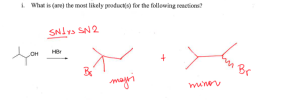 For SN1 reactions, a chiral substrate will yield a
mixture of enantiomers. In this reaction, there is only one
SN1 product given as the major product even though the
substrate is chiral. Why does the SN1 product not
exhibit stereochemistry?
i. What is (are) the most likely product(s) for the following reactions? SNdys SN 2 HBO from t he majo muno
For SN1 reactions, a chiral substrate will yield a
mixture of enantiomers. In this reaction, there is only one
SN1 product given as the major product even though the
substrate is chiral. Why does the SN1 product not
exhibit stereochemistry?
i. What is (are) the most likely product(s) for the following reactions? SNdys SN 2 HBO from t he majo muno
28) A) In an SN2 reaction, nucleophilic addition occurs at a carbon involved in a nonpolar...
28) A) In an SN2 reaction, nucleophilic addition occurs at a carbon involved in a nonpolar covalent bond. Why? B) Weak nucleophiles are utilized in unimolecular reactions. Why?
19 Which of the following statements is NOT true for an SN2 reaction? et red out...
 19 Which of the following statements is NOT true for an SN2 reaction? et red out of Select one: a. The product involves retention of the stereochemistry in chiral substrates. O b. Steric crowding makes the nucleophilic attack become unfavourable. O c. It is a bimolecular that follows second order kinetics. O d. The product involves inversion of the stereochemistry in chiral substrates. e. Both the nucleophile and alkyl halide are involved in the rate determining step.
s/reactants of the SN2 reactions below. Be very careful of the stereochemistry if applicable. 8. Provide...
 s/reactants of the SN2 reactions below. Be very careful of the stereochemistry if applicable. 8. Provide the products/reactants of the SX2 reactions below Please compare every two consecutive reactions. (1 pts, 0.25 pt each) Br + Na :C Hint: Na, and K are very easy to dissociate as Na' and K. + KCN CN + KBT + NaCl .. . + Na S-CHg dl. What is the type of the halide (1º, 2º, 3º)? d2. Which reactant is the nucleophile?...
For the following substitution reactions predict the products showing stereochemistry only if is of relevance. Also...
 For the following substitution reactions predict the
products showing stereochemistry only if is of relevance. Also
comment on what type of reaction: Sn1 or Sn2. Finally is the
starting material and product optically active or inactive?
Explain.
CH3CH2CH3 НО HBr CH-Br НЫС
For the following substitution reactions predict the
products showing stereochemistry only if is of relevance. Also
comment on what type of reaction: Sn1 or Sn2. Finally is the
starting material and product optically active or inactive?
Explain.
CH3CH2CH3 НО HBr CH-Br НЫС
7. For the following substitution reactions predict the product(s) showing stereochemistry only if is of revelance...
 7. For the following substitution reactions predict the product(s) showing stereochemistry only if is of revelance. Also comment on what type reaction: S1 or SN2. Finally is the starting material and product optically active or inactive? Explain! CH, OH HBr CN CH3CH2CH3 HO HBr CN 1 CI CH3CH2CH3 НО HBr CH Br H3C
4. For the next two reactions: • Show the complete mechanism involved in the reaction. Add...
 4. For the next two reactions: • Show the complete mechanism involved in the reaction. Add a deportation step, if necessary to give the neutral product Determine whether there is a chiral carbon. If so give R/S designations of the substrate. Also give the R/S designation of the product(s). Show all stereoisomers formed where applicable. Show how each stereoisomer is formed. ..Br CEN Functional group in product: DMSO Functional group in product: 5. Give a reasonable mechanism for the following...
1. The chiral compound in the center of the diagram below can undergo three different reactions. Fill in product struct...
 1. The chiral compound in the center of the diagram below can undergo three different reactions. Fill in product structures in each box and give their stereochemistry. For the Sul reaction the two products are enantiomers of each other. For the E1 reaction products, two are diastereomers of each other and the third is a constitutional isomer of the other two. H30 NaOH H20 E1 E2 Sn1 NaOH SN2 2. Draw the structure of the major product of the reaction...
please indicate stereochemistry (20 marks) 1. Identify each of the following reactions as SN1, SN2, E1,...
 please indicate stereochemistry
(20 marks) 1. Identify each of the following reactions as SN1, SN2, E1, or E2 and give the products formed in each case, and indicate the stereochemistry of the product if appropriate (mechanisms are not required). If no reaction would occur, indicate this with N.R. forno reaction" and give the reason for which you don't expect a product. a) E HEC-CH2-C...Br (CH3),C07 (CH3),COH CHE 70°C CH3 SN2 Morand SN2 H H₃C-CH2-c...Br. CN/DMSO in CH 25°C d) Br...
please indicate stereochemistry
(20 marks) 1. Identify each of the following reactions as SN1, SN2, E1, or E2 and give the products formed in each case, and indicate the stereochemistry of the product if appropriate (mechanisms are not required). If no reaction would occur, indicate this with N.R. forno reaction" and give the reason for which you don't expect a product. a) E HEC-CH2-C...Br (CH3),C07 (CH3),COH CHE 70°C CH3 SN2 Morand SN2 H H₃C-CH2-c...Br. CN/DMSO in CH 25°C d) Br...
 need help with 14-21
Stereochemistry of the Su2 reaction In the Sn2 reaction the tetrahedral carbon center is inverted. We describe the mechanism as nudeophilic (Nuc) back side attack; the leaving group (LG) is leav ing from the front side. Generally, the LG and the Nucare electron rich so it would be unfavorable for them to react from the same side (charge repuls ion). The geometry of the carbon at the transition state is trigonal planar. 14) Label the 2-bromobuta...
need help with 14-21
Stereochemistry of the Su2 reaction In the Sn2 reaction the tetrahedral carbon center is inverted. We describe the mechanism as nudeophilic (Nuc) back side attack; the leaving group (LG) is leav ing from the front side. Generally, the LG and the Nucare electron rich so it would be unfavorable for them to react from the same side (charge repuls ion). The geometry of the carbon at the transition state is trigonal planar. 14) Label the 2-bromobuta...
 For SN1 reactions, a chiral substrate will yield a
mixture of enantiomers. In this reaction, there is only one
SN1 product given as the major product even though the
substrate is chiral. Why does the SN1 product not
exhibit stereochemistry?
i. What is (are) the most likely product(s) for the following reactions? SNdys SN 2 HBO from t he majo muno
For SN1 reactions, a chiral substrate will yield a
mixture of enantiomers. In this reaction, there is only one
SN1 product given as the major product even though the
substrate is chiral. Why does the SN1 product not
exhibit stereochemistry?
i. What is (are) the most likely product(s) for the following reactions? SNdys SN 2 HBO from t he majo muno
 19 Which of the following statements is NOT true for an SN2 reaction? et red out of Select one: a. The product involves retention of the stereochemistry in chiral substrates. O b. Steric crowding makes the nucleophilic attack become unfavourable. O c. It is a bimolecular that follows second order kinetics. O d. The product involves inversion of the stereochemistry in chiral substrates. e. Both the nucleophile and alkyl halide are involved in the rate determining step.
 s/reactants of the SN2 reactions below. Be very careful of the stereochemistry if applicable. 8. Provide the products/reactants of the SX2 reactions below Please compare every two consecutive reactions. (1 pts, 0.25 pt each) Br + Na :C Hint: Na, and K are very easy to dissociate as Na' and K. + KCN CN + KBT + NaCl .. . + Na S-CHg dl. What is the type of the halide (1º, 2º, 3º)? d2. Which reactant is the nucleophile?...
 For the following substitution reactions predict the
products showing stereochemistry only if is of relevance. Also
comment on what type of reaction: Sn1 or Sn2. Finally is the
starting material and product optically active or inactive?
Explain.
CH3CH2CH3 НО HBr CH-Br НЫС
For the following substitution reactions predict the
products showing stereochemistry only if is of relevance. Also
comment on what type of reaction: Sn1 or Sn2. Finally is the
starting material and product optically active or inactive?
Explain.
CH3CH2CH3 НО HBr CH-Br НЫС
 7. For the following substitution reactions predict the product(s) showing stereochemistry only if is of revelance. Also comment on what type reaction: S1 or SN2. Finally is the starting material and product optically active or inactive? Explain! CH, OH HBr CN CH3CH2CH3 HO HBr CN 1 CI CH3CH2CH3 НО HBr CH Br H3C
 4. For the next two reactions: • Show the complete mechanism involved in the reaction. Add a deportation step, if necessary to give the neutral product Determine whether there is a chiral carbon. If so give R/S designations of the substrate. Also give the R/S designation of the product(s). Show all stereoisomers formed where applicable. Show how each stereoisomer is formed. ..Br CEN Functional group in product: DMSO Functional group in product: 5. Give a reasonable mechanism for the following...
 1. The chiral compound in the center of the diagram below can undergo three different reactions. Fill in product structures in each box and give their stereochemistry. For the Sul reaction the two products are enantiomers of each other. For the E1 reaction products, two are diastereomers of each other and the third is a constitutional isomer of the other two. H30 NaOH H20 E1 E2 Sn1 NaOH SN2 2. Draw the structure of the major product of the reaction...
 please indicate stereochemistry
(20 marks) 1. Identify each of the following reactions as SN1, SN2, E1, or E2 and give the products formed in each case, and indicate the stereochemistry of the product if appropriate (mechanisms are not required). If no reaction would occur, indicate this with N.R. forno reaction" and give the reason for which you don't expect a product. a) E HEC-CH2-C...Br (CH3),C07 (CH3),COH CHE 70°C CH3 SN2 Morand SN2 H H₃C-CH2-c...Br. CN/DMSO in CH 25°C d) Br...
please indicate stereochemistry
(20 marks) 1. Identify each of the following reactions as SN1, SN2, E1, or E2 and give the products formed in each case, and indicate the stereochemistry of the product if appropriate (mechanisms are not required). If no reaction would occur, indicate this with N.R. forno reaction" and give the reason for which you don't expect a product. a) E HEC-CH2-C...Br (CH3),C07 (CH3),COH CHE 70°C CH3 SN2 Morand SN2 H H₃C-CH2-c...Br. CN/DMSO in CH 25°C d) Br...
Most questions answered within 3 hours.
-
Where is the error in this code sequence?
String s1 = "Hello";
String s2 = "ello";...
asked 10 months ago -
Financial data for Joel de Paris, Inc., for last year
follow:
Joel de Paris, Inc.
Balance...
asked 10 months ago -
Consider this reaction:
Al2(SO4)3 (aq)+ BaCl3
(aq) Al2Cl6 (aq)- +
3BaSO4(s) . What is the...
asked 10 months ago -
Suppose that Savneet is considering increasing her
recent random sample from 20 car rentals to 40...
asked 10 months ago -
Trucks arrive at an unloading terminal at an average rate of 120
per hour.
Trucks arrive...
asked 10 months ago -
Why are methanol and ethanol completely soluble in water while
octanol is not very little soluble....
asked 10 months ago -
A facilities manager at a university reads in a research report
that the mean amount of...
asked 10 months ago -
When the CuSO4 is rehydrated by adding water to the anhydrous
compound, is this an endothermic...
asked 10 months ago -
A ray of sunlight is passing from diamond into crown glass; the
angle of incidence is...
asked 10 months ago -
A block of mass 0.249 kg is placed on top of a light, vertical
spring of...
asked 10 months ago -
how do the kidneys compensate in the presences of acidosis
a) trigger hyperventilate
b) reserve acid...
asked 10 months ago -
Question 501 pts
The rental rate of capital to the firm increases. Which of the
following...
asked 10 months ago