28) A) In an SN2 reaction, nucleophilic addition occurs at a carbon involved in a nonpolar...
28) A) In an SN2 reaction, nucleophilic addition occurs at a carbon involved in a nonpolar covalent bond. Why?
B) Weak nucleophiles are utilized in unimolecular reactions. Why?
Homework Answers
1.nucleophilic addition occurs at a carbon involved in nonpolar covalent bond because of less hindrance like in C-H bond than C-Cl etc
2.A weaker nucleophile favours SN1 reactions like water and unimolecular reactions also happened in SN1 so weak nucleophiles are utilized in unimolecular reactions
Add Answer to:
28) A) In an SN2 reaction, nucleophilic addition occurs at a
carbon involved in a nonpolar...
In SN2 reactions, the stereochemistry inverts only for the chiral carbon involved in the reaction or...
In SN2 reactions, the stereochemistry inverts only for the chiral carbon involved in the reaction or for the whole molecule? I mean, if we have a dichiral molecule in SN2 reaction, the product will be an enantiomer or a diastereomer?
The nucleophilic addition reaction depicted below involves a prochiral ketone carbon atom reacting with a nucleophilic...
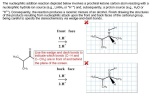 The nucleophilic addition reaction depicted below involves a
prochiral ketone carbon atom reacting with a nucleophilic hydride
ion source (e.g., LiAlH4 or \"H–\") and, subsequently, a proton
source (e.g., H2O or \"H \"). Consequently, the reaction produces a
racemic mixture of an alcohol. Finish drawing the structures of the
products resulting from nucleophilic attack upon the front and back
faces of the carbonyl group, being careful to specify the
stereochemistry via wedge-and-dash bonds.
The nucleophilic addition reaction depicted below involves a
prochiral ketone carbon atom reacting with a nucleophilic hydride
ion source (e.g., LiAlH4 or \"H–\") and, subsequently, a proton
source (e.g., H2O or \"H \"). Consequently, the reaction produces a
racemic mixture of an alcohol. Finish drawing the structures of the
products resulting from nucleophilic attack upon the front and back
faces of the carbonyl group, being careful to specify the
stereochemistry via wedge-and-dash bonds.
9) 9) Why do aldehydes undergo nucleophilic addition reactions, whereas esters undergo nucleophilic acyl substitution reactions?...
 9) 9) Why do aldehydes undergo nucleophilic addition reactions, whereas esters undergo nucleophilic acyl substitution reactions? A) The carbonyl carbon of an ester is more electrophilic than that of an aldehyde. B) Once the nucleophile adds to an aldehyde, neither H- nor R-can be eliminated because they are strongly basic. C) Aldehydes are more sterically hindered than esters. D) The ester carbonyl carbon is sp3 hybridized while the aldehyde carbonyl carbon is sp2 hybridized. E) Once the nucleophile adds to...
1. We will be doing the following reactions. Draw the reactions as Snl or Sn2 reactions...
 1. We will be doing the following reactions. Draw the reactions as Snl or Sn2 reactions including reaction arrows. RFR + Nal → R R + NaBr(s) acetone R PT R EtOH AgNOR OEt R + AgBr(s) + HNO3 2. We will be using Nal (in acetone) and ethanol as nucleophiles. Nat is a spectator ion. Classify I and ethanol as good nucleophiles or poor nucleophiles. Explain why. 3. In your lab notebook draw the following table a. Rank cach...
Question 28 Which of the following compounds is most reactive towards a nucleophilic addition reaction? o...
 Question 28 Which of the following compounds is most reactive towards a nucleophilic addition reaction? o e H Н H 1 11 IV II III IV V FO F10 FB F7 F6 F5 F4 F2 F3 * A & @ $ % 5 7 LO 8 3 4 N
31. What kind of reaction does the conversion of A to B represent? A) Addition reaction....
 31. What kind of reaction does the conversion of A to B represent? A) Addition reaction. B) Substitution reaction. C) Elimination reaction. D) Acid-base reaction 32. What kind of reaction does the conversion of A to B represent? H2SO. + HO нон A) Addition reaction B) Elimination reaction C) Substitution reaction D) Oxidation-reduction reaction. 33. Which of the following statements about addition reactions is true? A) Two a bonds are formed. B) Two bonds are broken C) Two o bonds...
1. Provide the products of the reaction below and a detailed reaction mechanism using curved arrows...
 1. Provide the products of the reaction below and a detailed reaction mechanism using curved arrows to indicate the movement of electrons. (a) (b) КОН (c) Note that formation of 4- or 7-membered rings is disfavored. Hiyo KOH acidie workup 2. An interesting problem that involves a bit of review (imines and Grignard chemistry) and application of what you previously learned to a new reaction: The Carbon of an imine functional group (i.e. R.C-NR) is sufficiently electron deficient to be...
For the following two SN2 reactions A and B, indicate which reaction occurs in the protic...
 For the following two SN2 reactions A and B, indicate which reaction occurs in the protic solvent and which the aprotic solvent, AND, indicate which reactions would be faster A or B, you do NOT need to give an explanation. A CH30-*Na ~ Cor: Br: - Cho Na> ocH, CH3OH CH3O-+Na BM : CHzo "Na → M ochy CH3CN
Use SN1/SN2 or E1/E2 reactions along with addition reaction to complete the synthesis. We were unable...
 Use SN1/SN2 or E1/E2 reactions along with addition
reaction to complete the synthesis.
We were unable to transcribe this imageSynthesis 1. The following transformations cannot be performed in one step. Provide a sequence of reactions to convert the "starting material to the "product." Show all the reagents and synthetic intermediates You can use any additional carbon sources if needed, but you must use the starting material given.
Use SN1/SN2 or E1/E2 reactions along with addition
reaction to complete the synthesis.
We were unable to transcribe this imageSynthesis 1. The following transformations cannot be performed in one step. Provide a sequence of reactions to convert the "starting material to the "product." Show all the reagents and synthetic intermediates You can use any additional carbon sources if needed, but you must use the starting material given.
1. (a) In the first step of an SN1 reaction, the carbon-leaving group bond breaks and...
 1. (a) In the first step of an SN1 reaction, the carbon-leaving group bond breaks and a carbocation forms. In the second step, the carbocation undergoes a nucleophilic attack. The rate limiting step in an SN1 reaction is: The nucleophilic attack. The formation of the product. The formation of the carbocation. Submit Answer Tries 0/1 (b) In an SN2 reaction, the nucleophile attacks while the leaving group leaves in a concerted mechanism. The rate limiting step in an SN2 reaction...
 The nucleophilic addition reaction depicted below involves a
prochiral ketone carbon atom reacting with a nucleophilic hydride
ion source (e.g., LiAlH4 or \"H–\") and, subsequently, a proton
source (e.g., H2O or \"H \"). Consequently, the reaction produces a
racemic mixture of an alcohol. Finish drawing the structures of the
products resulting from nucleophilic attack upon the front and back
faces of the carbonyl group, being careful to specify the
stereochemistry via wedge-and-dash bonds.
The nucleophilic addition reaction depicted below involves a
prochiral ketone carbon atom reacting with a nucleophilic hydride
ion source (e.g., LiAlH4 or \"H–\") and, subsequently, a proton
source (e.g., H2O or \"H \"). Consequently, the reaction produces a
racemic mixture of an alcohol. Finish drawing the structures of the
products resulting from nucleophilic attack upon the front and back
faces of the carbonyl group, being careful to specify the
stereochemistry via wedge-and-dash bonds.
 9) 9) Why do aldehydes undergo nucleophilic addition reactions, whereas esters undergo nucleophilic acyl substitution reactions? A) The carbonyl carbon of an ester is more electrophilic than that of an aldehyde. B) Once the nucleophile adds to an aldehyde, neither H- nor R-can be eliminated because they are strongly basic. C) Aldehydes are more sterically hindered than esters. D) The ester carbonyl carbon is sp3 hybridized while the aldehyde carbonyl carbon is sp2 hybridized. E) Once the nucleophile adds to...
 1. We will be doing the following reactions. Draw the reactions as Snl or Sn2 reactions including reaction arrows. RFR + Nal → R R + NaBr(s) acetone R PT R EtOH AgNOR OEt R + AgBr(s) + HNO3 2. We will be using Nal (in acetone) and ethanol as nucleophiles. Nat is a spectator ion. Classify I and ethanol as good nucleophiles or poor nucleophiles. Explain why. 3. In your lab notebook draw the following table a. Rank cach...
 Question 28 Which of the following compounds is most reactive towards a nucleophilic addition reaction? o e H Н H 1 11 IV II III IV V FO F10 FB F7 F6 F5 F4 F2 F3 * A & @ $ % 5 7 LO 8 3 4 N
 31. What kind of reaction does the conversion of A to B represent? A) Addition reaction. B) Substitution reaction. C) Elimination reaction. D) Acid-base reaction 32. What kind of reaction does the conversion of A to B represent? H2SO. + HO нон A) Addition reaction B) Elimination reaction C) Substitution reaction D) Oxidation-reduction reaction. 33. Which of the following statements about addition reactions is true? A) Two a bonds are formed. B) Two bonds are broken C) Two o bonds...
 1. Provide the products of the reaction below and a detailed reaction mechanism using curved arrows to indicate the movement of electrons. (a) (b) КОН (c) Note that formation of 4- or 7-membered rings is disfavored. Hiyo KOH acidie workup 2. An interesting problem that involves a bit of review (imines and Grignard chemistry) and application of what you previously learned to a new reaction: The Carbon of an imine functional group (i.e. R.C-NR) is sufficiently electron deficient to be...
 For the following two SN2 reactions A and B, indicate which reaction occurs in the protic solvent and which the aprotic solvent, AND, indicate which reactions would be faster A or B, you do NOT need to give an explanation. A CH30-*Na ~ Cor: Br: - Cho Na> ocH, CH3OH CH3O-+Na BM : CHzo "Na → M ochy CH3CN
 Use SN1/SN2 or E1/E2 reactions along with addition
reaction to complete the synthesis.
We were unable to transcribe this imageSynthesis 1. The following transformations cannot be performed in one step. Provide a sequence of reactions to convert the "starting material to the "product." Show all the reagents and synthetic intermediates You can use any additional carbon sources if needed, but you must use the starting material given.
Use SN1/SN2 or E1/E2 reactions along with addition
reaction to complete the synthesis.
We were unable to transcribe this imageSynthesis 1. The following transformations cannot be performed in one step. Provide a sequence of reactions to convert the "starting material to the "product." Show all the reagents and synthetic intermediates You can use any additional carbon sources if needed, but you must use the starting material given.
 1. (a) In the first step of an SN1 reaction, the carbon-leaving group bond breaks and a carbocation forms. In the second step, the carbocation undergoes a nucleophilic attack. The rate limiting step in an SN1 reaction is: The nucleophilic attack. The formation of the product. The formation of the carbocation. Submit Answer Tries 0/1 (b) In an SN2 reaction, the nucleophile attacks while the leaving group leaves in a concerted mechanism. The rate limiting step in an SN2 reaction...
Most questions answered within 3 hours.
-
Where is the error in this code sequence?
String s1 = "Hello";
String s2 = "ello";...
asked 10 months ago -
Financial data for Joel de Paris, Inc., for last year
follow:
Joel de Paris, Inc.
Balance...
asked 10 months ago -
Consider this reaction:
Al2(SO4)3 (aq)+ BaCl3
(aq) Al2Cl6 (aq)- +
3BaSO4(s) . What is the...
asked 10 months ago -
Suppose that Savneet is considering increasing her
recent random sample from 20 car rentals to 40...
asked 10 months ago -
Trucks arrive at an unloading terminal at an average rate of 120
per hour.
Trucks arrive...
asked 10 months ago -
Why are methanol and ethanol completely soluble in water while
octanol is not very little soluble....
asked 10 months ago -
A facilities manager at a university reads in a research report
that the mean amount of...
asked 10 months ago -
When the CuSO4 is rehydrated by adding water to the anhydrous
compound, is this an endothermic...
asked 10 months ago -
A ray of sunlight is passing from diamond into crown glass; the
angle of incidence is...
asked 10 months ago -
A block of mass 0.249 kg is placed on top of a light, vertical
spring of...
asked 10 months ago -
how do the kidneys compensate in the presences of acidosis
a) trigger hyperventilate
b) reserve acid...
asked 10 months ago -
Question 501 pts
The rental rate of capital to the firm increases. Which of the
following...
asked 10 months ago