In the reduction of benzil after the color disappeared and you were told to wait 10...
- In the reduction of benzil after the color disappeared and you were told to wait 10 minutes, the directions said to add 0.5 mL of water and to heat the solution to boiling. Why was the water added and the solution heated.
Homework Answers
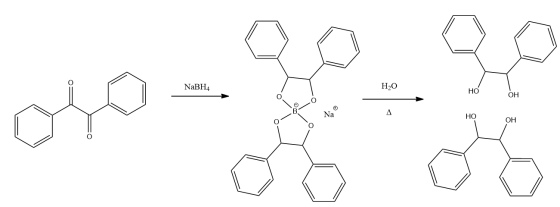
In NaBH4 reduction, one NaBH4 molecule can reduce up to 4 carbonyl groups. During the reduction process, boron bonds with the reduced carbonyl oxygen. Addition of water and subsequent heating cleaves of boron-oxygen bonds and the thereby release the alcohols i.e. hydrobenzoin.
Add Answer to:
In the reduction of benzil after the color disappeared and you
were told to wait 10...
hello, i need help with the questions in the second photo Experiment 6. the reduction of...
 hello, i need help with the questions in the second photo
Experiment 6. the reduction of bencil (March 2020) Your name Sodium borohydride is a convert recent for the reduction of dehydes and ketones to 1" and 2 alcohols, respectively. The mechanism of the reaction (below) is straightforward and is driven by boron's affinity for oxygen. In addition, given borohydride's remarkably low reactivity with OH groups under neutral and especially basic conditions, this reaction can be done in alcohol solvents....
hello, i need help with the questions in the second photo
Experiment 6. the reduction of bencil (March 2020) Your name Sodium borohydride is a convert recent for the reduction of dehydes and ketones to 1" and 2 alcohols, respectively. The mechanism of the reaction (below) is straightforward and is driven by boron's affinity for oxygen. In addition, given borohydride's remarkably low reactivity with OH groups under neutral and especially basic conditions, this reaction can be done in alcohol solvents....
Experiment . the reduction of bencil (March 2020) Your name Sodium borohydride is a convert recent...
 Experiment . the reduction of bencil (March 2020) Your name Sodium borohydride is a convert recent for the reduction of dehydes and ketones to 1" and 2 alcohols, respectively. The mechanism of the reaction - (below) is straightforward and is driven by boron's affinity for oxygen. In addition, given borohydride's remarkably low reactivity with OH groups under neutral and especially basic conditions, this reaction can be done in alcohol solvents. This means that (unlike LAH or Grignard reactions) no separate...
Data and Observations Record color and temperature changes that occurred during the reaction, as well as...
 Data and Observations Record color and temperature changes that occurred during the reaction, as well as the weight and melting point of the product. Attach the IR spectrum to your report, and give the result of the 2,4-dinitrophenylhydrazine test. Calculations and Graphs Write a balanced equation for the reaction and calculate the per cent yield Conclusions 1. How many carbonyl groups in the benzil were reduced? Give the experimental evidence for your answer. (HINTS: Refer to your melting point, 2,4-dinitrophenylhydrazine...
In the experiment reduction of benzophenone with sodium borohydride, why was the solution heated to boiling...
In the experiment reduction of benzophenone with sodium borohydride, why was the solution heated to boiling after addition of sodium borohydride? why was it added to ice? THANK YOU!!!
Post lab Exp 10: Preparation of benzil from benzoin Place 1 g of benzoin and 3...
 Post lab
Exp 10: Preparation of benzil from benzoin Place 1 g of benzoin and 3 mL of concentrated nitric acid in a 50 mL beaker. Heat the mixture on a water bath for 15 minutes. At the end of this time, add 30 mL of cold water to the reaction mixture. Cooling the reaction mixture in ice-water bath will cause crystallization. Vacuum filter the product. Press the crystal gently with a clean glass stopper to remove as much of...
Post lab
Exp 10: Preparation of benzil from benzoin Place 1 g of benzoin and 3 mL of concentrated nitric acid in a 50 mL beaker. Heat the mixture on a water bath for 15 minutes. At the end of this time, add 30 mL of cold water to the reaction mixture. Cooling the reaction mixture in ice-water bath will cause crystallization. Vacuum filter the product. Press the crystal gently with a clean glass stopper to remove as much of...
Proteins are composed of amino acid units bound by peptide bonds. By the addition of the...
Proteins are composed of amino acid units bound by peptide bonds. By the addition of the enzyme Bacterial Protease these bonds are broken and the individual amino acids are freed. A simple test for free amino acids is the use of the reagent Ninhydrin which turns purple in the presence of amino acids but remains yellowish in the presence of protein. I. Label one 250 ml beaker A and one 250 ml beaker B. To each beaker add l 00...
for this experiment of syntheis of aspirin, was the product obtained pure (based on color)? how...
 for this experiment of syntheis of aspirin, was the product
obtained pure (based on color)? how do you know? the color was
white
Experimental Procedure HAZARD: Sulfuric acid, acetic anhydride and glacial acetic acid are corrosive to the skin. They are also irritants, and all operations in which these substances are used should be carried out under the hood. Prepare a hot-water bath by heating a 400-ml beaker containing about 200 mL of water. 1. Use a centigram balance and...
for this experiment of syntheis of aspirin, was the product
obtained pure (based on color)? how do you know? the color was
white
Experimental Procedure HAZARD: Sulfuric acid, acetic anhydride and glacial acetic acid are corrosive to the skin. They are also irritants, and all operations in which these substances are used should be carried out under the hood. Prepare a hot-water bath by heating a 400-ml beaker containing about 200 mL of water. 1. Use a centigram balance and...
Write out your separation scheme for this experiment. 1. Heat 75 mL of water to 90...
Write out your separation scheme for this experiment. 1. Heat 75 mL of water to 90 °C in a 250-mL beaker. 2. While the water is being heated, place 250 mg of salicylic acid, 1 drop of 85% phosphoric acid and 0.5 mL of acetic anhydride in a test tube. Add a boiling chip to the mixture and gently shake it in order to mix the reactants. 3. Heat the tube in the beaker of water at 85 - 90...
5.0 ml of 2-methylcyclohexanol was placed in a 50 ml round bottom flask. Phosphoric acid (85%,...
5.0 ml of 2-methylcyclohexanol was placed in a 50 ml round bottom flask. Phosphoric acid (85%, 5 ml) was added cautiously, and the mixture swirled. Boiling stones were added to prevent bumping during heating. The mixture was heated to reflux temperature and refluxed for 15 minutes. The products were collected between 85-90 ˚C, in a small round bottom flask, cooled in ice water. Isolation Procedure The distillate was washed with 2 x 5 ml saturated sodium chloride solution in a...
Question: What is the active ingredient present in Tea responsible for the reduction of AuNps? Experiment:...
Question: What is the active ingredient present in Tea responsible for the reduction of AuNps? Experiment: Synthesize gold nanoparticles of ~ 10-15nm size using Tea leaves as a reducing agent. Synthesis: Step 1: In a 20 ml vial, 0.012g of Gum Arabic was dissolved in 6ml of doubly ionized water D (I). Step 2: 100mg of Tea leaves (Lipton Loose Tea) was added to the above solution. The reaction mixture was stirred continuously at 25 C for 15 min. Step...
 hello, i need help with the questions in the second photo
Experiment 6. the reduction of bencil (March 2020) Your name Sodium borohydride is a convert recent for the reduction of dehydes and ketones to 1" and 2 alcohols, respectively. The mechanism of the reaction (below) is straightforward and is driven by boron's affinity for oxygen. In addition, given borohydride's remarkably low reactivity with OH groups under neutral and especially basic conditions, this reaction can be done in alcohol solvents....
hello, i need help with the questions in the second photo
Experiment 6. the reduction of bencil (March 2020) Your name Sodium borohydride is a convert recent for the reduction of dehydes and ketones to 1" and 2 alcohols, respectively. The mechanism of the reaction (below) is straightforward and is driven by boron's affinity for oxygen. In addition, given borohydride's remarkably low reactivity with OH groups under neutral and especially basic conditions, this reaction can be done in alcohol solvents....
 Experiment . the reduction of bencil (March 2020) Your name Sodium borohydride is a convert recent for the reduction of dehydes and ketones to 1" and 2 alcohols, respectively. The mechanism of the reaction - (below) is straightforward and is driven by boron's affinity for oxygen. In addition, given borohydride's remarkably low reactivity with OH groups under neutral and especially basic conditions, this reaction can be done in alcohol solvents. This means that (unlike LAH or Grignard reactions) no separate...
 Data and Observations Record color and temperature changes that occurred during the reaction, as well as the weight and melting point of the product. Attach the IR spectrum to your report, and give the result of the 2,4-dinitrophenylhydrazine test. Calculations and Graphs Write a balanced equation for the reaction and calculate the per cent yield Conclusions 1. How many carbonyl groups in the benzil were reduced? Give the experimental evidence for your answer. (HINTS: Refer to your melting point, 2,4-dinitrophenylhydrazine...
 Post lab
Exp 10: Preparation of benzil from benzoin Place 1 g of benzoin and 3 mL of concentrated nitric acid in a 50 mL beaker. Heat the mixture on a water bath for 15 minutes. At the end of this time, add 30 mL of cold water to the reaction mixture. Cooling the reaction mixture in ice-water bath will cause crystallization. Vacuum filter the product. Press the crystal gently with a clean glass stopper to remove as much of...
Post lab
Exp 10: Preparation of benzil from benzoin Place 1 g of benzoin and 3 mL of concentrated nitric acid in a 50 mL beaker. Heat the mixture on a water bath for 15 minutes. At the end of this time, add 30 mL of cold water to the reaction mixture. Cooling the reaction mixture in ice-water bath will cause crystallization. Vacuum filter the product. Press the crystal gently with a clean glass stopper to remove as much of...
 for this experiment of syntheis of aspirin, was the product
obtained pure (based on color)? how do you know? the color was
white
Experimental Procedure HAZARD: Sulfuric acid, acetic anhydride and glacial acetic acid are corrosive to the skin. They are also irritants, and all operations in which these substances are used should be carried out under the hood. Prepare a hot-water bath by heating a 400-ml beaker containing about 200 mL of water. 1. Use a centigram balance and...
for this experiment of syntheis of aspirin, was the product
obtained pure (based on color)? how do you know? the color was
white
Experimental Procedure HAZARD: Sulfuric acid, acetic anhydride and glacial acetic acid are corrosive to the skin. They are also irritants, and all operations in which these substances are used should be carried out under the hood. Prepare a hot-water bath by heating a 400-ml beaker containing about 200 mL of water. 1. Use a centigram balance and...
Most questions answered within 3 hours.
-
Where is the error in this code sequence?
String s1 = "Hello";
String s2 = "ello";...
asked 11 months ago -
Financial data for Joel de Paris, Inc., for last year
follow:
Joel de Paris, Inc.
Balance...
asked 11 months ago -
Consider this reaction:
Al2(SO4)3 (aq)+ BaCl3
(aq) Al2Cl6 (aq)- +
3BaSO4(s) . What is the...
asked 11 months ago -
Suppose that Savneet is considering increasing her
recent random sample from 20 car rentals to 40...
asked 11 months ago -
Trucks arrive at an unloading terminal at an average rate of 120
per hour.
Trucks arrive...
asked 11 months ago -
Why are methanol and ethanol completely soluble in water while
octanol is not very little soluble....
asked 11 months ago -
A facilities manager at a university reads in a research report
that the mean amount of...
asked 11 months ago -
When the CuSO4 is rehydrated by adding water to the anhydrous
compound, is this an endothermic...
asked 11 months ago -
A ray of sunlight is passing from diamond into crown glass; the
angle of incidence is...
asked 11 months ago -
A block of mass 0.249 kg is placed on top of a light, vertical
spring of...
asked 11 months ago -
how do the kidneys compensate in the presences of acidosis
a) trigger hyperventilate
b) reserve acid...
asked 11 months ago -
Question 501 pts
The rental rate of capital to the firm increases. Which of the
following...
asked 11 months ago