I understand if reaction is reversed, you change the sign but how to you know to...
I understand if reaction is reversed, you change the sign but
how to you know to reverse the reaction? In the problem, Sand is
converedto pure silicon in a 3 step process. The final step in this
process is as follows: SiCl4 (g) + 2Mg (s) --> 2MgCl (s) + Si
(s) ChangeHrxn=6256kj/mol
What is the enthalpy change if 25.0 mol of silicon tetrachloride is
converted to elemental silicon?
I get the answer by 25 mol SiCl4 x 6256kj/mol=15640kj but I do not
understand why this is neg, not +
Homework Answers


Add Answer to:
I understand if reaction is reversed, you change the sign but
how to you know to...
18. c Sand is converted to pure silicon in a three step process. The third step...
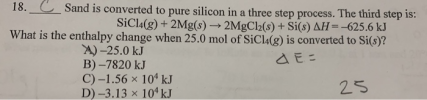 18. c Sand is converted to pure silicon in a three step process. The third step is: SiCl4(g) + 2Mg(s) 2MgCl2(s) + Si(s) AH= -625.6 kJ What is the enthalpy change when 25.0 mol of SiCl(g) is converted to Si(s)? A) -25.0 kJ dE= B) -7820 kJ C) -1.56 x 10⁴ kJ 25 D) -3.13 x 10⁴ kJ
Learning Goal: To understand how to use Hess's law to find the enthalpy of an overall...
 Learning Goal: To understand how to use Hess's law to find the enthalpy of an overall reaction. Correct The change in enthalpy, AH, is the heat absorbed or produced during any reaction at constant pressure. Hess's law states that ? H for an overall reaction is the sum of the values for the individual reactions. For example, if we wanted to know the enthalpy change for the reaction PartB What is the enthalpy for reaction 1 reversed? Express your answer...
I don't understand the step by step process to figuring this out. I don't know how...
 I don't understand the step by step process to figuring this
out. I don't know how you would calculate percent yield?
Would love answers to all of the questions in part 3!
Thank you!
Practice: Many computer chips are manufactured from silicon, which occurs in nature as SiO2. When SiO2 is heated to melting, it reacts with solid carbon to form liquid silicon and carbon monoxide gas. In an industrial preparation of silicon, 155.8 kg of Sio2 reacts with 78.3...
I don't understand the step by step process to figuring this
out. I don't know how you would calculate percent yield?
Would love answers to all of the questions in part 3!
Thank you!
Practice: Many computer chips are manufactured from silicon, which occurs in nature as SiO2. When SiO2 is heated to melting, it reacts with solid carbon to form liquid silicon and carbon monoxide gas. In an industrial preparation of silicon, 155.8 kg of Sio2 reacts with 78.3...
Learning Goal: To understand how to use Hess's law to find the enthalpy of an overall...
Learning Goal: To understand how to use Hess's law to find the enthalpy of an overall reaction. The change in enthalpy, ΔH, is the heat absorbed or produced during any reaction at constant pressure. Hess's law states that ΔH for an overall reaction is the sum of the ΔH values for the individual reactions. For example, if we wanted to know the enthalpy change for the reaction 3Mn+3O2→3MnO2 we could calculate it using the enthalpy values for the following individual...
sorry i was confused here is the correct photo Learning Goal: To understand how to use...
 sorry i was confused here is the correct photo
Learning Goal: To understand how to use Hess's law to find the enthalpy of an overall reaction The change in enthalpy, AH is the heat absorbed or produced during any reaction at constant pressure. Hess's law states that AH for an overall reaction is the sum of the AH values for the individual reactions. For example, if we wanted to know the enthalpy change for the reaction 3Mn +302+3MnO2 we could...
sorry i was confused here is the correct photo
Learning Goal: To understand how to use Hess's law to find the enthalpy of an overall reaction The change in enthalpy, AH is the heat absorbed or produced during any reaction at constant pressure. Hess's law states that AH for an overall reaction is the sum of the AH values for the individual reactions. For example, if we wanted to know the enthalpy change for the reaction 3Mn +302+3MnO2 we could...
Can you please explain how you’d know which reaction woulf be spontaneous? I dont understand At...
 Can
you please explain how you’d know which reaction woulf be
spontaneous? I dont understand
At SATP, which reaction below is spontaneous? O CO2(s)-CO2(0) O Co2(s)-CO2(g) O CO2(g) CO2(0) CO20)-CO2(s)
Can
you please explain how you’d know which reaction woulf be
spontaneous? I dont understand
At SATP, which reaction below is spontaneous? O CO2(s)-CO2(0) O Co2(s)-CO2(g) O CO2(g) CO2(0) CO20)-CO2(s)
Use the observations about each chemical reaction in the table below to decide the sign (positive or negative) of...
 Use the observations about each chemical reaction in the table below to decide the sign (positive or negative) of the reaction enthalpy AH and reaction entropy AS. Note: if you have not been given enough information to decide a sign, select the "unknown" option. reaction observations conclusions AH is (pick one) This reaction is spontaneous except below A 31. C AS is (pick one) (pick one) The reverse of this reaction is always spontaneous but proceeds slower at temperatures below-15....
Given 2Al2O3 (s) --> 4Al(s) + 3O2 (g) (standard enthalpy change= 3351.4 kJ) a) What is the heat of formation of aluminum oxide
Given 2Al2O3 (s) --> 4Al(s) + 3O2 (g) (standard enthalpy change= 3351.4 kJ) a) What is the heat of formation of aluminum oxide? How do I find heat of formation from standard enthalpy change? I know how to do it when I'm given enthalpy, but they aren't the same thing- correct? Also, if this question gave me delta-H, I know that the heat of formation for 4Al = 0 and 3O2 = 0 because they are elementary species. This would...
Thermodynamics Practice Problems 1. Predict the sign of AS.(positive or negative) for the following reactions a...
 Thermodynamics Practice Problems 1. Predict the sign of AS.(positive or negative) for the following reactions a 2 Mg(s) +,(@) 2 Mgo (s) AS b. CH206(s) → 2C,H,OH(I) + 2003(g) AS c. 2 NH3(g) + CO2(g) → H2O(l) + NH CONH3(aq) AS d. Cu(s) (at 100°C) → Cu(s) (at 25°C) AS 2. Which two variables can indicate if a reaction is spontaneous or not? 3. The second law of thermodynamics tells us that: a Energy is conserved. b. The entropy of...
1.a) What is the sign of the entropy change for the following reaction? Note: You do...
 1.a) What is the sign of the entropy change for the following
reaction? Note: You do not need the standard entropy values
2Zn (s) + O2 (g) ---> 2ZnO (s)
answer
a) 0 (Zero)
b) <0 (Negative)
c) No change
d)> 0 (Positive)
2.c)
ASO = Ensº(product ) - EnS°(reactant ) rxn O 173.6 K-mol -1893 W/K-mol O 6165 /K-mal 0 -1736 K-mol
1.a) What is the sign of the entropy change for the following
reaction? Note: You do not need the standard entropy values
2Zn (s) + O2 (g) ---> 2ZnO (s)
answer
a) 0 (Zero)
b) <0 (Negative)
c) No change
d)> 0 (Positive)
2.c)
ASO = Ensº(product ) - EnS°(reactant ) rxn O 173.6 K-mol -1893 W/K-mol O 6165 /K-mal 0 -1736 K-mol
 18. c Sand is converted to pure silicon in a three step process. The third step is: SiCl4(g) + 2Mg(s) 2MgCl2(s) + Si(s) AH= -625.6 kJ What is the enthalpy change when 25.0 mol of SiCl(g) is converted to Si(s)? A) -25.0 kJ dE= B) -7820 kJ C) -1.56 x 10⁴ kJ 25 D) -3.13 x 10⁴ kJ
 Learning Goal: To understand how to use Hess's law to find the enthalpy of an overall reaction. Correct The change in enthalpy, AH, is the heat absorbed or produced during any reaction at constant pressure. Hess's law states that ? H for an overall reaction is the sum of the values for the individual reactions. For example, if we wanted to know the enthalpy change for the reaction PartB What is the enthalpy for reaction 1 reversed? Express your answer...
 I don't understand the step by step process to figuring this
out. I don't know how you would calculate percent yield?
Would love answers to all of the questions in part 3!
Thank you!
Practice: Many computer chips are manufactured from silicon, which occurs in nature as SiO2. When SiO2 is heated to melting, it reacts with solid carbon to form liquid silicon and carbon monoxide gas. In an industrial preparation of silicon, 155.8 kg of Sio2 reacts with 78.3...
I don't understand the step by step process to figuring this
out. I don't know how you would calculate percent yield?
Would love answers to all of the questions in part 3!
Thank you!
Practice: Many computer chips are manufactured from silicon, which occurs in nature as SiO2. When SiO2 is heated to melting, it reacts with solid carbon to form liquid silicon and carbon monoxide gas. In an industrial preparation of silicon, 155.8 kg of Sio2 reacts with 78.3...
 sorry i was confused here is the correct photo
Learning Goal: To understand how to use Hess's law to find the enthalpy of an overall reaction The change in enthalpy, AH is the heat absorbed or produced during any reaction at constant pressure. Hess's law states that AH for an overall reaction is the sum of the AH values for the individual reactions. For example, if we wanted to know the enthalpy change for the reaction 3Mn +302+3MnO2 we could...
sorry i was confused here is the correct photo
Learning Goal: To understand how to use Hess's law to find the enthalpy of an overall reaction The change in enthalpy, AH is the heat absorbed or produced during any reaction at constant pressure. Hess's law states that AH for an overall reaction is the sum of the AH values for the individual reactions. For example, if we wanted to know the enthalpy change for the reaction 3Mn +302+3MnO2 we could...
 Can
you please explain how you’d know which reaction woulf be
spontaneous? I dont understand
At SATP, which reaction below is spontaneous? O CO2(s)-CO2(0) O Co2(s)-CO2(g) O CO2(g) CO2(0) CO20)-CO2(s)
Can
you please explain how you’d know which reaction woulf be
spontaneous? I dont understand
At SATP, which reaction below is spontaneous? O CO2(s)-CO2(0) O Co2(s)-CO2(g) O CO2(g) CO2(0) CO20)-CO2(s)
 Use the observations about each chemical reaction in the table below to decide the sign (positive or negative) of the reaction enthalpy AH and reaction entropy AS. Note: if you have not been given enough information to decide a sign, select the "unknown" option. reaction observations conclusions AH is (pick one) This reaction is spontaneous except below A 31. C AS is (pick one) (pick one) The reverse of this reaction is always spontaneous but proceeds slower at temperatures below-15....
 Thermodynamics Practice Problems 1. Predict the sign of AS.(positive or negative) for the following reactions a 2 Mg(s) +,(@) 2 Mgo (s) AS b. CH206(s) → 2C,H,OH(I) + 2003(g) AS c. 2 NH3(g) + CO2(g) → H2O(l) + NH CONH3(aq) AS d. Cu(s) (at 100°C) → Cu(s) (at 25°C) AS 2. Which two variables can indicate if a reaction is spontaneous or not? 3. The second law of thermodynamics tells us that: a Energy is conserved. b. The entropy of...
 1.a) What is the sign of the entropy change for the following
reaction? Note: You do not need the standard entropy values
2Zn (s) + O2 (g) ---> 2ZnO (s)
answer
a) 0 (Zero)
b) <0 (Negative)
c) No change
d)> 0 (Positive)
2.c)
ASO = Ensº(product ) - EnS°(reactant ) rxn O 173.6 K-mol -1893 W/K-mol O 6165 /K-mal 0 -1736 K-mol
1.a) What is the sign of the entropy change for the following
reaction? Note: You do not need the standard entropy values
2Zn (s) + O2 (g) ---> 2ZnO (s)
answer
a) 0 (Zero)
b) <0 (Negative)
c) No change
d)> 0 (Positive)
2.c)
ASO = Ensº(product ) - EnS°(reactant ) rxn O 173.6 K-mol -1893 W/K-mol O 6165 /K-mal 0 -1736 K-mol
Most questions answered within 3 hours.
-
Where is the error in this code sequence?
String s1 = "Hello";
String s2 = "ello";...
asked 10 months ago -
Financial data for Joel de Paris, Inc., for last year
follow:
Joel de Paris, Inc.
Balance...
asked 10 months ago -
Consider this reaction:
Al2(SO4)3 (aq)+ BaCl3
(aq) Al2Cl6 (aq)- +
3BaSO4(s) . What is the...
asked 10 months ago -
Suppose that Savneet is considering increasing her
recent random sample from 20 car rentals to 40...
asked 10 months ago -
Trucks arrive at an unloading terminal at an average rate of 120
per hour.
Trucks arrive...
asked 10 months ago -
Why are methanol and ethanol completely soluble in water while
octanol is not very little soluble....
asked 10 months ago -
A facilities manager at a university reads in a research report
that the mean amount of...
asked 10 months ago -
When the CuSO4 is rehydrated by adding water to the anhydrous
compound, is this an endothermic...
asked 10 months ago -
A ray of sunlight is passing from diamond into crown glass; the
angle of incidence is...
asked 10 months ago -
A block of mass 0.249 kg is placed on top of a light, vertical
spring of...
asked 10 months ago -
how do the kidneys compensate in the presences of acidosis
a) trigger hyperventilate
b) reserve acid...
asked 10 months ago -
Question 501 pts
The rental rate of capital to the firm increases. Which of the
following...
asked 10 months ago