It is stated that the higher the coefficient of thermal expansion of a glass and the...
It is stated that the higher the coefficient of thermal expansion of a glass and the lower its thermal conductivity, the higher the level of the residual stresses developed. Explain why?
Homework Answers
Thermal expansion coefficient depends mainly on its component materials, composite state and environment.
Glasses have low thermal conductivity and high resistance resistivity and dilelectric strength. Their thermal coefficients are lower than those for metals and plastics and have good thermal shock resistance.
Glass can be strengthened by thermal tempering, chemical tempering and laminate strengthening.
Thermal tempering also known as physical tempering or chill tempering cools the surface of the hot glass rapidly. As a result the surfaces shrink and tensile stresses will develop on the surfaces. As the bulk of the glass begins to cool it contracts. The already solidified surfaces are forced to contract and so they develop residual compressive surface stresses while the interior develops tensile stresses. compressive surface stresses improve the strength of the glass.
The higher the coefficient of thermal expansion of the gas and the lower its thermal conductivity ,the higher will be the residual stresses developed and hence the stronger the glass becomes. Thermal tempering takes a relatively short time and can be applied to most glasses. Because of the large amount of energy stored in the residual stresses tempered glass shatters into a large number of pieces when broken.
Add Answer to:
It is stated that the higher the coefficient of thermal
expansion of a glass and the...
5. 20 pts (A) What are typical values of thermal conductivity and coefficient of thermal expansion...
 5. 20 pts (A) What are typical values of thermal conductivity and coefficient of thermal expansion for metals and polymers? Metal Ceramic Thermal Conductivity CTE (B) If you heat the metal, what happens to its thermal conductivity, and why (25 words or less) (C) You have 10.0000 cm bars of your typical metal and ceramic from part (5A) at 25.0000 deg C. You heat them both to 300.0000 deg C. What are their lengths upon heating?
Explain why polymers have a higher coefficient of thermal expansion than ceramics in terms of atomic...
Explain why polymers have a higher coefficient of thermal expansion than ceramics in terms of atomic bonding. How does particle gradation (i.e., size distribution) affect the properties of composites?
why do Borosilicate glass have a very low coefficient of thermal expansion compared to other type of glasses?
why do Borosilicate glass have a very low coefficient of thermal expansion compared to other type of glasses?
Explain why the coefficient of thermal expansion for a solid vanishes at T=0.
Explain why the coefficient of thermal expansion for a solid vanishes at T=0.
Prove that the volume thermal expansion coefficient of a solid is equal to the sum of...
Prove that the volume thermal expansion coefficient of a solid is equal to the sum of its linear expansion coefficients in the three dimensions
j 1) The volume thermal expansion coefficient is defined as the fractional change in volume of...
 j
1) The volume thermal expansion coefficient is defined as the fractional change in volume of a substance per unit change in temperature. Consider a closed chamber containing a monatomic ideal gas at atmospheric pressure. Consider its behavior as its temperature is increased by a small amount T, and find its volume expansion coefficient, assuming (a) isobaric and (b) adiabatic conditions. Finally, (c) discuss why these two values are different, and compare them to expansion coefficients of liquids and solids.
j
1) The volume thermal expansion coefficient is defined as the fractional change in volume of a substance per unit change in temperature. Consider a closed chamber containing a monatomic ideal gas at atmospheric pressure. Consider its behavior as its temperature is increased by a small amount T, and find its volume expansion coefficient, assuming (a) isobaric and (b) adiabatic conditions. Finally, (c) discuss why these two values are different, and compare them to expansion coefficients of liquids and solids.
In this solution, just trying to understand why the coefficient of thermal expansion of steel is...
In this solution, just trying to understand why the coefficient of thermal expansion of steel is multiplied by 3. I understand volume is cubic. Don't need answer. Thx The average coefficient of volume expansion for carbon tetrachloride is 5.81 ✕ 10−4 (°C)−1. If a 55.0-gal steel container is filled completely with carbon tetrachloride when the temperature is 10.0°C, how much will spill over when the temperature rises to 26.5°C? (Assume the coefficient of thermal expansion of steel is 11 ✕...
4. The A-36 steel bar (coefficient of thermal expansion = 6.6x10 6/°F and modulus of elasticity...
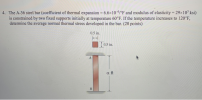 4. The A-36 steel bar (coefficient of thermal expansion = 6.6x10 6/°F and modulus of elasticity = 29x10ksi) is constrained by two fixed supports initially at temperature 60°F. If the temperature increases to 120°F, determine the average normal thermal stress developed in the bar. (20 points) o Sin aft
What the numerical values of the thermal coefficient of linear expansion be the same if you...
What the numerical values of the thermal coefficient of linear expansion be the same if you had measured in degrees Fahrenheit instead of degrees Celsius? If not, explain how they would have been different
Material Soda-lime glass Coef of Thermal Expansion 9.0 x 10⁻⁶°C 1 23.8 x 10 6°C 4.9...
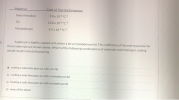 Material Soda-lime glass Coef of Thermal Expansion 9.0 x 10⁻⁶°C 1 23.8 x 10 6°C 4.9 x 100°C Tin Molybdenum A glass jar is tightly capped with either a tin or molybdenum lid. The coefficient of thermal expansion for three materials are shown above. Which of the following combinations of materials and heating or cooling would result in the lid loosening • cooling a soda-lime glass jar with a tin lid cooling a soda-lime glass jar with a molybdenum lid...
 5. 20 pts (A) What are typical values of thermal conductivity and coefficient of thermal expansion for metals and polymers? Metal Ceramic Thermal Conductivity CTE (B) If you heat the metal, what happens to its thermal conductivity, and why (25 words or less) (C) You have 10.0000 cm bars of your typical metal and ceramic from part (5A) at 25.0000 deg C. You heat them both to 300.0000 deg C. What are their lengths upon heating?
 j
1) The volume thermal expansion coefficient is defined as the fractional change in volume of a substance per unit change in temperature. Consider a closed chamber containing a monatomic ideal gas at atmospheric pressure. Consider its behavior as its temperature is increased by a small amount T, and find its volume expansion coefficient, assuming (a) isobaric and (b) adiabatic conditions. Finally, (c) discuss why these two values are different, and compare them to expansion coefficients of liquids and solids.
j
1) The volume thermal expansion coefficient is defined as the fractional change in volume of a substance per unit change in temperature. Consider a closed chamber containing a monatomic ideal gas at atmospheric pressure. Consider its behavior as its temperature is increased by a small amount T, and find its volume expansion coefficient, assuming (a) isobaric and (b) adiabatic conditions. Finally, (c) discuss why these two values are different, and compare them to expansion coefficients of liquids and solids.
 4. The A-36 steel bar (coefficient of thermal expansion = 6.6x10 6/°F and modulus of elasticity = 29x10ksi) is constrained by two fixed supports initially at temperature 60°F. If the temperature increases to 120°F, determine the average normal thermal stress developed in the bar. (20 points) o Sin aft
 Material Soda-lime glass Coef of Thermal Expansion 9.0 x 10⁻⁶°C 1 23.8 x 10 6°C 4.9 x 100°C Tin Molybdenum A glass jar is tightly capped with either a tin or molybdenum lid. The coefficient of thermal expansion for three materials are shown above. Which of the following combinations of materials and heating or cooling would result in the lid loosening • cooling a soda-lime glass jar with a tin lid cooling a soda-lime glass jar with a molybdenum lid...
Most questions answered within 3 hours.
-
Where is the error in this code sequence?
String s1 = "Hello";
String s2 = "ello";...
asked 11 months ago -
Financial data for Joel de Paris, Inc., for last year
follow:
Joel de Paris, Inc.
Balance...
asked 11 months ago -
Consider this reaction:
Al2(SO4)3 (aq)+ BaCl3
(aq) Al2Cl6 (aq)- +
3BaSO4(s) . What is the...
asked 11 months ago -
Suppose that Savneet is considering increasing her
recent random sample from 20 car rentals to 40...
asked 11 months ago -
Trucks arrive at an unloading terminal at an average rate of 120
per hour.
Trucks arrive...
asked 11 months ago -
Why are methanol and ethanol completely soluble in water while
octanol is not very little soluble....
asked 11 months ago -
A facilities manager at a university reads in a research report
that the mean amount of...
asked 11 months ago -
When the CuSO4 is rehydrated by adding water to the anhydrous
compound, is this an endothermic...
asked 11 months ago -
A ray of sunlight is passing from diamond into crown glass; the
angle of incidence is...
asked 11 months ago -
A block of mass 0.249 kg is placed on top of a light, vertical
spring of...
asked 11 months ago -
how do the kidneys compensate in the presences of acidosis
a) trigger hyperventilate
b) reserve acid...
asked 11 months ago -
Question 501 pts
The rental rate of capital to the firm increases. Which of the
following...
asked 11 months ago