1 ) a) Under what conditions would the Fermi energy be at mid-gap? b) Near the...
1 )
a) Under what conditions would the Fermi energy be at mid-gap? b) Near the conduction band? c) Near the valence band?
2)
What are a direct and indirect bandgap semiconductors? Explain the difference between the two.
Homework Answers
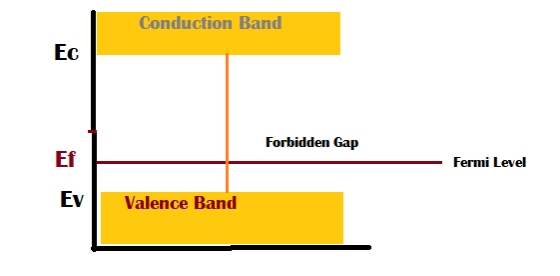
Fermi Level is the probability of occupancy of energy levels in conduction and valence band.
Position of Fermi level deponds upon nature of doping and quantity of doping .
Case 1: Intrinsic Type of Semi Conductor
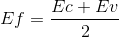
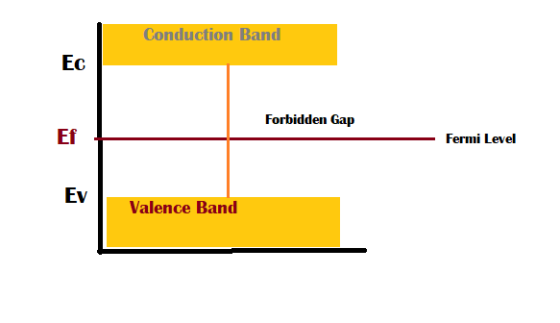
In Intrinsic type semi conductor the number of holes in valence band is equal to the number of electrons in the conduction band and thus the probability of occupation of energy levels in conduction band and valence band are equal.
So Fermi Level Energy
Case 2: N- Type
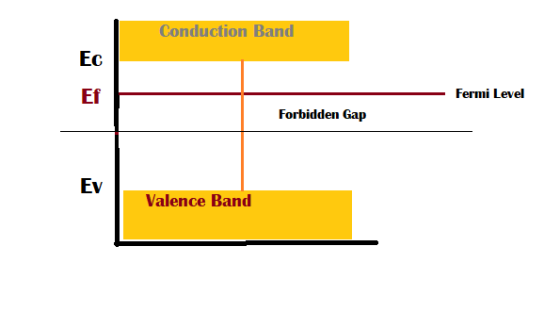
In N pentavalent impurities like Phosphorus (P) is added which will provide free electron .Hence number of free electrons will increase and thus probability of finding an electron in conduction band is more and hence probability of occupation of energy levels by the electrons in the conduction band is greater than the probability of occupation of energy levels by the holes in the valence band.
and Fermi Energy Ef
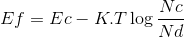
where Nc= Effective density of states in the conduction band and Nd is concentrtion of Donar (Pentavalent) atoms.
Case 3: P Type
In p-type semiconductors, trivalent impurity like Gallium(G) is added which creates large number of hole in valance band and hence probability of occupation of energy levels by the holes in the valence band is greater than the probability of occupation of energy levels by the electrons in the conduction band.
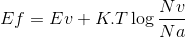
where
Nv is Effective density of states in the Valence band and Na is concentrtion of Acceptor (Trivalent) atoms.
2.
- In direct band-gap semiconductor maximum energy level of the valence band aligns with the minimum energy level of the conduction band with respect to momentum where as in in indirect band gap maximum energy level of the valence band and the minimum energy level of the conduction band are misaligned with respect to momentum.
- In direct band-gap probability of a radiative recombination is high where as in indirect band-gap probability of a radiative recombination is comparatively low as compared to direct band.
- In direct band-gap due to radioactive recombination there is emission of photons (Energy is released in form of light energy) and thats why it is well suited for making LASER and LEDS but in case of indirect band-gap energy is released in form of heat energy.
- Examle of direct band-gap - Gallium Arsenide and Example of indirect band-gap is Silicon.
Add Answer to:
1 )
a) Under what conditions would the Fermi energy be at mid-gap?
b) Near the...
(2) In a semiconductor with an energy gap Eg between the valence and the conduction bands we can take Ef (the Fermi ene...
 (2) In a semiconductor with an energy gap Eg between the valence and the conduction bands we can take Ef (the Fermi energy) to be halfway between the bands (see figure below): Conduction band Energy gap Eg Valence band Semiconductor a. Show that for a typical semiconductor or insulator at room temperature the Fermi- Dirac factor is approximately equal to exp(-E 2kBT). (Typical Eg for semi-conductors ranges from about 0.5eV to 6eV at T-293K.) b. In heavily doped n-type silicon,...
(0) If in GaAs, the Fermi level is 0.30 eV below the conduction band. [10] calculate the thermal equilibrium electron and hole concentration at room temperature. Bandgap of CaAs is 1.42 eV, the effective density of states of the conduction band at 300K i
 (0)If in GaAs, the Fermi level is 0.30 eV below the conduction band. [10] calculate the thermal equilibrium electron and hole concentration at room temperature. Bandgap of CaAs is 1.42 eV, the effective density of states of the conduction band at 300K is 4.7x10 cm and the effective density of states of the valence band is 7x10¹ cm³.L213(11)Identify and illustrate with required equations and diagrams, how energy and momentum are conserved in band to band transitions in indirect band gap...
Please help me 1. In degenerate p-type silicon, a. The Fermi energy is above the valence...
 Please help me
1. In degenerate p-type silicon, a. The Fermi energy is above the valence energy and below the intrinsic Fermi energy b. The Fermi energy is below the valence energy c. The Fermi energy is above the conduction energy d. The Fermi energy is below the conduction energy and above the intrinsic Fermi energy 2. A semiconductor has No 5X 1010 cm3 and N-2X 1018 cm2. It is a. b. C. d. N-type and electrons are the majority...
Please help me
1. In degenerate p-type silicon, a. The Fermi energy is above the valence energy and below the intrinsic Fermi energy b. The Fermi energy is below the valence energy c. The Fermi energy is above the conduction energy d. The Fermi energy is below the conduction energy and above the intrinsic Fermi energy 2. A semiconductor has No 5X 1010 cm3 and N-2X 1018 cm2. It is a. b. C. d. N-type and electrons are the majority...
PART A: The electrons in solids can be found ____________in only certain discrete sharp energy states...
PART A: The electrons in solids can be found ____________in only certain discrete sharp energy states associated with their orbits.in energy states that overlap so that more than one electron is associated with a given energy level.in the same energy states as if the atoms forming the solid were far enough so that their interactions could be neglected.in closely spaced energy levels that form a continuous distribution of energy within a certain range.PART B: When an electron in the valence...
1. Explain why an indirect bandgap semiconductor is not considered “good” optical semiconductor. 2. Explain why...
1. Explain why an indirect bandgap semiconductor is not considered “good” optical semiconductor. 2. Explain why a direct bandgap semiconductor is considered a “good” optical semiconductor. 3. Explain what a phonon is and explain why they are important for electron transitions between conduction and valence bands in indirect bandgap semiconductors. 4. Explain what is meant by a “radiative transition” and a “non-radiative transition” in semiconductors.
i. l e blank(s). A gap suggest two-word in your answer Drift current in semiconductors is...
 i. l e blank(s). A gap suggest two-word in your answer Drift current in semiconductors is due to electric [20] tield. Carriers in the band are referred to as statistics is applied to electrons in The semiconductors. The position and principle states that we cannot simultaneously determine the of electrons. Vy is a . while w is a number and Current in the conduction is due to the flow of Extrinsic semiconductors are vii. viii. The wave function in Schrodinger's...
Please explain part b in details thx! Question 2 At 300 K, the bandgap of GaP is 2.26 eV and the effective density of states at the conduction and valence band edge are 1.8 x 1019 cm23 and 1.9 x 10¹⁹...
 Please explain part b in details thx!
Question 2 At 300 K, the bandgap of GaP is 2.26 eV and the effective density of states at the conduction and valence band edge are 1.8 x 1019 cm23 and 1.9 x 1019 cm3, respectively. (a) Calculate the intrinsic concentration of GaP at 300K (7 marks) Calculate the GaP effective mass of holes at 300K. (b) (8 marks) (c The GaP sample is now doped with donor concentration of 1021 cm3 with...
Please explain part b in details thx!
Question 2 At 300 K, the bandgap of GaP is 2.26 eV and the effective density of states at the conduction and valence band edge are 1.8 x 1019 cm23 and 1.9 x 1019 cm3, respectively. (a) Calculate the intrinsic concentration of GaP at 300K (7 marks) Calculate the GaP effective mass of holes at 300K. (b) (8 marks) (c The GaP sample is now doped with donor concentration of 1021 cm3 with...
Conduction band Energy gap, Valence band The energy gap between the valence band and the conduction...
 Conduction band Energy gap, Valence band The energy gap between the valence band and the conduction band in the widely-used semiconductor gallium arsenide (GaAs) is A - 1.424 eV. Suppose that we consider a small piece of GaAs with 1020 available electrons, and use the equilibrium condition derived in the prelecture. 1) On average, how many electrons will be in the conduction band if T-282.15 K? electrons Submit 2) How many holes (the white dots in the figure) will be...
The energy gap between the valence band and the conduction band in the widely-usd semiconductor gallium...
 The energy gap between the valence band and the conduction band in the widely-usd semiconductor gallium arsenide (GaAs) is A- 1.424 ev. (k 8.617x10⁵ eV/K) At T 0 K the valence band has all the electrons. At T 0 K (shown), electrons are thermally excited across the gap into the conduction band, leaving an equal number of holes behind. Conduction band Energy gap, A Valence band 1) The density of free electrons (ne number per volumer) in a pure crystal...
Fermi Energy Eqn. 4.22 in Kasap gives the Fermi energy (at 0 K) as is the conduction electron con...
 Fermi Energy Eqn. 4.22 in Kasap gives the Fermi energy (at 0 K) as is the conduction electron concentration. This is equivalent to the equation we derived in class. Kasap Eqn. 4.23 gives the Fermi energy as a function of temperature: EFEF1 a. If each copper atom contributes one conduction electron, what is the Fermi energy of copper at 29:3 b. Since this Fermi energy was derived from the Sommerfeld model, the energy is entirely kinetic 12 LEFo K? energy...
 (2) In a semiconductor with an energy gap Eg between the valence and the conduction bands we can take Ef (the Fermi energy) to be halfway between the bands (see figure below): Conduction band Energy gap Eg Valence band Semiconductor a. Show that for a typical semiconductor or insulator at room temperature the Fermi- Dirac factor is approximately equal to exp(-E 2kBT). (Typical Eg for semi-conductors ranges from about 0.5eV to 6eV at T-293K.) b. In heavily doped n-type silicon,...
 Please help me
1. In degenerate p-type silicon, a. The Fermi energy is above the valence energy and below the intrinsic Fermi energy b. The Fermi energy is below the valence energy c. The Fermi energy is above the conduction energy d. The Fermi energy is below the conduction energy and above the intrinsic Fermi energy 2. A semiconductor has No 5X 1010 cm3 and N-2X 1018 cm2. It is a. b. C. d. N-type and electrons are the majority...
Please help me
1. In degenerate p-type silicon, a. The Fermi energy is above the valence energy and below the intrinsic Fermi energy b. The Fermi energy is below the valence energy c. The Fermi energy is above the conduction energy d. The Fermi energy is below the conduction energy and above the intrinsic Fermi energy 2. A semiconductor has No 5X 1010 cm3 and N-2X 1018 cm2. It is a. b. C. d. N-type and electrons are the majority...
 i. l e blank(s). A gap suggest two-word in your answer Drift current in semiconductors is due to electric [20] tield. Carriers in the band are referred to as statistics is applied to electrons in The semiconductors. The position and principle states that we cannot simultaneously determine the of electrons. Vy is a . while w is a number and Current in the conduction is due to the flow of Extrinsic semiconductors are vii. viii. The wave function in Schrodinger's...
 Please explain part b in details thx!
Question 2 At 300 K, the bandgap of GaP is 2.26 eV and the effective density of states at the conduction and valence band edge are 1.8 x 1019 cm23 and 1.9 x 1019 cm3, respectively. (a) Calculate the intrinsic concentration of GaP at 300K (7 marks) Calculate the GaP effective mass of holes at 300K. (b) (8 marks) (c The GaP sample is now doped with donor concentration of 1021 cm3 with...
Please explain part b in details thx!
Question 2 At 300 K, the bandgap of GaP is 2.26 eV and the effective density of states at the conduction and valence band edge are 1.8 x 1019 cm23 and 1.9 x 1019 cm3, respectively. (a) Calculate the intrinsic concentration of GaP at 300K (7 marks) Calculate the GaP effective mass of holes at 300K. (b) (8 marks) (c The GaP sample is now doped with donor concentration of 1021 cm3 with...
 Conduction band Energy gap, Valence band The energy gap between the valence band and the conduction band in the widely-used semiconductor gallium arsenide (GaAs) is A - 1.424 eV. Suppose that we consider a small piece of GaAs with 1020 available electrons, and use the equilibrium condition derived in the prelecture. 1) On average, how many electrons will be in the conduction band if T-282.15 K? electrons Submit 2) How many holes (the white dots in the figure) will be...
 The energy gap between the valence band and the conduction band in the widely-usd semiconductor gallium arsenide (GaAs) is A- 1.424 ev. (k 8.617x10⁵ eV/K) At T 0 K the valence band has all the electrons. At T 0 K (shown), electrons are thermally excited across the gap into the conduction band, leaving an equal number of holes behind. Conduction band Energy gap, A Valence band 1) The density of free electrons (ne number per volumer) in a pure crystal...
 Fermi Energy Eqn. 4.22 in Kasap gives the Fermi energy (at 0 K) as is the conduction electron concentration. This is equivalent to the equation we derived in class. Kasap Eqn. 4.23 gives the Fermi energy as a function of temperature: EFEF1 a. If each copper atom contributes one conduction electron, what is the Fermi energy of copper at 29:3 b. Since this Fermi energy was derived from the Sommerfeld model, the energy is entirely kinetic 12 LEFo K? energy...
Most questions answered within 3 hours.
-
Where is the error in this code sequence?
String s1 = "Hello";
String s2 = "ello";...
asked 10 months ago -
Financial data for Joel de Paris, Inc., for last year
follow:
Joel de Paris, Inc.
Balance...
asked 10 months ago -
Consider this reaction:
Al2(SO4)3 (aq)+ BaCl3
(aq) Al2Cl6 (aq)- +
3BaSO4(s) . What is the...
asked 10 months ago -
Suppose that Savneet is considering increasing her
recent random sample from 20 car rentals to 40...
asked 10 months ago -
Trucks arrive at an unloading terminal at an average rate of 120
per hour.
Trucks arrive...
asked 10 months ago -
Why are methanol and ethanol completely soluble in water while
octanol is not very little soluble....
asked 10 months ago -
A facilities manager at a university reads in a research report
that the mean amount of...
asked 10 months ago -
When the CuSO4 is rehydrated by adding water to the anhydrous
compound, is this an endothermic...
asked 10 months ago -
A ray of sunlight is passing from diamond into crown glass; the
angle of incidence is...
asked 10 months ago -
A block of mass 0.249 kg is placed on top of a light, vertical
spring of...
asked 10 months ago -
how do the kidneys compensate in the presences of acidosis
a) trigger hyperventilate
b) reserve acid...
asked 10 months ago -
Question 501 pts
The rental rate of capital to the firm increases. Which of the
following...
asked 10 months ago