1. Discuss the importance of hydrophobic and hydrophilic interactions on the organization of living cells and...
Homework Answers
The living organism has kind of hydrophobic and hydrophilic interactions in different cellular places.
Hydrophobic or nonpolar molecules are those molecules which stay away from water. Example : lipid. Hydrophilic or polar molecules are those molecule which make interactions with water. In other words we can say, these molecules are water loving.
The hydrophobic and hydrophilic interactions in the cell are given below:
1. Membrane system of a cell: A major example or most important hydrophobic and hydrophilic interaction is cell membrane system. The plasma membrane of any cell is composed of lipid and protein bilayer. Lipids bilayer of a cell membrane is formed by the hydrophobic and hydrophilic interactions. A cell has aquous environment outside and inside the cell. This aquous environment allows the lipid bilayer arrangement of lipid molecules because hydrophobic region of lipid try to stay away from water and hydrophilic molecule tries to develop interactions with water. Due to this reason lipid arrange itself in bilayer form.
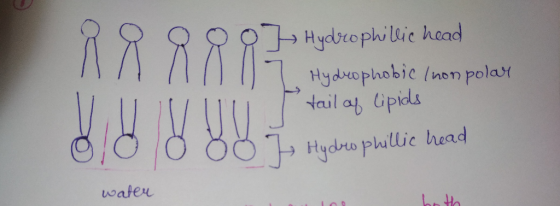
Image : lipid bilayer membrane arrangement.
Different cell organelles of a cell also have membrane which is a lipid bilayer.
2. Protein structure: protein is a long linear chain of amino acid which are linked together by peptide bond. There are different kind of amino acids which have different chemical properties of a side chain. Some of the amino acids are hydrophobic in nature and others are hydrophilic in nature. The arrangement or sequence of the amino acid in a peptide was decided by messenger RNA which is formed by the DNA. So the sequence can be any, consist of hydrophobic and hydrophilic amino acid. These proteins are present in cell cytoplasm, cell membrane, as enzyme, in cell organelles, outside the cells etc.
When a protein placed in aqueous solution like cytoplasm they acquire a particular kind of structural configuration. This is due to hydrophobic and hydrophilic interactions. The hydrophilic molecules make interaction with aqueous environment by forming hydrogen bonds and hydrophobic molecules burried in the the highly folded protein. Hydrophobic region of a protein was covered by hydrophilic region of protein and keeps away from water. So we can say that hydrophobic hydrophillic innteraction is very important in the formation of of protein structural configuration.
If a protein is present in a non polar hydrophobic condition than hydrophobic molecules leaves on the surface of protein and hydrophilic molecules are present in the central region of highly folded protein. This is also due to hydrophobic and hydrophilic interactions.
overall we can say that hydrophobic and hydrophilic interactions are important in the formation of protein structural configuration. The tertiary structure of protein was stabilized by hydrophobic interactions.
Thanks.
I answered the first full question according to the Chegg guidelines, for more answers you have to upload each question separately.
Add Answer to:
1.
Discuss the importance of hydrophobic and hydrophilic interactions
on the organization of living cells and...
1. Draw one string of ten (10) phospholipids. Label the hydrophilic heads and the hydrophobic tails....
 1. Draw one string of ten (10) phospholipids. Label the hydrophilic heads and the hydrophobic tails. (3 points) chrohobia hrudiephilic CH₂-CH-CH 2. What are the basic components of one phospholipid molecule? (3 points) 3. Draw a phospholipid bilayer. Label the hydrophilic heads and the hydrophobic tails. (3 points) 4. Cell membranes are made of phospholipid bilayers. Why is it important for there to be both hydrophilic and hydrophobic components of the membranes that surround all of our cells and organelles?...
1. Discuss the importance of monitoring logs on a regular basis. 2. Discuss the regulatory requirements that might require an organization to implement a DLP solution, like PCI, HIPPA, or SOX. Need a...
1. Discuss the importance of monitoring logs on a regular basis. 2. Discuss the regulatory requirements that might require an organization to implement a DLP solution, like PCI, HIPPA, or SOX. Need a unique answer and dont copy from other people
1. Like phospholipids, lipopolysaccharides have a hydrophilic head and a hydrophobic tail. True or false 2....
1. Like phospholipids, lipopolysaccharides have a hydrophilic head and a hydrophobic tail. True or false 2. The outer membrane of Gram negative bacteria contains lipopolysaccharides T or F 3. Biofilms and pure culture are formed by only one type of microorganism T or F 4. Any given antibiotic will have the same minimum inhibitory concentration (MIC) against any test microorganism. T or F 5. Production of antibiotics by the microorganism is not affected by the culture conditions T or F...
1) Discuss the importance of magnification and resolution in microscopy. How are the magnification and resolution...
1) Discuss the importance of magnification and resolution in microscopy. How are the magnification and resolution of a light microscope different from that of an electron microscope? 2) Which microscope would you use to study the following? a) the changes in shape of a living human white blood cell b) the finest details of the surface texture of a human hair c) the detailed structure of an organelle in a liver cell 3) State the cell theory?...
1) Which function is NOT a p Populations of organis B) Living things exhibit co C)...
 1) Which function is NOT a p Populations of organis B) Living things exhibit co C) Organisms take in energy unction is NOT a property of life? hs of organisms rarely change over time. Wings exhibit complex but ordered organization. ake in energy and use it to perform all of life's activities. Organisms reproduce their own kind. 2) What are the two main p A) speciation and evolution C) decomposition and nutrient recycling the two main processes upon which ecosystems...
1. If you were to build a phylogenetic tree of living animals, which of the following...
 1. If you were to build a phylogenetic tree of living animals,
which of the following derived characters would appear first?
A. deuterostome development
B. true tissues
C. protostome development
D. bilateral symmetry
2. Birds and mammals are endotherms. They maintain body
temperature by producing heat through metabolism. Endothermy is
energetically expensive for an organism, yet endotherms have become
the dominant group of tetrapods. What is a major evolutionary
advantage of endothermy?
A. Endothermy allows greater independence from water.
B....
1. If you were to build a phylogenetic tree of living animals,
which of the following derived characters would appear first?
A. deuterostome development
B. true tissues
C. protostome development
D. bilateral symmetry
2. Birds and mammals are endotherms. They maintain body
temperature by producing heat through metabolism. Endothermy is
energetically expensive for an organism, yet endotherms have become
the dominant group of tetrapods. What is a major evolutionary
advantage of endothermy?
A. Endothermy allows greater independence from water.
B....
1. Explain the importance of an organization-specific down 4. Describe key components of a business continuity...
 1. Explain the importance of an organization-specific down 4. Describe key components of a business continuity plan time risk assessment. 2. Describe the pros and cons of different assessment tools and (a) how they might differ for different types of orga- nizations and (b) how they might differ depending on for evaluating downtime events and discuss scenarios in EHR maturity level. which they might be used to their best advantage. 3. Compare and contrast the roles of the informatician, the...
1. A student uses iodine to visualize cells under the light microscope. Iodine stains starch deep...
1. A student uses iodine to visualize cells under the light microscope. Iodine stains starch deep blue and glycogen granules dark brown. Observation of the cells reveals the presence of cell walls, dark brown granules, mitochondria, and a prominent nucleus. If the chemical composition of the cell wall is determined, which of the following molecules would MOST likely be the major constituent? A. cellulose B. chitin C. lignin D. peptidoglycan 2. Which of the following statements is the MOST compelling...
1 ) Using factors and concepts of protein interactions, describe protein-ligand binding as fully as possible,...
1 ) Using factors and concepts of protein interactions, describe protein-ligand binding as fully as possible, including the role it plays in the body's physiology, using some of the examples of soluble proteins. 2 ) Describe the structural and functional aspects of a transporting epithelium, including the specific proteins involved that generate the characteristics of this type of epithelium. 3 ) Picture the following fluid replacement therapy: A solution of 0.45% NaCl, 3.3% dextrose (glucose), 100mM urea, and 100mM Albumin...
1. Prokaryotes lack some parts found in eukaryotic cells, including which item? a. a nuclear membrane...
 1. Prokaryotes lack some parts found in eukaryotic cells, including which item? a. a nuclear membrane b. DNA c. one or more chromosomes d. a plasma membrane e. all of the above 2. Which of the following statements best describes most bacteria? a) They are generally harmful. b) They are limited to living in a few habitats. c) They are very common in the environment. d) They are responsible for the common cold." 3. Which statement about biofilms would lose...
 1. Draw one string of ten (10) phospholipids. Label the hydrophilic heads and the hydrophobic tails. (3 points) chrohobia hrudiephilic CH₂-CH-CH 2. What are the basic components of one phospholipid molecule? (3 points) 3. Draw a phospholipid bilayer. Label the hydrophilic heads and the hydrophobic tails. (3 points) 4. Cell membranes are made of phospholipid bilayers. Why is it important for there to be both hydrophilic and hydrophobic components of the membranes that surround all of our cells and organelles?...
 1) Which function is NOT a p Populations of organis B) Living things exhibit co C) Organisms take in energy unction is NOT a property of life? hs of organisms rarely change over time. Wings exhibit complex but ordered organization. ake in energy and use it to perform all of life's activities. Organisms reproduce their own kind. 2) What are the two main p A) speciation and evolution C) decomposition and nutrient recycling the two main processes upon which ecosystems...
 1. If you were to build a phylogenetic tree of living animals,
which of the following derived characters would appear first?
A. deuterostome development
B. true tissues
C. protostome development
D. bilateral symmetry
2. Birds and mammals are endotherms. They maintain body
temperature by producing heat through metabolism. Endothermy is
energetically expensive for an organism, yet endotherms have become
the dominant group of tetrapods. What is a major evolutionary
advantage of endothermy?
A. Endothermy allows greater independence from water.
B....
1. If you were to build a phylogenetic tree of living animals,
which of the following derived characters would appear first?
A. deuterostome development
B. true tissues
C. protostome development
D. bilateral symmetry
2. Birds and mammals are endotherms. They maintain body
temperature by producing heat through metabolism. Endothermy is
energetically expensive for an organism, yet endotherms have become
the dominant group of tetrapods. What is a major evolutionary
advantage of endothermy?
A. Endothermy allows greater independence from water.
B....
 1. Explain the importance of an organization-specific down 4. Describe key components of a business continuity plan time risk assessment. 2. Describe the pros and cons of different assessment tools and (a) how they might differ for different types of orga- nizations and (b) how they might differ depending on for evaluating downtime events and discuss scenarios in EHR maturity level. which they might be used to their best advantage. 3. Compare and contrast the roles of the informatician, the...
 1. Prokaryotes lack some parts found in eukaryotic cells, including which item? a. a nuclear membrane b. DNA c. one or more chromosomes d. a plasma membrane e. all of the above 2. Which of the following statements best describes most bacteria? a) They are generally harmful. b) They are limited to living in a few habitats. c) They are very common in the environment. d) They are responsible for the common cold." 3. Which statement about biofilms would lose...
Most questions answered within 3 hours.
-
Where is the error in this code sequence?
String s1 = "Hello";
String s2 = "ello";...
asked 11 months ago -
Financial data for Joel de Paris, Inc., for last year
follow:
Joel de Paris, Inc.
Balance...
asked 11 months ago -
Consider this reaction:
Al2(SO4)3 (aq)+ BaCl3
(aq) Al2Cl6 (aq)- +
3BaSO4(s) . What is the...
asked 11 months ago -
Suppose that Savneet is considering increasing her
recent random sample from 20 car rentals to 40...
asked 11 months ago -
Trucks arrive at an unloading terminal at an average rate of 120
per hour.
Trucks arrive...
asked 11 months ago -
Why are methanol and ethanol completely soluble in water while
octanol is not very little soluble....
asked 11 months ago -
A facilities manager at a university reads in a research report
that the mean amount of...
asked 11 months ago -
When the CuSO4 is rehydrated by adding water to the anhydrous
compound, is this an endothermic...
asked 11 months ago -
A ray of sunlight is passing from diamond into crown glass; the
angle of incidence is...
asked 11 months ago -
A block of mass 0.249 kg is placed on top of a light, vertical
spring of...
asked 11 months ago -
how do the kidneys compensate in the presences of acidosis
a) trigger hyperventilate
b) reserve acid...
asked 11 months ago -
Question 501 pts
The rental rate of capital to the firm increases. Which of the
following...
asked 11 months ago