Write a program to print all the prime numbers below a certain given number. A prime...
Write a program to print all the prime numbers below a certain given number. A prime number is defined as a number that can only be divided by 1 and itself.
Requirements:
1. Accept the upper limit from the user as an integer.
2. You can assume the user input will be positive and smaller than INT MAX
3. Go from 1 to the number. If you happen to find a number that is prime, print it. The input and output should match the sample run.
Please try and restrict yourself to loops, selection statements, and calls to library methods
Sample Run:
Enter the upper limit: 25
The prime numbers are:
2, 3, 5, 7, 11, 13, 17, 19, 23
Homework Answers
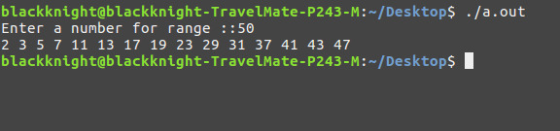
#include<bits/stdc++.h>
using namespace std;
void printPrimes(int n) {
int i = 2;
while(i <= n) {
bool isPrime = true;
for(int j = 2; j < i-1; j++) {
if(i%j == 0){
isPrime = false;
break;
}
}
if(isPrime) cout << i << " ";
i++;
}
cout << endl;
}
int main() {
int n;
cout << "Enter a number for range ::";
cin >> n;
printPrimes(n);
return 0;
}
Add Answer to:
Write a program to print all the prime numbers below a certain
given number. A prime...
Write a java program to print all the prime numbers below a certain given number. A...
Write a java program to print all the prime numbers below a certain given number. A prime number is defined as a number that can only be divided by 1 and itself. Requirements: 1. Accept the upper limit from the user as an integer. 2. You can assume the user input will be positive and smaller than INT MAX 3. Go from 1 to the number. If you happen to find a number that is prime, print it. The input...
Write a java program to print all the powers of 2 below a certain number and...
Write a java program to print all the powers of 2 below a certain number and calculate their sum Requirements: 1. Accept the upper limit from the user as an integer 2. Make sure the sum variable is of the “long” type. You can assume that the test output will be less than LONG MAX. 3. Print all the numbers as a running sum, and finally print their sum. Please try and restrict yourself to loops, selection statements, and calls...
write a program in java to print all the powers of 2 below a certain number...
write a program in java to print all the powers of 2 below a certain number and calculate their sum. Make sure your program conforms to the following requirements. 1. Accept the upper limit from the user (as an integer). 2. These numbers grow very fast. make sure the sum variable is of the "long" type. You can assume that the test output will be less that LONG MAX. 3.Print all numbers as a running sum, and finally print their...
I must create a Loop in C++ that will print all prime numbers less than the...
I must create a Loop in C++ that will print all prime numbers less than the number entertered by the user. 1. Accept the upper limit from the user (as an integer). (5 points) 2. Make sure the number is positive. If it is not, terminate the program. (5 points). 3. Go from 1 to the number. If you happen to find a number that is prime, print it. (35 points) example: Enter the upper limit: 25 The prime numbers...
Write a C program which computes the count of the prime and perfect numbers within a...
 Write a C program which computes the count of the prime and perfect numbers within a given limit Land U, representing the lower and upper limit respectively. Prime numbers are numbers that have only 2 factors: 1 and themselves (1 is not prime). An integer number is said to be perfect number if its factors, including 1 (but not the number itself), sum to the number. Sample Inputi: 1 100 Sample Outputs: Prime: 25 Perfect: 2 Sample Input2: 101 10000...
Your program write a program to test whether a number is prime or not. Your program should...
 Your
program write
a program to test whether a number is prime or not.
Your program should
ask user to input an integer and respond: "Prime" or "Not
prime".
Don't use any
library function that tests for prime numbers.
The program should
continue to ask for input, till it sees a 0, when it exits.
Please submit printed
pseudocodeshould ask user to input an
integer and respond: "Prime" or "Not prime".
Don't use any library function that tests for prime numbers....
Your
program write
a program to test whether a number is prime or not.
Your program should
ask user to input an integer and respond: "Prime" or "Not
prime".
Don't use any
library function that tests for prime numbers.
The program should
continue to ask for input, till it sees a 0, when it exits.
Please submit printed
pseudocodeshould ask user to input an
integer and respond: "Prime" or "Not prime".
Don't use any library function that tests for prime numbers....
a) Write a program that uses a while loop to print all divisors of a number...
a) Write a program that uses a while loop to print all divisors of a number supplied by the user. The program should also print the sum of all the divisors and whether the number the user entered is a prime number or not. Note: The definition of a divisor is a number that divides another evenly (i.e., without a remainder) and the definition of a prime number is a number whose only divisors are 1 and itself. b) Implement...
Use C programming Make sure everything works well only upload Write a program that takes an...
 Use C programming
Make sure everything works well only upload
Write a program that takes an integer from standard input and prints all prime numbers that are smaller than it to standard output. Recall that a prime number is a natural number greater than 1 whose only positive divisors are 1 and itself. At the start of the program, prompt the user to input a number by printing "Input a number greater than 2:\n". If the user's input is less...
Use C programming
Make sure everything works well only upload
Write a program that takes an integer from standard input and prints all prime numbers that are smaller than it to standard output. Recall that a prime number is a natural number greater than 1 whose only positive divisors are 1 and itself. At the start of the program, prompt the user to input a number by printing "Input a number greater than 2:\n". If the user's input is less...
17. Prime Numbers A prime number is a number that is only evenly divisible by itself...
 17. Prime Numbers A prime number is a number that is only evenly divisible by itself and 1. For example, the number 5 is prime because it can only be evenly divided by 1 and S. The number 6, how- ever, is not prime because it can be divided evenly by 1, 2, 3, and 6. Write a Boolean function named is_prime which takes an integer as an argument and returns true if the argument is a prime number, or...
Is Prime Number In this program, you will be using C++ programming constructs, such as functions....
Is Prime Number In this program, you will be using C++ programming constructs, such as functions. main.cpp Write a program that asks the user to enter a positive integer, and outputs a message indicating whether the integer is a prime number. If the user enters a negative integer, output an error message. isPrime Create a function called isPrime that contains one integer parameter, and returns a boolean result. If the integer input is a prime number, then this function returns...
 Write a C program which computes the count of the prime and perfect numbers within a given limit Land U, representing the lower and upper limit respectively. Prime numbers are numbers that have only 2 factors: 1 and themselves (1 is not prime). An integer number is said to be perfect number if its factors, including 1 (but not the number itself), sum to the number. Sample Inputi: 1 100 Sample Outputs: Prime: 25 Perfect: 2 Sample Input2: 101 10000...
 Your
program write
a program to test whether a number is prime or not.
Your program should
ask user to input an integer and respond: "Prime" or "Not
prime".
Don't use any
library function that tests for prime numbers.
The program should
continue to ask for input, till it sees a 0, when it exits.
Please submit printed
pseudocodeshould ask user to input an
integer and respond: "Prime" or "Not prime".
Don't use any library function that tests for prime numbers....
Your
program write
a program to test whether a number is prime or not.
Your program should
ask user to input an integer and respond: "Prime" or "Not
prime".
Don't use any
library function that tests for prime numbers.
The program should
continue to ask for input, till it sees a 0, when it exits.
Please submit printed
pseudocodeshould ask user to input an
integer and respond: "Prime" or "Not prime".
Don't use any library function that tests for prime numbers....
 Use C programming
Make sure everything works well only upload
Write a program that takes an integer from standard input and prints all prime numbers that are smaller than it to standard output. Recall that a prime number is a natural number greater than 1 whose only positive divisors are 1 and itself. At the start of the program, prompt the user to input a number by printing "Input a number greater than 2:\n". If the user's input is less...
Use C programming
Make sure everything works well only upload
Write a program that takes an integer from standard input and prints all prime numbers that are smaller than it to standard output. Recall that a prime number is a natural number greater than 1 whose only positive divisors are 1 and itself. At the start of the program, prompt the user to input a number by printing "Input a number greater than 2:\n". If the user's input is less...
 17. Prime Numbers A prime number is a number that is only evenly divisible by itself and 1. For example, the number 5 is prime because it can only be evenly divided by 1 and S. The number 6, how- ever, is not prime because it can be divided evenly by 1, 2, 3, and 6. Write a Boolean function named is_prime which takes an integer as an argument and returns true if the argument is a prime number, or...
Most questions answered within 3 hours.
-
Where is the error in this code sequence?
String s1 = "Hello";
String s2 = "ello";...
asked 11 months ago -
Financial data for Joel de Paris, Inc., for last year
follow:
Joel de Paris, Inc.
Balance...
asked 11 months ago -
Consider this reaction:
Al2(SO4)3 (aq)+ BaCl3
(aq) Al2Cl6 (aq)- +
3BaSO4(s) . What is the...
asked 11 months ago -
Suppose that Savneet is considering increasing her
recent random sample from 20 car rentals to 40...
asked 11 months ago -
Trucks arrive at an unloading terminal at an average rate of 120
per hour.
Trucks arrive...
asked 11 months ago -
Why are methanol and ethanol completely soluble in water while
octanol is not very little soluble....
asked 11 months ago -
A facilities manager at a university reads in a research report
that the mean amount of...
asked 11 months ago -
When the CuSO4 is rehydrated by adding water to the anhydrous
compound, is this an endothermic...
asked 11 months ago -
A ray of sunlight is passing from diamond into crown glass; the
angle of incidence is...
asked 11 months ago -
A block of mass 0.249 kg is placed on top of a light, vertical
spring of...
asked 11 months ago -
how do the kidneys compensate in the presences of acidosis
a) trigger hyperventilate
b) reserve acid...
asked 11 months ago -
Question 501 pts
The rental rate of capital to the firm increases. Which of the
following...
asked 11 months ago