Do exercise 9.1 in the book (page 362, or page 384 of the Comprehensive Version of...
Do exercise 9.1 in the book (page 362, or page 384 of the Comprehensive Version of the book)
Also add a method named getDiagonal which computes and returns the diagonal of the rectangle. For example the distance from the top left corner to the bottom right corner. Or equivalently the distance from the top right corner to the bottom left corner.
Call this method and display it's output in your test program. for the two Rectangle objects.
Here is exercise 9.1 from the book:
(The Rectangle class) Following the example of the Circle class
in Section 9.2,
design a class named Rectangle to represent a rectangle. The class
contains:
- Two double data fields named width and height that specify the
width and
height of the rectangle. The default values are 1 for both width
and height.
- A no-arg constructor that creates a default rectangle.
- A constructor that creates a rectangle with the specified width
and height.
- A method named getArea() that returns the area of this
rectangle.
- A method named getPerimeter() that returns the perimeter.
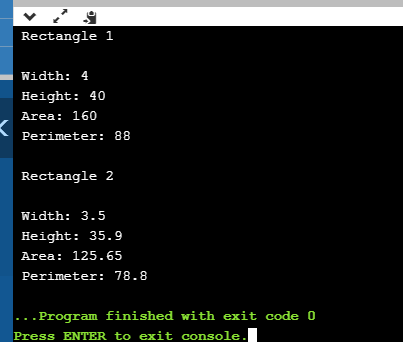
Write a test program that creates two Rectangle objects—one with width 4 and height 40, and the other with width 3.5 and height 35.9.
Display the width, height, area, and perimeter of each rectangle in this order.
Homework Answers
Answer: Hey dear student finds the solution of your query if you have any doubt feel free to ask. Thanks!!
This C++ program has a class named Rectangle which has two constructors one is default nad other is specified the values for data members and two member functions. One is to calculate Area of Rectangle and returns area, second to calculate the perimeter of rectangle calculate perimeter and returns perimeter. A test program which creates two objects of class Rectangle and specified values and call functions separately as you can see below in code and finally print all information on the screen.
#include<iostream> using namespace std; class Rectangle //class rectangle { double height; //private data members double width; public: Rectangle() //defalut constructor { width = 1; //default values of data members height = 1; } Rectangle(double h, double w) //parametrized constructor { height = h; //specified values for data members width = w; } double getArea() //function that returns area { double area = height*width; return area; } double getPerimeter() //function that returns Perimeter { double peri = 2*(height+width); return peri; } }; int main() //main function to test { double h,w,h1,w1; //declaration of variables h = 40; //specific values to variables w= 4; h1= 35.9; w1 = 3.5; double area,peri,area1,peri1; Rectangle r1(h,w); //create object of class area = r1.getArea(); //call function area peri = r1.getPerimeter(); //call function and return value store into variable Rectangle r2(h1,w1); //create 2nd object of class area1 = r2.getArea(); //call function and returning value store into variable peri1 = r2.getPerimeter(); //call function and returning value store into variable cout<<" Rectangle 1"; //print all information about each rectangle cout<<"\n\n Width: "<<w; cout<<"\n Height: "<<h; cout<<"\n Area: "<<area; cout<<"\n Perimeter: "<<peri; //Rectangle 2 information cout<<"\n\n Rectangle 2"; cout<<"\n\n Width: "<<w1; cout<<"\n Height: "<<h1; cout<<"\n Area: "<<area1; cout<<"\n Perimeter: "<<peri1; return 0; }
C++ Code to Copy:
#include<iostream>
using namespace std;
class Rectangle //class rectangle
{
double height; //private data members
double width;
public:
Rectangle() //defalut constructor
{
width = 1; //default values of data members
height = 1;
}
Rectangle(double h, double w) //parametrized constructor
{
height = h; //specified values for data members
width = w;
}
double getArea() //function that returns area
{
double area = height*width;
return area;
}
double getPerimeter() //function that returns Perimeter
{
double peri = 2*(height+width);
return peri;
}
};
int main() //main function
to test
{
double h,w,h1,w1;
//declaration of variables
h = 40; //specific values
to variables
w= 4;
h1= 35.9;
w1 = 3.5;
double
area,peri,area1,peri1;
Rectangle r1(h,w); //create
object of class
area = r1.getArea(); //call
function area
peri = r1.getPerimeter();
//call function and return value store into variable
Rectangle r2(h1,w1);
//create 2nd object of class
area1 = r2.getArea();
//call function and returning value store into
variable
peri1 = r2.getPerimeter();
//call function and returning value store into
variable
cout<<" Rectangle 1";
//print all information about each rectangle
cout<<"\n\n Width:
"<<w;
cout<<"\n Height:
"<<h;
cout<<"\n Area:
"<<area;
cout<<"\n Perimeter:
"<<peri; //Rectangle 2 information
cout<<"\n\n Rectangle
2";
cout<<"\n\n Width:
"<<w1;
cout<<"\n Height:
"<<h1;
cout<<"\n Area:
"<<area1;
cout<<"\n Perimeter:
"<<peri1;
return
0;
}
Add Answer to:
Do exercise 9.1 in the book (page 362, or page 384 of the
Comprehensive Version of...
JAVA design a class named Rectangle to represent a rectangle. The class contains: A method named getPerimeter() that returns the perimeter. Two double data fields named width and height that specify...
JAVA design a class named Rectangle to represent a rectangle. The class contains: A method named getPerimeter() that returns the perimeter. Two double data fields named width and height that specify the width and height of the rectangle. The default values are 1 for both width and height. A no-arg constructor that creates a default rectangle. A constructor that creates a rectangle with the specified width and height. A method named getArea() that returns the area of this rectangle. design...
Following the example of the Circle class in Section 8.2, design a class named Rectangle to...
Following the example of the Circle class in Section 8.2, design a class named Rectangle to represent a rectangle. The class contains: ■ Two double data fields named width and height that specify the width and height of the rectangle. The default values are 1 for both width and height. ■ A no-arg constructor that creates a default rectangle. ■ A constructor that creates a rectangle with the specified width and height. ■ A method named getArea() that returns the...
(The Rectangle class) Following the example of the Circle class in Section 9.2, design a class...
(The Rectangle class) Following the example of the Circle class in Section 9.2, design a class named Rectangle to represent a rectangle. The class contains: ■ Two double data fields named width and height that specify the width and height of the rectangle. The default values are 1 for both width and height. ■ A no-arg constructor that creates a default rectangle. ■ A constructor that creates a rectangle with the specified width and height. ■ A method named getArea()...
Within NetBeans, write a Java program for EACH of the following problems. (The Rectangle class) Following...
Within NetBeans, write a Java program for EACH of the following problems. (The Rectangle class) Following the example of the Circle class in Section 9.2, design a class named Rectangle to represent a rectangle. The class contains: · Two double data fields named width and height that specify the width and height of the rectangle. The default values are 1 for both width and height. · A no-arg constructor that creates a default rectangle. · A constructor that creates a...
Please use Java to answer the question. (The Rectangle class) Following the example of the Circle...
Please use Java to answer the question. (The Rectangle class) Following the example of the Circle class in Section 8.2, design a class named Rectangle to represent a rectangle. The class contains: ■ Two double data fields named width and height that specify the width and height of the rectangle. The default values are 1 for both width and height. ■ A no-arg constructor that creates a default rectangle. ■ A constructor that creates a rectangle with the specified width...
NEEDS TO BE IN PYTHON: (The Rectangle class) Following the example of the Circle class in...
NEEDS TO BE IN PYTHON: (The Rectangle class) Following the example of the Circle class in Section 9.2, design a class named Rectangle to represent a rectangle. The class contains: - Two data fields named width and height. - A constructor that creates a rectangle with the specified width and height. The default values are 1 and 2 for the width and height, respectively. - A method named getArea() that returns the area of this rectangle. - A method named...
PLEASE DO IN C# AND MAKE SURE I CAN COPY CODE IN VISUAL STUDIO Exercise #1:...
PLEASE DO IN C# AND MAKE SURE I CAN COPY CODE IN VISUAL STUDIO Exercise #1: Design and implement class Rectangle to represent a rectangle object. The class defines the following attributes (variables) and methods: 1. Two Class variables of type double named height and width to represent the height and width of the rectangle. Set their default values to 1.0 in the default constructor. 2. A non-argument constructor method to create a default rectangle. 3. Another constructor method to...
using c++ E2b:Design a class named Rectangle to represent a rectangle . The class contains: (1)...
using c++ E2b:Design a class named Rectangle to represent a rectangle . The class contains: (1) Two double data members named width and height which specifies the width and height of the rectangle . (2) A no-arg constructor that creates a rectangle with width 1 and height 1. (3) A constructor that creates a rectangle with the specified width and height . (4) A function named getArea() that returns the area of this rectangle . (5) A function named getPerimeter()...
PLEASE DO BOTH OF THESE IN PYTHON 1) Exercise #1: Design and implement class Rectangle to...
PLEASE DO BOTH OF THESE IN PYTHON 1) Exercise #1: Design and implement class Rectangle to represent a rectangle object. The class defines the following attributes (variables) and methods: Two Class variables of type double named height and width to represent the height and width of the rectangle. Set their default values to 1.0 in the default constructor. A non-argument constructor method to create a default rectangle. Another constructor method to create a rectangle with user-specified height and width. Python...
Design a general class GeometricObject can be used to model all geometric objects. This class contains...
Design a general class GeometricObject can be used to model all geometric objects. This class contains the properties color and filled and their appropriate get and set methods. Assume that this class also contains toString() methods. The toString() method returns a string representation of the object. Define the Triangle, Circle, and Rectangle classes that extend the GeometricObject class. The Triangle class inherits all accessible data fields and methods from the GeometricObject class.In addition, it has three double data fields named...
Most questions answered within 3 hours.
-
Where is the error in this code sequence?
String s1 = "Hello";
String s2 = "ello";...
asked 11 months ago -
Financial data for Joel de Paris, Inc., for last year
follow:
Joel de Paris, Inc.
Balance...
asked 11 months ago -
Consider this reaction:
Al2(SO4)3 (aq)+ BaCl3
(aq) Al2Cl6 (aq)- +
3BaSO4(s) . What is the...
asked 11 months ago -
Suppose that Savneet is considering increasing her
recent random sample from 20 car rentals to 40...
asked 11 months ago -
Trucks arrive at an unloading terminal at an average rate of 120
per hour.
Trucks arrive...
asked 11 months ago -
Why are methanol and ethanol completely soluble in water while
octanol is not very little soluble....
asked 11 months ago -
A facilities manager at a university reads in a research report
that the mean amount of...
asked 11 months ago -
When the CuSO4 is rehydrated by adding water to the anhydrous
compound, is this an endothermic...
asked 11 months ago -
A ray of sunlight is passing from diamond into crown glass; the
angle of incidence is...
asked 11 months ago -
A block of mass 0.249 kg is placed on top of a light, vertical
spring of...
asked 11 months ago -
how do the kidneys compensate in the presences of acidosis
a) trigger hyperventilate
b) reserve acid...
asked 11 months ago -
Question 501 pts
The rental rate of capital to the firm increases. Which of the
following...
asked 11 months ago