Given a 0.100 M solution of anserine at its isoelectric point and ready access to 0.100...
Given a 0.100 M solution of anserine at its isoelectric point and ready access to 0.100 M HCl, 0.100 M NaOH and distilled water, describe the preparation of 1 L of 0.0500 Manserine buffered solution, pH 7.20.
Volume of stock solution needed = _____________ mL
Volume of HCl needed to adjust the imidazole group = _____________mL
Volume of HCl needed to titrate the amino group = __________ mL
Total HCl needed = ________ mL
Homework Answers
This is a very long question based on the isolectric point for anserine. Below I have explained the process for the question.


Add Answer to:
Given a 0.100 M solution of anserine
at its isoelectric point and ready access to 0.100...
Given a 0.200 M solution of anserine at its isoelectric point and ready access to 0.100...
Given a 0.200 M solution of anserine at its isoelectric point and ready access to 0.100 M HCl, 0.100 M NaOH and distilled water, describe the preparation of 1 L of 0.0500 M anserine buffered solution, pH 7.20. Volume of stock solution needed =____ mL Volume of HCl needed to adjust the imidazole group =____ mL Volume of HCl needed to titrate the amino group =_____ mL Total HCl needed = _____ mL
You titrate 25.0 mL of 0.100 M HCl solution with 0.086 M NaOH. What is the...
You titrate 25.0 mL of 0.100 M HCl solution with 0.086 M NaOH. What is the limiting reactant?You titrate 25.0 mL of 0.100 M HCl solution with 0.086 M NaOH. What is the final [H3O+]?You titrate 25.0 mL of 0.100 M HCl solution with 0.086 M NaOH. What is the final pH of the solution?
A 40.0 mL volume of 0.100 M NaOH is titrated with 0.0500 M HCl. Calculate the...
A 40.0 mL volume of 0.100 M NaOH is titrated with 0.0500 M HCl. Calculate the pH after addition of the following volumes of acid. A). 83.6 mL
I titrate 25.00 mL of a 0.100 M HCl solution with 0.100 M CH3NH2. CH3NH2 Kb=4.4x10^-4...
I titrate 25.00 mL of a 0.100 M HCl solution with 0.100 M CH3NH2. CH3NH2 Kb=4.4x10^-4 A) What is the initial pH of the solution? B) What is the pH after the addition of 10.00 mL of the HCl? C) What is the pH at the equivalence point? D) What is the pH 10.00 mL past the equivalence point?
Determine the pH of a solution when 25.7 mL of 0.13 M HNO3 is mixed with...
Determine the pH of a solution when 25.7 mL of 0.13 M HNO3 is mixed with 20.5 mL of: A) 0.100 M NaOH B) Distilled water C) .060M HClD).300M KOH
Number 3 contains 0.0050 moles of 2. You are given two solutions. Solution X has a...
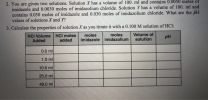 Number 3
contains 0.0050 moles of 2. You are given two solutions. Solution X has a volume of 100. ml and imidazole and 0.0030 moles of imidazolium chloride. Solution Y has a volume of 100. ml and contains 0.050 moles of imidazole and 0.030 moles of imidazolium chloride. What are the pH values of solutions X and ? 3. Calculate the properties of solution X as you titrate it with a 0.100 M solution of HCI: moles Volume of added...
Number 3
contains 0.0050 moles of 2. You are given two solutions. Solution X has a volume of 100. ml and imidazole and 0.0030 moles of imidazolium chloride. Solution Y has a volume of 100. ml and contains 0.050 moles of imidazole and 0.030 moles of imidazolium chloride. What are the pH values of solutions X and ? 3. Calculate the properties of solution X as you titrate it with a 0.100 M solution of HCI: moles Volume of added...
PROCEDURE 1. Prepare three 100 mL beakers for this experiment. Use the molecular weights on the bottles to calculate the amount of solid to use. a. *b. Prepare 25 mL of a 10 M NaOH solution (concentr...
 PROCEDURE 1. Prepare three 100 mL beakers for this experiment. Use the molecular weights on the bottles to calculate the amount of solid to use. a. *b. Prepare 25 mL of a 10 M NaOH solution (concentrated NaOH solution). Calculate the amount of solid NaOH needed to make. *c. Prepare 50 mL of a 20 mM histidine solution (calculate the amount of solid histidine needed to make it, m.w. 209.6 g/mol). In the fume hood, add 3 drops of concentrated...
4) A 40.0 mL sample of 0.100 M HCl is titrated with 0.100 M NaOH. Calculate...
 4) A 40.0 mL sample of 0.100 M HCl is titrated with 0.100 M NaOH. Calculate the pH after the addition of each of the following volumes of NaOH: (a) 0,0 mL, (b) 20.0 mL, (c) 40,0 mL, (d) 60,0 mL. A plot of the pH of the solution as a function of the volume of added titrant is known as a pH titration curve. Using the available data points, plot the pH titration curve for the above titration,
A 30.00 mL solution of 0.0500 M benzoic acid, a monoprotic acid, is titrated with 0.100...
A 30.00 mL solution of 0.0500 M benzoic acid, a monoprotic acid, is titrated with 0.100 M NaOH. The Ka of benzoic acid is 6.3 × 10⁻⁵. Determine the pH after 15.00 mL of the sodium hydroxide solution is added.
Prepare dilute acid and base solutions and buffered acid and base solutions to observe how buffering...
 Prepare dilute acid and base solutions and buffered acid and base solutions to observe how buffering affects the pH. Use four clean, dry 50 ml beakers. Put these pH measurments in the Data Sheet Dilute NaOH Beaker 3 1. add 25 mL distilled H2O Buffered NaOH Beaker 4 1. add 25 mL of original buffer solution Dilute HCI Buffered HCI Beaker 1 Beaker 2 1. add 25 mL distilled 1. add 25 mL of H2O original buffer solution 2. Measure...
 Number 3
contains 0.0050 moles of 2. You are given two solutions. Solution X has a volume of 100. ml and imidazole and 0.0030 moles of imidazolium chloride. Solution Y has a volume of 100. ml and contains 0.050 moles of imidazole and 0.030 moles of imidazolium chloride. What are the pH values of solutions X and ? 3. Calculate the properties of solution X as you titrate it with a 0.100 M solution of HCI: moles Volume of added...
Number 3
contains 0.0050 moles of 2. You are given two solutions. Solution X has a volume of 100. ml and imidazole and 0.0030 moles of imidazolium chloride. Solution Y has a volume of 100. ml and contains 0.050 moles of imidazole and 0.030 moles of imidazolium chloride. What are the pH values of solutions X and ? 3. Calculate the properties of solution X as you titrate it with a 0.100 M solution of HCI: moles Volume of added...
 PROCEDURE 1. Prepare three 100 mL beakers for this experiment. Use the molecular weights on the bottles to calculate the amount of solid to use. a. *b. Prepare 25 mL of a 10 M NaOH solution (concentrated NaOH solution). Calculate the amount of solid NaOH needed to make. *c. Prepare 50 mL of a 20 mM histidine solution (calculate the amount of solid histidine needed to make it, m.w. 209.6 g/mol). In the fume hood, add 3 drops of concentrated...
 4) A 40.0 mL sample of 0.100 M HCl is titrated with 0.100 M NaOH. Calculate the pH after the addition of each of the following volumes of NaOH: (a) 0,0 mL, (b) 20.0 mL, (c) 40,0 mL, (d) 60,0 mL. A plot of the pH of the solution as a function of the volume of added titrant is known as a pH titration curve. Using the available data points, plot the pH titration curve for the above titration,
 Prepare dilute acid and base solutions and buffered acid and base solutions to observe how buffering affects the pH. Use four clean, dry 50 ml beakers. Put these pH measurments in the Data Sheet Dilute NaOH Beaker 3 1. add 25 mL distilled H2O Buffered NaOH Beaker 4 1. add 25 mL of original buffer solution Dilute HCI Buffered HCI Beaker 1 Beaker 2 1. add 25 mL distilled 1. add 25 mL of H2O original buffer solution 2. Measure...
Most questions answered within 3 hours.
-
Where is the error in this code sequence?
String s1 = "Hello";
String s2 = "ello";...
asked 10 months ago -
Financial data for Joel de Paris, Inc., for last year
follow:
Joel de Paris, Inc.
Balance...
asked 10 months ago -
Consider this reaction:
Al2(SO4)3 (aq)+ BaCl3
(aq) Al2Cl6 (aq)- +
3BaSO4(s) . What is the...
asked 10 months ago -
Suppose that Savneet is considering increasing her
recent random sample from 20 car rentals to 40...
asked 10 months ago -
Trucks arrive at an unloading terminal at an average rate of 120
per hour.
Trucks arrive...
asked 10 months ago -
Why are methanol and ethanol completely soluble in water while
octanol is not very little soluble....
asked 10 months ago -
A facilities manager at a university reads in a research report
that the mean amount of...
asked 10 months ago -
When the CuSO4 is rehydrated by adding water to the anhydrous
compound, is this an endothermic...
asked 10 months ago -
A ray of sunlight is passing from diamond into crown glass; the
angle of incidence is...
asked 10 months ago -
A block of mass 0.249 kg is placed on top of a light, vertical
spring of...
asked 10 months ago -
how do the kidneys compensate in the presences of acidosis
a) trigger hyperventilate
b) reserve acid...
asked 10 months ago -
Question 501 pts
The rental rate of capital to the firm increases. Which of the
following...
asked 10 months ago