1. List the two mechanisms that pathogens use to attack host membranes. 2. Is a particular...
1. List the two mechanisms that pathogens use to attack host membranes.
2. Is a particular pathogen equally infective in all portals of entry into the human body?
3. How do pathogens damage host cells? Give examples of each
Homework Answers
Question No:1)
Answer:
- Basically, the two most common mechanisms that pathogens use to attack host membranes are :
A. The bacterial pathogen attacks the human host. The bacterial pathogen has various mechanism to induce the attack such as:
- Capsules: They cause Frustrated phagocytosis.
- LPS (Lipopolysaccharides) /Cell wall components: They induce septic shock in the host membranes.
- Toxins: These cause the bacterial cells to induce invasion and cause host cell damage.
- Adhesins: These substances in the pathogen bind to the host cell membrane.
B. The adhered bacterial pathogen attacks the human host membrane via phagocytosis (macrophage or neutrophils). The pathogens also secrete proteases and glycanases that digest the host extracellular matrix. The pathogen then attacks the host membranes and resides in the phagolysosomal vacuole or host cell cytosol.
Question No: 2)
Answer: No, a particular pathogen is not equally effective in all portals of entry into the human body. The portal of entry is important for pathogens to cause infection. For example, an airborne pathogen would in ineffective if it is not attacking in the respiratory system and instead gets in the digestive system. Thus, the effectiveness is not the same in all portal of entry.
Question No: 3)
Answer:
- Mainly, the pathogens damage the host cells in two ways:
Direct damage: Pathogens are able to cause direct damage to the host cells during the pathogen's replication process or during its production of toxins. The bacterial pathogen does intracellular replication within the host cells and replicates exponentially until the cell lysis and the intracellular bacteria gets released. This causes damage to the host cell.
- For example, Shiga toxin causes damage to the intestinal epithelial tissue and Tetanus is also a common example which causes neurons to become paralyzed by Direct damage.
Indirect damage: In this method, the pathogen causes damage to the host cells indirectly by triggering an immune response in the host which causes damage to the host cell. The immune system of the host recognizes a pathogen in the host and tries to attack it and it kills the host cells along with the pathogens.
- For example, Streptococcus in the lungs causes immune damage in the epithelial cells of the host and gains to access to the bloodstream of the host to spread further damage to the host cells.
Add Answer to:
1. List the two mechanisms that pathogens use to attack host
membranes.
2. Is a particular...
Immune system 1.The against pathogens that are general, and not targeted at specific pathogens immune system...
 Immune system 1.The against pathogens that are general, and not targeted at specific pathogens immune system includes the skin and defenses . The immune system that attack specific pathogens, like antibodies and the cells that produce them immune system includes the parts of the 3. The white blood cells are made in the 4. The lymph flows through cells of the immune system can accumulate to fight a local infection where white blood 5. Blood flows into, through and out...
Immune system 1.The against pathogens that are general, and not targeted at specific pathogens immune system...
 Immune system 1.The against pathogens that are general, and not targeted at specific pathogens immune system includes the skin and defenses . The immune system that attack specific pathogens, like antibodies and the cells that produce them immune system includes the parts of the 3. The white blood cells are made in the 4. The lymph flows through cells of the immune system can accumulate to fight a local infection where white blood 5. Blood flows into, through and out...
immunology 1. List and explain a minimum of four different defense mechanisms at the cellular levels?...
 immunology
1. List and explain a minimum of four different defense mechanisms at the cellular levels? components of the human immune system and how what role did pathogens played in their evolution. 3. Explain the following statement "Immune system co-evolves with pathogens". 4. Provide an argument in favor and against the use of primates as a model system to study the immune system. Justify your answer with the use of appropriate example 5. Provide two examples pertaining to the evolution...
immunology
1. List and explain a minimum of four different defense mechanisms at the cellular levels? components of the human immune system and how what role did pathogens played in their evolution. 3. Explain the following statement "Immune system co-evolves with pathogens". 4. Provide an argument in favor and against the use of primates as a model system to study the immune system. Justify your answer with the use of appropriate example 5. Provide two examples pertaining to the evolution...
ANSWER ALL QUESTIONS COMPLETELY AND CORRECTLY!! 1. After neutrophils and macrophages have engulfed pathogens into a...
ANSWER ALL QUESTIONS COMPLETELY AND CORRECTLY!! 1. After neutrophils and macrophages have engulfed pathogens into a phagosome, they still need to kill or deactivate the pathogen and any toxins they might possess. Describe 3 categories of moleculesand their activitiesthat help phagocytic cells to do this within the cell. List these chronologically if you can. 2. In a flow chart, drawand labelall the innate components needed for initiating the classical pathway of complement activation and forming its C3 convertase. For extra credit:...
22. (2 pts) The following step(s) occur in replication of both Bdellovibrio and a lytic virus...
 22. (2 pts) The following step(s) occur in replication of both Bdellovibrio and a lytic virus such as T4, pathogens of E. coli. A. The genetic material of the pathogen is injected into the host cell B. The pathogen carbohydrates in the host to replicate itself. uses C. The host cell lyses, releasing the replicated pathogen D. The host cell DNA polymerase replicates the pathogen genome. 23. (2 pts) Phage are composed of nucleic acid and protein. Which of the...
please help in all sections asap!! Infectious Diseases • Be able to contrast the types of...
 please help in all sections asap!!
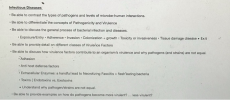
Infectious Diseases • Be able to contrast the types of pathogens and levels of microbe-human interactions - Be able to differentiate the concepts of Pathogenicity and Virulence • Be able to discuss the general process of bacterial infection and diseases. • Exposure/Entry . Adherence Invasion Colonization + growth. Toxicity or invasiveness. Tissue damage disease • Exit • Be able to provide detail on different classes of Virulence Factors . Be able to discuss how...
please help in all sections asap!!
Infectious Diseases • Be able to contrast the types of pathogens and levels of microbe-human interactions - Be able to differentiate the concepts of Pathogenicity and Virulence • Be able to discuss the general process of bacterial infection and diseases. • Exposure/Entry . Adherence Invasion Colonization + growth. Toxicity or invasiveness. Tissue damage disease • Exit • Be able to provide detail on different classes of Virulence Factors . Be able to discuss how...
Directions: Short answer questions. 10 points each. 1. List major types of infetious agents. (IILC.I) 2....
 Directions: Short answer questions. 10 points each. 1. List major types of infetious agents. (IILC.I) 2. Describe the infection cycle including: a. the infectious agent b. reservoir c susceptible host d. means of transmission e. portals of entry f portals of exit. (III.C2) 3. Define the following as practiced within an ambulatory care setting: a medical asepsis, b surgical asepsis. (IIC.3) 4. Identify methods of controlling the growth microorganisms. (IILC.4) 5. Define the principles of standard precautions. (IIL.C.5) 6. Define...
1. If you suspect someone is having a heart attack: a. Offer 1 baby aspirin b....
1. If you suspect someone is having a heart attack: a. Offer 1 baby aspirin b. Drive them to the hospital c. Call 911 d. All of the above 2. Which of the following refers to an approach to infection control in which all human blood and certain body fluids are treated as if they are infected with bloodborne pathogens? a. Work practice controls b. Standard precautions c. Regulated waste d. Exposure incident 3. While performing CPR by yourself on...
. Define hormone . Describe paracrine communication. Identify four mechanisms of intercellular communication. List t...
 . Define hormone . Describe paracrine communication. Identify four mechanisms of intercellular communication. List the three types of hormones based on their chemical structure. Provide examples of each type Describe the process of hormones that communicate with the plasma membrane receptors. . What primary factor determines each cell's hormonal sensitivities? . Identify the two lobes of the pituitary gland. How do they differ structurally and functionally? . List and discuss the functions of the 9 pituitary hormones Describe the feedback...
Suppose there are 2 routers in sequence between Host A and Host B, all of which...
Suppose there are 2 routers in sequence between Host A and Host B, all of which use store-and-forward routing. What is the total end-to-end delay for a packet originating from Host A with destination Host B, under the following conditions. Each of the link transmission rates are 3.7 Mbps The total distance from Host A to Host B along its path of transmisison is 171.6 km The speed of propagation through the transmission medium is is 2.7 x 10⁸ m/s...
 Immune system 1.The against pathogens that are general, and not targeted at specific pathogens immune system includes the skin and defenses . The immune system that attack specific pathogens, like antibodies and the cells that produce them immune system includes the parts of the 3. The white blood cells are made in the 4. The lymph flows through cells of the immune system can accumulate to fight a local infection where white blood 5. Blood flows into, through and out...
 Immune system 1.The against pathogens that are general, and not targeted at specific pathogens immune system includes the skin and defenses . The immune system that attack specific pathogens, like antibodies and the cells that produce them immune system includes the parts of the 3. The white blood cells are made in the 4. The lymph flows through cells of the immune system can accumulate to fight a local infection where white blood 5. Blood flows into, through and out...
 immunology
1. List and explain a minimum of four different defense mechanisms at the cellular levels? components of the human immune system and how what role did pathogens played in their evolution. 3. Explain the following statement "Immune system co-evolves with pathogens". 4. Provide an argument in favor and against the use of primates as a model system to study the immune system. Justify your answer with the use of appropriate example 5. Provide two examples pertaining to the evolution...
immunology
1. List and explain a minimum of four different defense mechanisms at the cellular levels? components of the human immune system and how what role did pathogens played in their evolution. 3. Explain the following statement "Immune system co-evolves with pathogens". 4. Provide an argument in favor and against the use of primates as a model system to study the immune system. Justify your answer with the use of appropriate example 5. Provide two examples pertaining to the evolution...
 22. (2 pts) The following step(s) occur in replication of both Bdellovibrio and a lytic virus such as T4, pathogens of E. coli. A. The genetic material of the pathogen is injected into the host cell B. The pathogen carbohydrates in the host to replicate itself. uses C. The host cell lyses, releasing the replicated pathogen D. The host cell DNA polymerase replicates the pathogen genome. 23. (2 pts) Phage are composed of nucleic acid and protein. Which of the...
 please help in all sections asap!!
Infectious Diseases • Be able to contrast the types of pathogens and levels of microbe-human interactions - Be able to differentiate the concepts of Pathogenicity and Virulence • Be able to discuss the general process of bacterial infection and diseases. • Exposure/Entry . Adherence Invasion Colonization + growth. Toxicity or invasiveness. Tissue damage disease • Exit • Be able to provide detail on different classes of Virulence Factors . Be able to discuss how...
please help in all sections asap!!
Infectious Diseases • Be able to contrast the types of pathogens and levels of microbe-human interactions - Be able to differentiate the concepts of Pathogenicity and Virulence • Be able to discuss the general process of bacterial infection and diseases. • Exposure/Entry . Adherence Invasion Colonization + growth. Toxicity or invasiveness. Tissue damage disease • Exit • Be able to provide detail on different classes of Virulence Factors . Be able to discuss how...
 Directions: Short answer questions. 10 points each. 1. List major types of infetious agents. (IILC.I) 2. Describe the infection cycle including: a. the infectious agent b. reservoir c susceptible host d. means of transmission e. portals of entry f portals of exit. (III.C2) 3. Define the following as practiced within an ambulatory care setting: a medical asepsis, b surgical asepsis. (IIC.3) 4. Identify methods of controlling the growth microorganisms. (IILC.4) 5. Define the principles of standard precautions. (IIL.C.5) 6. Define...
 . Define hormone . Describe paracrine communication. Identify four mechanisms of intercellular communication. List the three types of hormones based on their chemical structure. Provide examples of each type Describe the process of hormones that communicate with the plasma membrane receptors. . What primary factor determines each cell's hormonal sensitivities? . Identify the two lobes of the pituitary gland. How do they differ structurally and functionally? . List and discuss the functions of the 9 pituitary hormones Describe the feedback...
Most questions answered within 3 hours.
-
Where is the error in this code sequence?
String s1 = "Hello";
String s2 = "ello";...
asked 10 months ago -
Financial data for Joel de Paris, Inc., for last year
follow:
Joel de Paris, Inc.
Balance...
asked 10 months ago -
Consider this reaction:
Al2(SO4)3 (aq)+ BaCl3
(aq) Al2Cl6 (aq)- +
3BaSO4(s) . What is the...
asked 10 months ago -
Suppose that Savneet is considering increasing her
recent random sample from 20 car rentals to 40...
asked 10 months ago -
Trucks arrive at an unloading terminal at an average rate of 120
per hour.
Trucks arrive...
asked 10 months ago -
Why are methanol and ethanol completely soluble in water while
octanol is not very little soluble....
asked 10 months ago -
A facilities manager at a university reads in a research report
that the mean amount of...
asked 10 months ago -
When the CuSO4 is rehydrated by adding water to the anhydrous
compound, is this an endothermic...
asked 10 months ago -
A ray of sunlight is passing from diamond into crown glass; the
angle of incidence is...
asked 10 months ago -
A block of mass 0.249 kg is placed on top of a light, vertical
spring of...
asked 10 months ago -
how do the kidneys compensate in the presences of acidosis
a) trigger hyperventilate
b) reserve acid...
asked 10 months ago -
Question 501 pts
The rental rate of capital to the firm increases. Which of the
following...
asked 10 months ago