A ball thrown up from a rooftop of height 40.0 m lands on the ground in...
A ball thrown up from a rooftop of height 40.0 m lands on the ground in 4.10 s. (a) What is the balls maximum height above the ground? (b) What is its velocity 15.0 m below the rooftop?
Homework Answers

Add Answer to:
A ball thrown up from a rooftop of height 40.0 m lands on the
ground in...
A ball thrown up from a rooftop of height 40.0m lands on the ground in 4.10s....
A ball thrown up from a rooftop of height 40.0m lands on the ground in 4.10s. (a) What is the balls maximum height above the ground? (b) What is its velocity 15.0m below the rooftop? Please use the basic free fall formula to solve this question. thank you.
(1 point) A ball is thrown at 35A below the horizontal from a rooftop of height...
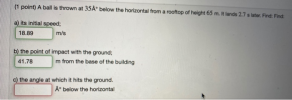 (1 point) A ball is thrown at 35A below the horizontal from a rooftop of height 65 m. It lands 2.7 s later. Find: Find a) its initial speed; 18.89 m/s b) the point of impact with the ground; 41.78 m from the base of the building c) the angle at which it hits the ground. Å below the horizontal
You throw a ball straight up from a rooftop. The ball misses the rooftop and eventually strikes the ground A ma...
 You throw a ball straight up from a rooftop. The ball misses the rooftop and eventually strikes the ground A mathematical model can be used to describe the relationship for the ball's height above the ground, y. after x seconds. x, seconds after the ball is y, ball's height, in feet, above the ground 289 271 214 on its way down thrown 3 4 2 a. Find the quadratic function y= - ax +bx + c whose graph passes through...
A ball is thrown from the ground onto a roof of height yroof 16 m from...
 A ball is thrown from the ground onto a roof of height yroof 16 m from a distance of x 7 meters away as shown in the diagram to the left. The maximum height of the ball's trajectory is ymax 3.2 meters above the top of the roof. Standard Exercise Roof Toss Standard Exercse Cliff Toss 1) Find the required initial vertical component of the velocity, V vy 0 m/s Submit Help 2) Find the time for the ball to...
A ball is thrown from a rooftop with an initial downward velocity of magnitude v0 = 1.1 m/s. The rooftop is a distance above the ground, h = 46 m.
 A ball is thrown from a rooftop with an initial downward velocity of magnitude v0 = 1.1 m/s. The rooftop is a distance above the ground, h = 46 m. In this problem use a coordinate system in which upwards is positive. Part (a) Find the vertical component of the velocity, Vfy, in meters per second, with which the ball hits the ground. Part (b) If we wanted the ball's final speed to be exactly 27.3 m/s from what height, hnew (in...
A blue ball is thrown upward with an initial speed of 22.8 m/s, from a height...
A blue ball is thrown upward with an initial speed of 22.8 m/s, from a height of 0.6 meters above the ground. 2.8 seconds after the blue ball is thrown, a red ball is thrown down with an initial speed of 7.7 m/s from a height of 28.2 meters above the ground. The force of gravity due to the earth results in the balls each having a constant downward acceleration of 9.81 m/s2. ) What is the speed of the...
Two throw A blue ball is thrown upward with an initial speed of 22.2 m/s, from...
 Two throw
A blue ball is thrown upward with an initial speed of 22.2 m/s, from a height of 0.8 meters above the ground. 2.7 seconds after the blue ball is thrown, a red ball is thrown down with an initial speed of 9.2 m/s from a height of 27.8 meters above the ground. The force of grandly due to the earth results in the balls each having a constant downward acceleration of 9.81 m/s^2. What is the speed of...
Two throw
A blue ball is thrown upward with an initial speed of 22.2 m/s, from a height of 0.8 meters above the ground. 2.7 seconds after the blue ball is thrown, a red ball is thrown down with an initial speed of 9.2 m/s from a height of 27.8 meters above the ground. The force of grandly due to the earth results in the balls each having a constant downward acceleration of 9.81 m/s^2. What is the speed of...
5) Ball A is thrown up from the ground at 25.0 m/s and ball B is...
5) Ball A is thrown up from the ground at 25.0 m/s and ball B is thrown down at 15.0 m/s 1.00 s later from a roof of height 95.0 m. (a) Where and when do they meet? (b) What are their velocities when they meet?
A ball is thrown from an initial height of 3.2 m above the ground. Its initial...
A ball is thrown from an initial height of 3.2 m above the ground. Its initial velocity is 6.5 m/s at an angle of 22◦ above the horizontal. (a) How much time does the ball spend in the air? (b) How much time does it take for the ball to reach its maximum height? Take g = 9.81 m/s2
An object has an initial velocity of 40.0 m/s and is thrown horizontally at a height...
An object has an initial velocity of 40.0 m/s and is thrown horizontally at a height of 10 m. How long does it take to land on the ground? An object has an initial velocity of 40.0 m/s and is thrown horizontally off of a building with a height of 10 m. What is the distance from the object to the building when it lands? (How far from the building is the object?) A person kicks a football at an...
 (1 point) A ball is thrown at 35A below the horizontal from a rooftop of height 65 m. It lands 2.7 s later. Find: Find a) its initial speed; 18.89 m/s b) the point of impact with the ground; 41.78 m from the base of the building c) the angle at which it hits the ground. Å below the horizontal
 You throw a ball straight up from a rooftop. The ball misses the rooftop and eventually strikes the ground A mathematical model can be used to describe the relationship for the ball's height above the ground, y. after x seconds. x, seconds after the ball is y, ball's height, in feet, above the ground 289 271 214 on its way down thrown 3 4 2 a. Find the quadratic function y= - ax +bx + c whose graph passes through...
 A ball is thrown from the ground onto a roof of height yroof 16 m from a distance of x 7 meters away as shown in the diagram to the left. The maximum height of the ball's trajectory is ymax 3.2 meters above the top of the roof. Standard Exercise Roof Toss Standard Exercse Cliff Toss 1) Find the required initial vertical component of the velocity, V vy 0 m/s Submit Help 2) Find the time for the ball to...
 Two throw
A blue ball is thrown upward with an initial speed of 22.2 m/s, from a height of 0.8 meters above the ground. 2.7 seconds after the blue ball is thrown, a red ball is thrown down with an initial speed of 9.2 m/s from a height of 27.8 meters above the ground. The force of grandly due to the earth results in the balls each having a constant downward acceleration of 9.81 m/s^2. What is the speed of...
Two throw
A blue ball is thrown upward with an initial speed of 22.2 m/s, from a height of 0.8 meters above the ground. 2.7 seconds after the blue ball is thrown, a red ball is thrown down with an initial speed of 9.2 m/s from a height of 27.8 meters above the ground. The force of grandly due to the earth results in the balls each having a constant downward acceleration of 9.81 m/s^2. What is the speed of...
Most questions answered within 3 hours.
-
Where is the error in this code sequence?
String s1 = "Hello";
String s2 = "ello";...
asked 11 months ago -
Financial data for Joel de Paris, Inc., for last year
follow:
Joel de Paris, Inc.
Balance...
asked 11 months ago -
Consider this reaction:
Al2(SO4)3 (aq)+ BaCl3
(aq) Al2Cl6 (aq)- +
3BaSO4(s) . What is the...
asked 11 months ago -
Suppose that Savneet is considering increasing her
recent random sample from 20 car rentals to 40...
asked 11 months ago -
Trucks arrive at an unloading terminal at an average rate of 120
per hour.
Trucks arrive...
asked 11 months ago -
Why are methanol and ethanol completely soluble in water while
octanol is not very little soluble....
asked 11 months ago -
A facilities manager at a university reads in a research report
that the mean amount of...
asked 11 months ago -
When the CuSO4 is rehydrated by adding water to the anhydrous
compound, is this an endothermic...
asked 11 months ago -
A ray of sunlight is passing from diamond into crown glass; the
angle of incidence is...
asked 11 months ago -
A block of mass 0.249 kg is placed on top of a light, vertical
spring of...
asked 11 months ago -
how do the kidneys compensate in the presences of acidosis
a) trigger hyperventilate
b) reserve acid...
asked 11 months ago -
Question 501 pts
The rental rate of capital to the firm increases. Which of the
following...
asked 11 months ago