A ball is thrown from a rooftop with an initial downward velocity of magnitude v0 = 1.1 m/s. The rooftop is a distance above the ground, h = 46 m.
A ball is thrown from a rooftop with an initial downward velocity of magnitude v0 = 1.1 m/s. The rooftop is a distance above the ground, h = 46 m. In this problem use a coordinate system in which upwards is positive.
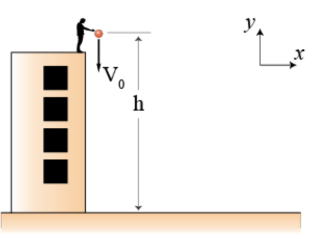
Part (a) Find the vertical component of the velocity, Vfy, in meters per second, with which the ball hits the ground.
Part (b) If we wanted the ball's final speed to be exactly 27.3 m/s from what height, hnew (in meters), would we need to throw it with the same initial velocity?
Part (c) If the height is fixed at 46 m, but we wanted the ball's final speed to be 32.7 m/s, what would the vertical component of the initial velocity viy need to be, in meters per second?
Homework Answers

Add Answer to:
A ball is thrown from a rooftop with an initial downward velocity of magnitude v0 = 1.1 m/s. The rooftop is a distance above the ground, h = 46 m.
A ball is thrown from the ground onto a roof of height yroof 16 m from...
 A ball is thrown from the ground onto a roof of height yroof 16 m from a distance of x 7 meters away as shown in the diagram to the left. The maximum height of the ball's trajectory is ymax 3.2 meters above the top of the roof. Standard Exercise Roof Toss Standard Exercse Cliff Toss 1) Find the required initial vertical component of the velocity, V vy 0 m/s Submit Help 2) Find the time for the ball to...
A ball is thrown vertically upwards with an initial velocity of 18.80 m/s, from the ground....
 A ball is thrown vertically upwards with an initial velocity of 18.80 m/s, from the ground. How long is the ball in the air? (Neglect air resistance.) What is the greatest height reached by the ball? Calculate the time at which the ascending ball reaches a height of 12.8 m above the ground. A rocket, initially at rest on the ground, accelerates straight upward with a constant acceleration of 53.0 m/s^2, until the fuel is used up after 6.80s. What...
A ball thrown up from a rooftop of height 40.0 m lands on the ground in...
A ball thrown up from a rooftop of height 40.0 m lands on the ground in 4.10 s. (a) What is the balls maximum height above the ground? (b) What is its velocity 15.0 m below the rooftop?
A ball is thrown from a point 1.0 m above the ground. The initial velocity is...
A ball is thrown from a point 1.0 m above the ground. The initial velocity is 20.5 m/s at an angle of 25.0° above the horizontal. (a) Find the maximum height of the ball above the ground. m (b) Calculate the speed of the ball at the highest point in the trajectory. m/s
A ball is kicked at ground level with an initial velocity of 18 m/s m the...
 A ball is kicked at ground level with an initial velocity of 18 m/s m the horizontal direction and 11 m/s in the vertical direction. At what speed doer the hall hit the pound in m/s? For how long does the ball remain in the air in seconds? What maximum height is attained by the ball in meters?
A baseball is thrown at an angle = 21° above the horizontal with an initial vertical velocity v0y = 9.75 m/s
 A baseball is thrown at an angle = 21° above the horizontal with an initial vertical velocity v0y = 9.75 m/s. Use a Cartesian coordinate system with the origin at the baseball's initial position.Part (a) Create an expression for the ball's initial horizontal velocity component, v0x, in terms of v0y, sin(θ), and cos(θ).Part (b) Calculate the initial horizontal velocity component, v0x in m/s. Part (c) Find the ball's initial velocity magnitude, v0 in m/s.
A ball is thrown horizontally from the top of a 95 m building and lands 110 m from the base of the building.
A ball is thrown horizontally from the top of a 95 m building and lands 110 m from the base of the building. Ignore air resistance, and use a coordinate system whose origin is at the top of the building, with positive y upwards and positive x in the direction of the throw. Part (a) How long is the ball in the air in seconds? Part (b) what must have been the initial horizontal component of the velocity, in meters per second? Part(c)...
A ball is thrown straight up into the air from the ground with initial velocity v0=...
A ball is thrown straight up into the air from the ground with initial velocity v0= 4 m/s, it reaches its apex and falls back down. Neglecting air resistance, how long does it take the ball to return to the ground?
Explore A baseball is thrown from the top of a tall building with an initial velocity...
Explore A baseball is thrown from the top of a tall building with an initial velocity of 10 m/s from a height of h= 11.5 m above the ground. Find its speed when it reaches the ground (a) if its launch angle is 37°, and (b) if it is launched horizontally. Conceptualize As the baseball moves upward and to the right, the force of gravity accelerates it downward. The vertical component of its velocity decreases in magnitude until the baseball...
A rocket is fired at an initial speed v0 = 141.0 m/s from ground level, at...
A rocket is fired at an initial speed v0 = 141.0 m/s from ground level, at an angle θ = 33 degrees above the horizontal. Ignore air resistance. The magnitude of the gravitational acceleration is 9.8 m/s2. Choose the RIGHT as positive x-direction. Choose UPWARD as psotitive y-direction. Keep 2 decimal places in all answers (a) Find v0x, the x component of the initial velocity (in m/s) (b) Find v0y, the y component of the initial velocity (in m/s) (c)...
 A ball is thrown from the ground onto a roof of height yroof 16 m from a distance of x 7 meters away as shown in the diagram to the left. The maximum height of the ball's trajectory is ymax 3.2 meters above the top of the roof. Standard Exercise Roof Toss Standard Exercse Cliff Toss 1) Find the required initial vertical component of the velocity, V vy 0 m/s Submit Help 2) Find the time for the ball to...
 A ball is thrown vertically upwards with an initial velocity of 18.80 m/s, from the ground. How long is the ball in the air? (Neglect air resistance.) What is the greatest height reached by the ball? Calculate the time at which the ascending ball reaches a height of 12.8 m above the ground. A rocket, initially at rest on the ground, accelerates straight upward with a constant acceleration of 53.0 m/s^2, until the fuel is used up after 6.80s. What...
 A ball is kicked at ground level with an initial velocity of 18 m/s m the horizontal direction and 11 m/s in the vertical direction. At what speed doer the hall hit the pound in m/s? For how long does the ball remain in the air in seconds? What maximum height is attained by the ball in meters?
Most questions answered within 3 hours.
-
Where is the error in this code sequence?
String s1 = "Hello";
String s2 = "ello";...
asked 10 months ago -
Financial data for Joel de Paris, Inc., for last year
follow:
Joel de Paris, Inc.
Balance...
asked 10 months ago -
Consider this reaction:
Al2(SO4)3 (aq)+ BaCl3
(aq) Al2Cl6 (aq)- +
3BaSO4(s) . What is the...
asked 10 months ago -
Suppose that Savneet is considering increasing her
recent random sample from 20 car rentals to 40...
asked 10 months ago -
Trucks arrive at an unloading terminal at an average rate of 120
per hour.
Trucks arrive...
asked 10 months ago -
Why are methanol and ethanol completely soluble in water while
octanol is not very little soluble....
asked 10 months ago -
A facilities manager at a university reads in a research report
that the mean amount of...
asked 10 months ago -
When the CuSO4 is rehydrated by adding water to the anhydrous
compound, is this an endothermic...
asked 10 months ago -
A ray of sunlight is passing from diamond into crown glass; the
angle of incidence is...
asked 10 months ago -
A block of mass 0.249 kg is placed on top of a light, vertical
spring of...
asked 10 months ago -
how do the kidneys compensate in the presences of acidosis
a) trigger hyperventilate
b) reserve acid...
asked 10 months ago -
Question 501 pts
The rental rate of capital to the firm increases. Which of the
following...
asked 10 months ago