Draw the extended structure of the peptide LFIKQMTS, label the residue at the N-terminus and C-terminus....
Draw the extended structure of the peptide LFIKQMTS, label the residue at the N-terminus and C-terminus. Show the full name and three letter abbreviations of each amino acid. Estimate the approximate pI of the peptide. What is the net charge of the peptide at pH 2.0 and pH 7.5?
I just need help with calculating the pI because I am not sure that I am doing it correctly. Thank you!
Homework Answers

Add Answer to:
Draw the extended structure of the peptide LFIKQMTS, label the
residue at the N-terminus and C-terminus....
The following structure is drawn in an unconventional manner. a. Label the N terminus and the...
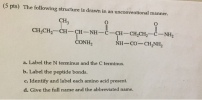 The following structure is drawn in an unconventional manner. a. Label the N terminus and the C terminus. b. Label the peptide bonds. c. Identify and label each amino acid present. d. Give the full name and the abbreviated name.
Draw the structure of the dipeptide Lys-Glu at pH 7.0. Label the following: a) Peptide bond...
 Draw the structure of the dipeptide Lys-Glu at pH 7.0. Label the
following:
a) Peptide bond
b) N-terminus
c) C-terminus
d) An α-amino group and an ε-amino group
e) An α-carboxylate group and a Y-carboxylate group
Draw the structure of the dipeptide Lys-Glu at pH 7.0. Label the following: (a). peptide bond, (b). N-terminus, (c). C-terminus, (d). an a-amino group and an e-amino group, (e), an α-carboxylate group and a -carboxylate group.
Draw the structure of the dipeptide Lys-Glu at pH 7.0. Label the
following:
a) Peptide bond
b) N-terminus
c) C-terminus
d) An α-amino group and an ε-amino group
e) An α-carboxylate group and a Y-carboxylate group
Draw the structure of the dipeptide Lys-Glu at pH 7.0. Label the following: (a). peptide bond, (b). N-terminus, (c). C-terminus, (d). an a-amino group and an e-amino group, (e), an α-carboxylate group and a -carboxylate group.
1. Draw the dipeptide His-Gly at pH 7.4. 2. Label the amino terminus, the carboxy terminus,...
1. Draw the dipeptide His-Gly at pH 7.4. 2. Label the amino terminus, the carboxy terminus, the two alpha carbons, and the peptide bond (1pt). 3. Calculate it’s net charge. 4. What is the net charge of this dipeptide at pH = 2? 5. List the levels of protein structure and the types of bonds/interactions that are characteristic of each level.
9 (a) In the box below, draw the dipeptide Phe-Arg at pH 7, with the N-terminus...
 9 (a) In the box below, draw the dipeptide Phe-Arg at pH 7, with the N-terminus at the left and the C-terminus on the right. 9 (b) Draw a single box around the three non-hydrogen atoms directly involved in the peptide bond. 9 (c) Label the Phi (φ) and Psi (ψ) torsion angles in your drawing. 9 (d) How many positive charges are on this dipeptide at pH 7? 9 (e) What is the total net charge at pH 7...
Can anyone confirm if these are correct? List and draw the structure(s) the amino acid(s) in...
 Can anyone confirm if these are correct?
List and draw the structure(s) the amino acid(s) in which would have a-1 net charge at pH? List the amino acid(s) in which would have a + 1 net charge at pH 7? Draw the structure- of the peptide Arg-Asp-His-Ser-Gly at pH 7. List the N-terminus and C-terminus. Make sure the amide bonds are 'trans'. Give the products of a trypsin digestion of the peptide: His-phe-lys-val-asp-asp-arg-val Draw the full structure of the predominant...
Can anyone confirm if these are correct?
List and draw the structure(s) the amino acid(s) in which would have a-1 net charge at pH? List the amino acid(s) in which would have a + 1 net charge at pH 7? Draw the structure- of the peptide Arg-Asp-His-Ser-Gly at pH 7. List the N-terminus and C-terminus. Make sure the amide bonds are 'trans'. Give the products of a trypsin digestion of the peptide: His-phe-lys-val-asp-asp-arg-val Draw the full structure of the predominant...
(a) Draw three different amino acid residues connected by two peptide bonds. (b) label each residue...
 (a) Draw three different amino acid residues connected by two peptide bonds. (b) label each residue (3-letter code is OK). (c) Note bonds that do not rotate with a star (d) Note bonds that do rotate with a semi-circle arrow, including those found in each side chain (e) Of the residues in your drawing, which one contributes most to the entropy of the polypeptide (assume an unfolded state)?
The tetrapeptide Ac-Asn-Met-Cys-Lys has its N-terminus blocked by acetylation. Its C-terminal pKa is 4.30. The side...
The tetrapeptide Ac-Asn-Met-Cys-Lys has its N-terminus blocked by acetylation. Its C-terminal pKa is 4.30. The side chain pKa’s are 7.8 and 10.4. a. Write this peptide sequence using single letter abbreviations. b. Draw its predominant chemical structure at pH 8.0, including charges. c. What fraction of the peptide will exist in the predominant form at pH 8.0? (Discount any species that represent less than 1% of all species.) d. Calculate the pI of the peptide. e. If this tetrapeptide is...
just complete 8-10 please coo CH3 CH2 H CH H H HN-c-c-N-C-C-N-C-C-N-C-Coo H OH OH OH...
 just complete 8-10 please
coo CH3 CH2 H CH H H HN-c-c-N-C-C-N-C-C-N-C-Coo H OH OH OH 1. How many amino acid residues are in this structure? 2. How many peptide bonds are in this structure? 3. What is the name of the C terminal residue? 4. What is the one-letter abbreviation of the N-terminal residue? 5. What is the sequence, given in three-letter code, of this peptide? 6. Circle one peptide bond. 7. Circle one alpha-carbon. 8. What is the...
just complete 8-10 please
coo CH3 CH2 H CH H H HN-c-c-N-C-C-N-C-C-N-C-Coo H OH OH OH 1. How many amino acid residues are in this structure? 2. How many peptide bonds are in this structure? 3. What is the name of the C terminal residue? 4. What is the one-letter abbreviation of the N-terminal residue? 5. What is the sequence, given in three-letter code, of this peptide? 6. Circle one peptide bond. 7. Circle one alpha-carbon. 8. What is the...
1. What amino acids do the following abbreviations stand for? Draw the structure of each. a)...
 1. What amino acids do the following abbreviations stand for? Draw the structure of each. a) lle b) Thr c) Gin 2. Name and draw the structures of the amino acids that fit these descriptions: a) Contains an isopropyl group b) Contains a secondary alcohol group 3. Which of the following objects is chiral? a) A pair of scissors b) A comb c) A drinking glass 4. What does the term achiral mean? Give two examples involving organic structures.. 5....
 The following structure is drawn in an unconventional manner. a. Label the N terminus and the C terminus. b. Label the peptide bonds. c. Identify and label each amino acid present. d. Give the full name and the abbreviated name.
 Draw the structure of the dipeptide Lys-Glu at pH 7.0. Label the
following:
a) Peptide bond
b) N-terminus
c) C-terminus
d) An α-amino group and an ε-amino group
e) An α-carboxylate group and a Y-carboxylate group
Draw the structure of the dipeptide Lys-Glu at pH 7.0. Label the following: (a). peptide bond, (b). N-terminus, (c). C-terminus, (d). an a-amino group and an e-amino group, (e), an α-carboxylate group and a -carboxylate group.
Draw the structure of the dipeptide Lys-Glu at pH 7.0. Label the
following:
a) Peptide bond
b) N-terminus
c) C-terminus
d) An α-amino group and an ε-amino group
e) An α-carboxylate group and a Y-carboxylate group
Draw the structure of the dipeptide Lys-Glu at pH 7.0. Label the following: (a). peptide bond, (b). N-terminus, (c). C-terminus, (d). an a-amino group and an e-amino group, (e), an α-carboxylate group and a -carboxylate group.
 9 (a) In the box below, draw the dipeptide Phe-Arg at pH 7, with the N-terminus at the left and the C-terminus on the right. 9 (b) Draw a single box around the three non-hydrogen atoms directly involved in the peptide bond. 9 (c) Label the Phi (φ) and Psi (ψ) torsion angles in your drawing. 9 (d) How many positive charges are on this dipeptide at pH 7? 9 (e) What is the total net charge at pH 7...
 Can anyone confirm if these are correct?
List and draw the structure(s) the amino acid(s) in which would have a-1 net charge at pH? List the amino acid(s) in which would have a + 1 net charge at pH 7? Draw the structure- of the peptide Arg-Asp-His-Ser-Gly at pH 7. List the N-terminus and C-terminus. Make sure the amide bonds are 'trans'. Give the products of a trypsin digestion of the peptide: His-phe-lys-val-asp-asp-arg-val Draw the full structure of the predominant...
Can anyone confirm if these are correct?
List and draw the structure(s) the amino acid(s) in which would have a-1 net charge at pH? List the amino acid(s) in which would have a + 1 net charge at pH 7? Draw the structure- of the peptide Arg-Asp-His-Ser-Gly at pH 7. List the N-terminus and C-terminus. Make sure the amide bonds are 'trans'. Give the products of a trypsin digestion of the peptide: His-phe-lys-val-asp-asp-arg-val Draw the full structure of the predominant...
 (a) Draw three different amino acid residues connected by two peptide bonds. (b) label each residue (3-letter code is OK). (c) Note bonds that do not rotate with a star (d) Note bonds that do rotate with a semi-circle arrow, including those found in each side chain (e) Of the residues in your drawing, which one contributes most to the entropy of the polypeptide (assume an unfolded state)?
 just complete 8-10 please
coo CH3 CH2 H CH H H HN-c-c-N-C-C-N-C-C-N-C-Coo H OH OH OH 1. How many amino acid residues are in this structure? 2. How many peptide bonds are in this structure? 3. What is the name of the C terminal residue? 4. What is the one-letter abbreviation of the N-terminal residue? 5. What is the sequence, given in three-letter code, of this peptide? 6. Circle one peptide bond. 7. Circle one alpha-carbon. 8. What is the...
just complete 8-10 please
coo CH3 CH2 H CH H H HN-c-c-N-C-C-N-C-C-N-C-Coo H OH OH OH 1. How many amino acid residues are in this structure? 2. How many peptide bonds are in this structure? 3. What is the name of the C terminal residue? 4. What is the one-letter abbreviation of the N-terminal residue? 5. What is the sequence, given in three-letter code, of this peptide? 6. Circle one peptide bond. 7. Circle one alpha-carbon. 8. What is the...
 1. What amino acids do the following abbreviations stand for? Draw the structure of each. a) lle b) Thr c) Gin 2. Name and draw the structures of the amino acids that fit these descriptions: a) Contains an isopropyl group b) Contains a secondary alcohol group 3. Which of the following objects is chiral? a) A pair of scissors b) A comb c) A drinking glass 4. What does the term achiral mean? Give two examples involving organic structures.. 5....
Most questions answered within 3 hours.
-
Where is the error in this code sequence?
String s1 = "Hello";
String s2 = "ello";...
asked 10 months ago -
Financial data for Joel de Paris, Inc., for last year
follow:
Joel de Paris, Inc.
Balance...
asked 10 months ago -
Consider this reaction:
Al2(SO4)3 (aq)+ BaCl3
(aq) Al2Cl6 (aq)- +
3BaSO4(s) . What is the...
asked 10 months ago -
Suppose that Savneet is considering increasing her
recent random sample from 20 car rentals to 40...
asked 10 months ago -
Trucks arrive at an unloading terminal at an average rate of 120
per hour.
Trucks arrive...
asked 10 months ago -
Why are methanol and ethanol completely soluble in water while
octanol is not very little soluble....
asked 10 months ago -
A facilities manager at a university reads in a research report
that the mean amount of...
asked 10 months ago -
When the CuSO4 is rehydrated by adding water to the anhydrous
compound, is this an endothermic...
asked 10 months ago -
A ray of sunlight is passing from diamond into crown glass; the
angle of incidence is...
asked 10 months ago -
A block of mass 0.249 kg is placed on top of a light, vertical
spring of...
asked 10 months ago -
how do the kidneys compensate in the presences of acidosis
a) trigger hyperventilate
b) reserve acid...
asked 10 months ago -
Question 501 pts
The rental rate of capital to the firm increases. Which of the
following...
asked 10 months ago