A sealed 89,98-m3 tank is filled with 5 265 moles of oxygen gas (O2) at an...
A sealed 89,98-m3 tank is filled with 5 265 moles of oxygen gas (O2) at an initial temperature of 293,38 K. The gas is heated to a final temperature of 397,1 K. The ATOMIC mass of oxygen is 16.0 g/mol, and the ideal gas constant is R = 8.314 J/mol · K = 0.0821 L · atm/mol · K. Calculate the initial pressure (MPa) of the gas. Answer in two decimal places.
Homework Answers
Ans: Given V = 89.98 m3, n = 5265
moles, T1 = 293.38 K, T2 = 397.1 K =>
 = 103.72 K
mO = 16 g/mol, R = 8.314 J/mol-K = 0.0821 L-atm/mol-K
By Ideal Gas Equation,

Therefore initial pressure is 0.14 MPa
Add Answer to:
A sealed 89,98-m3 tank is filled with 5 265 moles of oxygen gas
(O2) at an...
A sealed 33 m3 tank is filled with 3000 moles of ideal oxygen gas (diatomic) at...
A sealed 33 m3 tank is filled with 3000 moles of ideal oxygen gas (diatomic) at an initial temperature of 270 K. The gas is heated to a final temperature of 380 K. The atomic mass of oxygen is 16.0 g/mol. The initial pressure of the gas, in MPa, is closest to: 0.18 0.15 0.20 0.26 0.23
5. The figure shows a pV diagram for 4.3 g of oxygen gas (02) in a...
 5. The figure shows a pV diagram for 4.3 g of oxygen gas (02) in a sealed container. The temperature T1 of the gas in state 1 is 21°C. What are the temperatures T3 and T4 of the gas in states 3 and 4? The ideal gas constant is R 8.314 J/mol K 0.0821 L atm/mol K, and the ATOMIC weight of oxygen is 16 g/mol. 2 2.0 p1 15 P 4. 3 0.50 Vcm3) 150 100 50
1. What is the pressure of a 50.0L tank that contains 4.04kg of oxygen, O2, at...
 1. What is the pressure of a 50.0L tank that contains 4.04kg of oxygen, O2, at 23°C? Assume that the Ideal Gas Law is obeyed and use R=0.0821 L atm/mol K (Show ALL Work) 2. What is the pressure of a 50.0L tank that contains 4.04kg of oxygen, O2, at 40°C? Assume that the Ideal Gas Law is obeyed and use R = 0.0821 L atm/mol K (Show ALL Work)
A 30-m3 tank is filled with 3480 moles of an ideal gas. The temperature of the...
A 30-m3 tank is filled with 3480 moles of an ideal gas. The temperature of the gas is initially 305 K, but it is raised to 750 K. 1)What is the change in the pressure of the gas inside the tank?Pa 2)Let's assume that the tank is made out of a material which has a coefficient of linear expansion of 6.5 × 10⁻⁵ K-1, and that the temperature of the tank is always the same as the temperature of the...
Nitrate salts (NO3'), when heated, can produce nitrites (NO2) plus oxygen (O2). A sample of potassium...
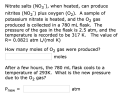 Nitrate salts (NO3'), when heated, can produce nitrites (NO2) plus oxygen (O2). A sample of potassium nitrate is heated, and the O2 gas produced is collected in a 780 mL flask. The pressure of the gas in the flask is 2.5 atm, and the temperature is recorded to be 317 K. The value of R= 0.0821 atm L/mol K) How many moles of O2 gas were produced? moles After a few hours, the 780 mL flask cools to a temperature...
The temperature of an ideal gas in a sealed 0,2-m3 rigid container is reduced from 340,5...
The temperature of an ideal gas in a sealed 0,2-m3 rigid container is reduced from 340,5 K to 288,2 K. The final pressure of the gas is 43,5 kPA. The molar heat capacity at constant volume of the gas is 29,39 J/mol · K. Calcukate the heat (kJ)absorbed by the gas. Answer in two decimal places.
Nitrate salts (NO3-), when heated, can produce nitrites (NO2-) plus oxygen (O2). A sample of pota...
Nitrate salts (NO3-), when heated, can produce nitrites (NO2-) plus oxygen (O2). A sample of potassium nitrate is heated, and the O2 gas produced is collected in a 780 mL flask. The pressure of the gas in the flask is 2.6 atm, and the temperature is recorded to be 323 K. The value of R= 0.0821 atm L/(mol K) How many moles of O2 gas were produced? _____moles After a few hours, the 780 mL flask cools to a temperature...
A tank is filled with 8.97 moles O2(g), 2.82 moles N2(g), and 2.3 moles of Ar,...
A tank is filled with 8.97 moles O2(g), 2.82 moles N2(g), and 2.3 moles of Ar, giving a final take pressure of 6.35 atm. What is the partial pressure of agron gas in the tank?
An ideal monatomic gas is contained in a vessel of constant volume 0.470 m3. The initial...
An ideal monatomic gas is contained in a vessel of constant volume 0.470 m3. The initial temperature and pressure of the gas are 300 K and 5.00 atm, respectively. The goal of this problem is to find the temperature and pressure of the gas after 30.0 kJ of thermal energy is supplied to the gas. (a) Use the ideal gas law and initial conditions to calculate the number of moles of gas in the vessel. mol (b) Find the specific...
A sealed container holds 0.020 moles of ideal nitrogen (N2) gas at a pressure of 1.5...
A sealed container holds 0.020 moles of ideal nitrogen (N2) gas at a pressure of 1.5 atmospheres and a temperature of 290 K. The atomic mass of nitrogen is 14.0 g/mol. What is the approximate quantity of heat, transferred at constant volume, that raises the temperature of the gas to 300 K, in SI units?
 5. The figure shows a pV diagram for 4.3 g of oxygen gas (02) in a sealed container. The temperature T1 of the gas in state 1 is 21°C. What are the temperatures T3 and T4 of the gas in states 3 and 4? The ideal gas constant is R 8.314 J/mol K 0.0821 L atm/mol K, and the ATOMIC weight of oxygen is 16 g/mol. 2 2.0 p1 15 P 4. 3 0.50 Vcm3) 150 100 50
 1. What is the pressure of a 50.0L tank that contains 4.04kg of oxygen, O2, at 23°C? Assume that the Ideal Gas Law is obeyed and use R=0.0821 L atm/mol K (Show ALL Work) 2. What is the pressure of a 50.0L tank that contains 4.04kg of oxygen, O2, at 40°C? Assume that the Ideal Gas Law is obeyed and use R = 0.0821 L atm/mol K (Show ALL Work)
 Nitrate salts (NO3'), when heated, can produce nitrites (NO2) plus oxygen (O2). A sample of potassium nitrate is heated, and the O2 gas produced is collected in a 780 mL flask. The pressure of the gas in the flask is 2.5 atm, and the temperature is recorded to be 317 K. The value of R= 0.0821 atm L/mol K) How many moles of O2 gas were produced? moles After a few hours, the 780 mL flask cools to a temperature...
Most questions answered within 3 hours.
-
Where is the error in this code sequence?
String s1 = "Hello";
String s2 = "ello";...
asked 11 months ago -
Financial data for Joel de Paris, Inc., for last year
follow:
Joel de Paris, Inc.
Balance...
asked 11 months ago -
Consider this reaction:
Al2(SO4)3 (aq)+ BaCl3
(aq) Al2Cl6 (aq)- +
3BaSO4(s) . What is the...
asked 11 months ago -
Suppose that Savneet is considering increasing her
recent random sample from 20 car rentals to 40...
asked 11 months ago -
Trucks arrive at an unloading terminal at an average rate of 120
per hour.
Trucks arrive...
asked 11 months ago -
Why are methanol and ethanol completely soluble in water while
octanol is not very little soluble....
asked 11 months ago -
A facilities manager at a university reads in a research report
that the mean amount of...
asked 11 months ago -
When the CuSO4 is rehydrated by adding water to the anhydrous
compound, is this an endothermic...
asked 11 months ago -
A ray of sunlight is passing from diamond into crown glass; the
angle of incidence is...
asked 11 months ago -
A block of mass 0.249 kg is placed on top of a light, vertical
spring of...
asked 11 months ago -
how do the kidneys compensate in the presences of acidosis
a) trigger hyperventilate
b) reserve acid...
asked 11 months ago -
Question 501 pts
The rental rate of capital to the firm increases. Which of the
following...
asked 11 months ago