
Homework Answers
Add Answer to:
Nitrate salts (NO3'), when heated, can produce nitrites (NO2) plus oxygen (O2). A sample of potassium...
Nitrate salts (NO3-), when heated, can produce nitrites (NO2-) plus oxygen (O2). A sample of pota...
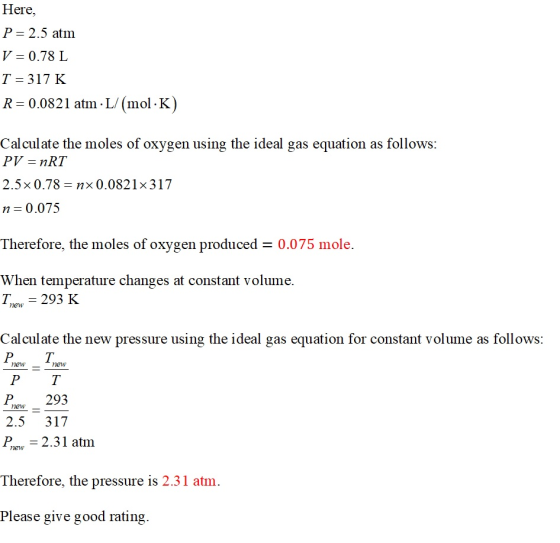
Nitrate salts (NO3-), when heated, can produce nitrites (NO2-) plus oxygen (O2). A sample of potassium nitrate is heated, and the O2 gas produced is collected in a 780 mL flask. The pressure of the gas in the flask is 2.6 atm, and the temperature is recorded to be 323 K. The value of R= 0.0821 atm L/(mol K) How many moles of O2 gas were produced? _____moles After a few hours, the 780 mL flask cools to a temperature...
missions | 1 Attempt Remaining Nitrate salts (NO 3 ), when heated, can produce nitrites (NO2)...
 missions | 1 Attempt Remaining Nitrate salts (NO 3 ), when heated, can produce nitrites (NO2) plus oxygen (O2). A sample of potassium nitrate is heated, and the O2 gas produced is collected in a 710 ml flask. The pressure of the gas in the flask is 2.6 atm, and the temperature is recorded to be 331 K. The value of R= 0.0821 atm (mol K) How many moles of O2 gas were produced? moles After a few hours, the...
(3) Potassium chlorate (KCIO3) is known to decompose into potassium chloride (KCl) and oxygen gas (O2)...
 (3) Potassium chlorate (KCIO3) is known to decompose into potassium chloride (KCl) and oxygen gas (O2) upon heating: 2KCIO3 → 2KCl + 302 Suppose 10.0g of potassium chlorate is heated to complete decomposition. What is the volume of oxygen gas produced at room temperature (25°C) and atmospheric pressure (1.00 atm)? {R = 0.0821 L'atm/K mol}
A sealed 89,98-m3 tank is filled with 5 265 moles of oxygen gas (O2) at an...
A sealed 89,98-m3 tank is filled with 5 265 moles of oxygen gas (O2) at an initial temperature of 293,38 K. The gas is heated to a final temperature of 397,1 K. The ATOMIC mass of oxygen is 16.0 g/mol, and the ideal gas constant is R = 8.314 J/mol · K = 0.0821 L · atm/mol · K. Calculate the initial pressure (MPa) of the gas. Answer in two decimal places.
A 3.10-g sample of lead nitrate, Pb(NO3)2, molar mass = 331 g/mol, is heated in an...
A 3.10-g sample of lead nitrate, Pb(NO3)2, molar mass = 331 g/mol, is heated in an evacuated cylinder with a volume of 2.00 L. The salt decomposes when heated, the unbalanced equation for the decomposition reaction is shown below: Pb(NO3)2(s) → PbO(s) + NO2(g) + O2(g) Assuming complete decomposition, what is the pressure in the cylinder after decomposition and cooling to a temperature of 303 K? Assume the PbO(s) takes up negligible volume.
When heated to 350 ∘C at 0.950 atm, ammonium nitrate decomposes to produce nitrogen, water, and...
When heated to 350 ∘C at 0.950 atm, ammonium nitrate decomposes to produce nitrogen, water, and oxygen gases: 2NH4NO3(s)→2N2(g)+4H2O(g)+O2(g) Part A How many liters of water vapor are produced when 25.7 g of NH4NO3 decomposes? Express your answer with the appropriate units. V = Part B How many grams of NH4NO3 are needed to produce 11.4 L of oxygen? Express your answer with the appropriate units. m = When solid CaCO3 is heated, it decomposes to give solid CaO and...
Potassium nitrate decomposes to potassium nitrite and oxygen. 2KNO3(s)→2KNO2(s)+O2(g) What volume, in liters, of O2 can...
Potassium nitrate decomposes to potassium nitrite and oxygen. 2KNO3(s)→2KNO2(s)+O2(g) What volume, in liters, of O2 can be produced from the decomposition of 58.0 g of KNO3 at 43 ∘C and 1.39 atm ? Express your answer with the appropriate units.
1.Potassium nitrate decomposes to potassium nitrite and oxygen. 2KNO3(s)→2KNO2(s)+O2(g) What volume, in liters, of O2 can...
1.Potassium nitrate decomposes to potassium nitrite and oxygen. 2KNO3(s)→2KNO2(s)+O2(g) What volume, in liters, of O2 can be produced from the decomposition of 54.0 g of KNO3 at 33 ∘C and 1.11 atm ? Express your answer with the appropriate units. 2,On a climb up Mt. Whitney, the atmospheric pressure drops to 507 mmHg . A.What is the pressure in atmospheres?Express the pressure in atmospheres to three significant figures. B.What is the pressure in torrs? Express the pressure in torrs to...
1. Silver oxide decomposes when heated: 2 Ag2O(s)4 Ag(s) + O2(g) If 5.76 g of Ag2O...
1. Silver oxide decomposes when heated: 2 Ag2O(s)4 Ag(s) + O2(g) If 5.76 g of Ag2O is heated and the O2 gas produced by the reaction is collected in an evacuated flask, what is the pressure of the O2 gas if the volume of the flask is 0.65 L and the gas temperature is 25 °C? (a) 0.94 atm (b) 0.039 atm (c) 0.012 atm (d) 0.47 atm (e) 3.2 atm 2. In the first step of the industrial process...
Nitrogen dioxide gas undergoes decomposition producing nitrogen monoxide and oxygen gases: 2 NO2(g)........ 2 NO(g) + O2...
Nitrogen dioxide gas undergoes decomposition producing nitrogen monoxide and oxygen gases: 2 NO2(g)........ 2 NO(g) + O2(g) A sample consisting of 0.10 moles of NO2 is placed in a 10.0 L in a container that is then heated to 750 K. When equilibrium is reached, the pressure in the container is 0.827 bar. Calculate the equilibrium constant and the degree of dissociation at this temperature. (Hint: pressures are directly proportional to concentration, so they can be used in ICE tables).
 missions | 1 Attempt Remaining Nitrate salts (NO 3 ), when heated, can produce nitrites (NO2) plus oxygen (O2). A sample of potassium nitrate is heated, and the O2 gas produced is collected in a 710 ml flask. The pressure of the gas in the flask is 2.6 atm, and the temperature is recorded to be 331 K. The value of R= 0.0821 atm (mol K) How many moles of O2 gas were produced? moles After a few hours, the...
 (3) Potassium chlorate (KCIO3) is known to decompose into potassium chloride (KCl) and oxygen gas (O2) upon heating: 2KCIO3 → 2KCl + 302 Suppose 10.0g of potassium chlorate is heated to complete decomposition. What is the volume of oxygen gas produced at room temperature (25°C) and atmospheric pressure (1.00 atm)? {R = 0.0821 L'atm/K mol}
Most questions answered within 3 hours.
-
Where is the error in this code sequence?
String s1 = "Hello";
String s2 = "ello";...
asked 10 months ago -
Financial data for Joel de Paris, Inc., for last year
follow:
Joel de Paris, Inc.
Balance...
asked 10 months ago -
Consider this reaction:
Al2(SO4)3 (aq)+ BaCl3
(aq) Al2Cl6 (aq)- +
3BaSO4(s) . What is the...
asked 10 months ago -
Suppose that Savneet is considering increasing her
recent random sample from 20 car rentals to 40...
asked 10 months ago -
Trucks arrive at an unloading terminal at an average rate of 120
per hour.
Trucks arrive...
asked 10 months ago -
Why are methanol and ethanol completely soluble in water while
octanol is not very little soluble....
asked 10 months ago -
A facilities manager at a university reads in a research report
that the mean amount of...
asked 10 months ago -
When the CuSO4 is rehydrated by adding water to the anhydrous
compound, is this an endothermic...
asked 10 months ago -
A ray of sunlight is passing from diamond into crown glass; the
angle of incidence is...
asked 10 months ago -
A block of mass 0.249 kg is placed on top of a light, vertical
spring of...
asked 10 months ago -
how do the kidneys compensate in the presences of acidosis
a) trigger hyperventilate
b) reserve acid...
asked 10 months ago -
Question 501 pts
The rental rate of capital to the firm increases. Which of the
following...
asked 10 months ago