An NBA player is receiving $15 million at the end of each of the next seven...
An NBA player is receiving $15 million at the end of each of the next seven years. He can earn 6 percent per year on his investments. What is the present value of his future revenues?
Use the FV function to determine the value to which $100 accumulates in three years, if you are earning 7 percent per year.
USE EXCEL
Homework Answers
An NBA player is receiving $15 million at the end of each of the next seven years. He can earn 6 percent per year on his investments. What is the present value of his future revenues?
Here is how the FV function works
FV( interest_rate, number_payments, payment, [PV], [Type] )
In our case -
interest_rate = 6
number_of_payments=7
payment = 15,00,0000
[PV] = 0 because we don't have an initial deposit amount
[Type] = will be 0 because we are finding the interest at the end of each year and not at the beginning
=FV(6%,7,-15000000,0,0)
will return value :
| $125,907,564.75 |
___________________________________________________________________________________________________
Use the FV function to determine the value to which $100 accumulates in three years if you are earning 7 percent per year.
In our case -
interest_rate = 7
number_of_payments=0
payment = 0
[PV] = 100 because we don't have an initial deposit amount
[Type] = will be 0 because we are finding the interest at the end of each year and not at the beginning
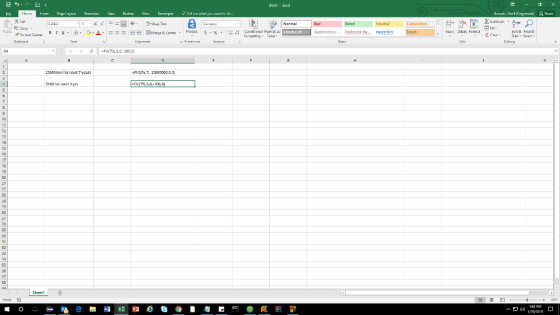
=FV(7%,3,0,-100,0)
will return value:
| $122.50 |
Here is the screenshot of the formulae
Thank you !
Add Answer to:
An NBA player is receiving $15 million at the end of each of the
next seven...
Please show formula to find the answer 1) You have just won the lottery. At the...
 Please show formula to find the answer
1) You have just won the lottery. At the end of each of the next 20 years, you will receive a payment of $50,000. If the cost of capital is 10 percent per year, what is the present value of your lottery winnings? 50,000 Cost of Capital Payment Term Rate 20 10% 0 2) A perpetuity is an annuity that is received forever. If I rent my house and at the beginning of...
Please show formula to find the answer
1) You have just won the lottery. At the end of each of the next 20 years, you will receive a payment of $50,000. If the cost of capital is 10 percent per year, what is the present value of your lottery winnings? 50,000 Cost of Capital Payment Term Rate 20 10% 0 2) A perpetuity is an annuity that is received forever. If I rent my house and at the beginning of...
An investment will pay $100 at the end of each of the next 3 years, $200...
An investment will pay $100 at the end of each of the next 3 years, $200 at the end of Year 4, $400 at the end of Year 5, and $500 at the end of Year 6. If other investments of equal risk earn 8% annually, what is its present value? Its future value? Do not round intermediate calculations. Round your answers to the nearest cent. Present value: $ Future value: $
An investment will pay $100 at the end of each of the next 3 years, $200...
An investment will pay $100 at the end of each of the next 3 years, $200 at the end of Year 4, $300 at the end of Year 5, and $500 at the end of Year 6. If other investments of equal risk earn 9% annually, what is this investment's present value? Its future value? Do not round intermediate calculations. Round your answers to the nearest cent. Present Value ? Future Value?
The question is: An investment will pay $100 at the end of each of the next...
The question is: An investment will pay $100 at the end of each of the next 3 years, $200 at the end of Year 4, $300 at the end of Year 5, and $600 at the end of Year 6. 1. If other investments of equal risk earn 6% annually, what is its present value? Round your answer to the nearest cent. 2. If other investments of equal risk earn 6% annually, what is its future value? Round your answer...
eBook An investment will pay $100 at the end of each of the next 3 years,...
 eBook An investment will pay $100 at the end of each of the next 3 years, $200 at the end of Year 4, $350 at the end of Year 5, and $500 at the end of Year 6. If other investments of equal risk earn 8% annually, what is its present value? Its future value? Do not round intermediate calculations. Round your answers to the nearest cent. Present value: Future value:
O'Reilly is a masterful lottery player. The megamillion jackpot is now up to $200 million. If...
 O'Reilly is a masterful lottery player. The megamillion jackpot is now up to $200 million. If O'Reilly wins the jackpot, he has a choice of receiving $200 million in five years or a smaller lump sum now. Advise O'Reilly on his choice under the following scenarios. Which option should he take and why? Use Exhibit 31. a. O'Reilly's after-tax return is 10 percent. If he chooses the current lump-sum option, the lottery will pay him $130 million b. O'Reilly's after-tax...
Juan just won $2.5 million in the state lottery. He is given the option of receiving...
Juan just won $2.5 million in the state lottery. He is given the option of receiving a total of $1.3 million now, or he can elect to be paid $100,000 at the end of each of the next 25 years. If Juan can earn 5% annually on his investments, from a strict economic point of view, which option should he take? Explain why.
Juan just won $2.5 million in the state lottery. He is given the option of receiving...
Juan just won $2.5 million in the state lottery. He is given the option of receiving a total of $1.3 million now, or he can elect to be paid $100,000 at the end of each of the next 25 years. If Juan can earn 5% annually on his investments, from a strict economic point of view, which option should he take? Explain why.
O'Reilly is a masterful lottery player. The megamillion jackpot is now up to $200 million. If...
 O'Reilly is a masterful lottery player. The megamillion jackpot is now up to $200 million. If O'Reilly wins the jackpot, he has a choice of receiving $200 million in five years or a smaller lump sum now. Advise O'Reilly on his choice under the following scenarios. Which option should he take and why? Use Exhibit 31. a. O'Reilly's after-tax return is 10 percent. If he chooses the current lump-sum option, the lottery will pay him $130 million b. O'Reilly's after-tax...
An investment will pay $100 at the end of each of the next 3 years, $250...
An investment will pay $100 at the end of each of the next 3 years, $250 at the end of Year 4, $350 at the end of Year 5, and $500 at the end of Year 6. If other investments of equal risk earn 11% annually, what is its present value? Its future value? Do not round intermediate calculations. Round your answers to the nearest cent.
 Please show formula to find the answer
1) You have just won the lottery. At the end of each of the next 20 years, you will receive a payment of $50,000. If the cost of capital is 10 percent per year, what is the present value of your lottery winnings? 50,000 Cost of Capital Payment Term Rate 20 10% 0 2) A perpetuity is an annuity that is received forever. If I rent my house and at the beginning of...
Please show formula to find the answer
1) You have just won the lottery. At the end of each of the next 20 years, you will receive a payment of $50,000. If the cost of capital is 10 percent per year, what is the present value of your lottery winnings? 50,000 Cost of Capital Payment Term Rate 20 10% 0 2) A perpetuity is an annuity that is received forever. If I rent my house and at the beginning of...
 eBook An investment will pay $100 at the end of each of the next 3 years, $200 at the end of Year 4, $350 at the end of Year 5, and $500 at the end of Year 6. If other investments of equal risk earn 8% annually, what is its present value? Its future value? Do not round intermediate calculations. Round your answers to the nearest cent. Present value: Future value:
 O'Reilly is a masterful lottery player. The megamillion jackpot is now up to $200 million. If O'Reilly wins the jackpot, he has a choice of receiving $200 million in five years or a smaller lump sum now. Advise O'Reilly on his choice under the following scenarios. Which option should he take and why? Use Exhibit 31. a. O'Reilly's after-tax return is 10 percent. If he chooses the current lump-sum option, the lottery will pay him $130 million b. O'Reilly's after-tax...
 O'Reilly is a masterful lottery player. The megamillion jackpot is now up to $200 million. If O'Reilly wins the jackpot, he has a choice of receiving $200 million in five years or a smaller lump sum now. Advise O'Reilly on his choice under the following scenarios. Which option should he take and why? Use Exhibit 31. a. O'Reilly's after-tax return is 10 percent. If he chooses the current lump-sum option, the lottery will pay him $130 million b. O'Reilly's after-tax...
Most questions answered within 3 hours.
-
Where is the error in this code sequence?
String s1 = "Hello";
String s2 = "ello";...
asked 10 months ago -
Financial data for Joel de Paris, Inc., for last year
follow:
Joel de Paris, Inc.
Balance...
asked 10 months ago -
Consider this reaction:
Al2(SO4)3 (aq)+ BaCl3
(aq) Al2Cl6 (aq)- +
3BaSO4(s) . What is the...
asked 10 months ago -
Suppose that Savneet is considering increasing her
recent random sample from 20 car rentals to 40...
asked 10 months ago -
Trucks arrive at an unloading terminal at an average rate of 120
per hour.
Trucks arrive...
asked 10 months ago -
Why are methanol and ethanol completely soluble in water while
octanol is not very little soluble....
asked 10 months ago -
A facilities manager at a university reads in a research report
that the mean amount of...
asked 10 months ago -
When the CuSO4 is rehydrated by adding water to the anhydrous
compound, is this an endothermic...
asked 10 months ago -
A ray of sunlight is passing from diamond into crown glass; the
angle of incidence is...
asked 10 months ago -
A block of mass 0.249 kg is placed on top of a light, vertical
spring of...
asked 10 months ago -
how do the kidneys compensate in the presences of acidosis
a) trigger hyperventilate
b) reserve acid...
asked 10 months ago -
Question 501 pts
The rental rate of capital to the firm increases. Which of the
following...
asked 10 months ago