10) Everything else held constant, when output is ________ potential output, wage demands will begin to...
10) Everything else held constant, when output is ________ potential output, wage demands will begin to ________, thereby shifting the short-run aggregate supply curve upwards and to the ________. A) above; fall; left B) above; rise; left C) below; fall; left D) below; rise; right
Homework Answers
Answer : The answer is option C.
When output level is less than the potential output level then the wage demand decrease. Due to decrease in wage demand the employment level increase which increase the aggregate supply. As a result, the aggregate supply curve shift to leftward. Therefore, option C is correct.
Add Answer to:
10) Everything else held constant, when output is ________
potential output, wage demands will begin to...
14. According to the sticky-wage hypothesis, when firms and workers lower their expectation on the price...
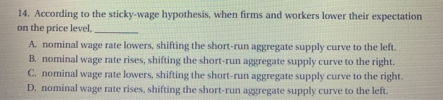 14. According to the sticky-wage hypothesis, when firms and workers lower their expectation on the price level, A. nominal wage rate lowers, shifting the short-run aggregate supply curve to the left. B. nominal wage rate rises, shifting the short-run aggregate supply curve to the right. C. nominal wage rate lowers, shifting the short-run aggregate supply curve to the right. D. nominal wage rate rises, shifting the short-run aggregate supply curve to the left.
It is not necessary to write detail answer, some question is easy to find answer, you...
 It is not necessary to write detail answer, some question is
easy to find answer, you dont need to explain in detail, thank you
:)
7. Everything else held constant, if aggregate output is to the right of the LM curve, then there is an excess of money which will cause the interest rate to A) supply; fall- B) supply; rise- C) demand; fall- D) demand; rise- t 8. If the economy is on the LM curve, but is to...
It is not necessary to write detail answer, some question is
easy to find answer, you dont need to explain in detail, thank you
:)
7. Everything else held constant, if aggregate output is to the right of the LM curve, then there is an excess of money which will cause the interest rate to A) supply; fall- B) supply; rise- C) demand; fall- D) demand; rise- t 8. If the economy is on the LM curve, but is to...
The following graph shows the economy in long-run equilibrium atthe expected price level of 120...
 The following graph shows the economy in long-run equilibrium at
the expected price level of 120 and the natural level of output of
$600 billion. Suppose a sudden and severe contraction in the
housing market reduces the value of homes and causes consumers to
spend less.Shift the short-run aggregate supply (AS) curve or the aggregate
demand (AD) curve to show the short-run impact of
the housing market slump.In the short run, the decrease in consumption spending
associated with the housing...
The following graph shows the economy in long-run equilibrium at
the expected price level of 120 and the natural level of output of
$600 billion. Suppose a sudden and severe contraction in the
housing market reduces the value of homes and causes consumers to
spend less.Shift the short-run aggregate supply (AS) curve or the aggregate
demand (AD) curve to show the short-run impact of
the housing market slump.In the short run, the decrease in consumption spending
associated with the housing...
1) The long-run aggregate supply curve shifts to the right when there is A) a decrease...
 1) The long-run aggregate supply curve shifts to the right when there is A) a decrease in the total amount of capital in the economy. B) a decrease in the total amount of labor supplied in the economy. C) a decrease in the available technology. D) a decline in the natural rate of unemployment. 2) The short-run aggregate supply curve shifts to the right when A) output gap is higher. B) output gap is lower. C) expected inflation is higher....
Other things constant, when nominal wages fall, the and the equilibrium price level -__ (Assume household wealth does N...
 Other things constant, when nominal wages fall, the and the equilibrium price level -__ (Assume household wealth does NOT change as a result of the decrease in wages.) Short Run Aggregate Supply curve shifts right, falls. Aggregate Demand curve shifts right; falls. Short Run Aggregate Supply curve shifts left: rises. Aggregate Demand curve shifts left: rises.
An increase in the price level when the money wage rate remains unchanged increases _______
 The graph shows a long-run aggregate supply curve and a short-run aggregate supply curve. Draw an arrow along one of the curves that illustrate a rise in the price level when the money wage rate remains unchanged. Label it 1. Draw an arrow along one of the curves that illustrate a rise in the price level accompanied by the same percentage rise in the money wage rate. Label it 2.An increase in the price level when the money wage rate remains...
7. A decrease in the nonborrowed monetary base, everything else hela constant( the multiplier the same)...
 7. A decrease in the nonborrowed monetary base, everything else hela constant( the multiplier the same) will cause the money supply D. Demand deposits to rise 8. Everything else held constant, a decrease in excess reserves will he money supply to rise c No change in will cause A. The money supply to rise B. The money supply to remain constant C. The money supply to fall D. Checkable deposits to rise 9. If the required reserve ratio is 15...
10. In the 1970s "Great Inflation", inflation was increased because Policy makers thought potential output was...
 10. In the 1970s "Great Inflation", inflation was increased because Policy makers thought potential output was higher than it actually turned out to be and policy shifted the AD curve to the left Policy makers thought potential output was lower than it actually turned out a. b. to be and policy shifted the AD curve to the left Policy makers thought potential output was lower than it actually turned out to be and policy shifted the AD curve to the...
__B__ 48. Economies of scale a. require inputs' MPP to fall as output increases (everything else...
__B__ 48. Economies of scale a. require inputs' MPP to fall as output increases (everything else equal). b. pertain to the long run only. c. refer to increased output generalized by an increase in the quantity of a single input. d. imply that the AC curve will fall continuously as output increases in the short run. __D__ 49. If in some production range average cost is rising, the firm is experiencing a. increasing returns to scale. b. decreasing returns to...
At higher rates of interest households save less because it is more expensive to save. businesses...
At higher rates of interest households save less because it is more expensive to save. businesses demand more investment because there are more funds available to invest. households save more because they get a greater return on their savings. businesses demand more investment because future profitability is likely to be greater. According to Keynesian economics using the modern short-run aggregate supply curve, if there are unutilized resources in the economy and the aggregate demand decreases real GDP will fall and...
 14. According to the sticky-wage hypothesis, when firms and workers lower their expectation on the price level, A. nominal wage rate lowers, shifting the short-run aggregate supply curve to the left. B. nominal wage rate rises, shifting the short-run aggregate supply curve to the right. C. nominal wage rate lowers, shifting the short-run aggregate supply curve to the right. D. nominal wage rate rises, shifting the short-run aggregate supply curve to the left.
 It is not necessary to write detail answer, some question is
easy to find answer, you dont need to explain in detail, thank you
:)
7. Everything else held constant, if aggregate output is to the right of the LM curve, then there is an excess of money which will cause the interest rate to A) supply; fall- B) supply; rise- C) demand; fall- D) demand; rise- t 8. If the economy is on the LM curve, but is to...
It is not necessary to write detail answer, some question is
easy to find answer, you dont need to explain in detail, thank you
:)
7. Everything else held constant, if aggregate output is to the right of the LM curve, then there is an excess of money which will cause the interest rate to A) supply; fall- B) supply; rise- C) demand; fall- D) demand; rise- t 8. If the economy is on the LM curve, but is to...
 The following graph shows the economy in long-run equilibrium at
the expected price level of 120 and the natural level of output of
$600 billion. Suppose a sudden and severe contraction in the
housing market reduces the value of homes and causes consumers to
spend less.Shift the short-run aggregate supply (AS) curve or the aggregate
demand (AD) curve to show the short-run impact of
the housing market slump.In the short run, the decrease in consumption spending
associated with the housing...
The following graph shows the economy in long-run equilibrium at
the expected price level of 120 and the natural level of output of
$600 billion. Suppose a sudden and severe contraction in the
housing market reduces the value of homes and causes consumers to
spend less.Shift the short-run aggregate supply (AS) curve or the aggregate
demand (AD) curve to show the short-run impact of
the housing market slump.In the short run, the decrease in consumption spending
associated with the housing...
 1) The long-run aggregate supply curve shifts to the right when there is A) a decrease in the total amount of capital in the economy. B) a decrease in the total amount of labor supplied in the economy. C) a decrease in the available technology. D) a decline in the natural rate of unemployment. 2) The short-run aggregate supply curve shifts to the right when A) output gap is higher. B) output gap is lower. C) expected inflation is higher....
 Other things constant, when nominal wages fall, the and the equilibrium price level -__ (Assume household wealth does NOT change as a result of the decrease in wages.) Short Run Aggregate Supply curve shifts right, falls. Aggregate Demand curve shifts right; falls. Short Run Aggregate Supply curve shifts left: rises. Aggregate Demand curve shifts left: rises.
 7. A decrease in the nonborrowed monetary base, everything else hela constant( the multiplier the same) will cause the money supply D. Demand deposits to rise 8. Everything else held constant, a decrease in excess reserves will he money supply to rise c No change in will cause A. The money supply to rise B. The money supply to remain constant C. The money supply to fall D. Checkable deposits to rise 9. If the required reserve ratio is 15...
 10. In the 1970s "Great Inflation", inflation was increased because Policy makers thought potential output was higher than it actually turned out to be and policy shifted the AD curve to the left Policy makers thought potential output was lower than it actually turned out a. b. to be and policy shifted the AD curve to the left Policy makers thought potential output was lower than it actually turned out to be and policy shifted the AD curve to the...
Most questions answered within 3 hours.
-
Where is the error in this code sequence?
String s1 = "Hello";
String s2 = "ello";...
asked 10 months ago -
Financial data for Joel de Paris, Inc., for last year
follow:
Joel de Paris, Inc.
Balance...
asked 10 months ago -
Consider this reaction:
Al2(SO4)3 (aq)+ BaCl3
(aq) Al2Cl6 (aq)- +
3BaSO4(s) . What is the...
asked 10 months ago -
Suppose that Savneet is considering increasing her
recent random sample from 20 car rentals to 40...
asked 10 months ago -
Trucks arrive at an unloading terminal at an average rate of 120
per hour.
Trucks arrive...
asked 10 months ago -
Why are methanol and ethanol completely soluble in water while
octanol is not very little soluble....
asked 10 months ago -
A facilities manager at a university reads in a research report
that the mean amount of...
asked 10 months ago -
When the CuSO4 is rehydrated by adding water to the anhydrous
compound, is this an endothermic...
asked 10 months ago -
A ray of sunlight is passing from diamond into crown glass; the
angle of incidence is...
asked 10 months ago -
A block of mass 0.249 kg is placed on top of a light, vertical
spring of...
asked 10 months ago -
how do the kidneys compensate in the presences of acidosis
a) trigger hyperventilate
b) reserve acid...
asked 10 months ago -
Question 501 pts
The rental rate of capital to the firm increases. Which of the
following...
asked 10 months ago