A small charge of +1.0 micro-Coulomb (µC) is constrained to move (frictionlessly) along the x-axis. There...
A small charge of +1.0 micro-Coulomb (µC) is constrained to move (frictionlessly) along the x-axis. There is also a charge of +1.0 µC fixed at x = 0, and another charge of +2.0 µC fixed at x = 1.0 m, both fixed charges also on the x-axis. (a) Where is the equilibrium position of the movable charge? (b) Is the equilibrium stable or unstable? Explain.
Homework Answers


Add Answer to:
A small charge of +1.0 micro-Coulomb (µC) is constrained to move
(frictionlessly) along the x-axis. There...
4. A particle of mass m and charge q is constrained to move along a straight...
 4. A particle of mass m and charge q is constrained to move along a straight line between two point charges of equal charge Q separated by distance 2L. The sign of all three charges is the same so that the charge q is repelled by the other two particles. (a) (5 points) What is equilibrium position of charge q? Use the symmetry of the system. Is the equilibrium stable or unstable? (b) (5 points) Chose the origin of your...
A particle is constrained to move along the positive x-axis under the influence of a force...
 A particle is constrained to move along the positive x-axis under the influence of a force whose potential energy is U(x) = U_0(2 cos x/a - x/a) where U_0 and a are positive constants. Plot U versus x. A simple hand sketch is fine. Find the equilibrium point(s). For each equilibrium point, determine whether the equilibrium is stable or unstable.
The potential energy of an object constrained to move only along the x-axis is given by...
The potential energy of an object constrained to move only along the x-axis is given by U=5x^2-4x where U is in Joules and x is in meters. a. Find the force associated with this potential. b. Assuming no other forces act on the object find the equilibrium positions of the object and determine whether each is stable, unstable, or neutral.
Two charges are in fixed positions on the x-axis. The charge q1 = +1.0 µC is...
Two charges are in fixed positions on the x-axis. The charge q1 = +1.0 µC is located at the origin; the charge q2 = −4.0 µC is located at x = 10.0 cm. Where (other than infinitely far away) can a third charge q0 be placed on the x-axis such that the net force on this charge is zero?
(12) Two point charges are located on the x-axis: a -1.0 µC charge located at x...
(12) Two point charges are located on the x-axis: a -1.0 µC charge located at x = -1.0 m, and a +2.0 µC charge located at x = +1.0 m. Find the magnitude of the electric field on the yaxis at a point y = +1.0 m above the origin. please show work.
Point charges of -8 µC, 2.0 µC, and +8 µC are located along the x axis...
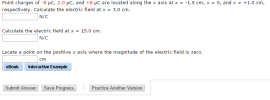 Point charges of -8 µC, 2.0 µC,
and +8 µC are located along the x axis at x = -1.0 cm, x = 0, and x
= +1.0 cm, respectively. Calculate the electric field at x = 3.0
cm.
Point charges of -8 µC, 2.0 µC,
and +8 µC are located along the x axis at x = -1.0 cm, x = 0, and x
= +1.0 cm, respectively. Calculate the electric field at x = 3.0
cm.
Three charges lie along the x-axis. The positive charge q1 = 9.07 µC is at x...
Three charges lie along the x-axis. The positive charge q1 = 9.07 µC is at x = 1.65m, and the negative charge q2 = -2.29 µC is at the origin. Where must a positivecharge q3 be placed on the x-axis so that the resultant force on it is zero?
Two positive point charges that are equal in magnitude are fixed in place, one at x...
 Two positive point charges that are equal in magnitude are fixed in place, one at x 0.00 m and the other at x 1.00 m, on the x axis. A third positive point charge is placed at an equilibrium position. (a) Where is this equilibrium position? This answer has not been graded yet (b) Is the equilibrium position stable if the third particle is constrained to move parallel with the x axis? O Yes O No Explain. This answer has...
Suppose a particle is constrained to move along the x-axis. There are two rings of contin-...
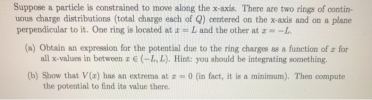 Suppose a particle is constrained to move along the x-axis. There are two rings of contin- uous charge distributions (total charge each of Q) centered on the x-axis and on a plane perpendicular to it. One ring is located at x L and the other at x =-L. (a) Obtain an expression for the potential due to the ring charges as a function of z for all x-values in between a E(-L, L). Hint: you should be integrating something. b)...
1. Two point charges are located on the x-axis: -8 µC at x = 5 cm,...
1. Two point charges are located on the x-axis: -8 µC at x = 5 cm, and +32 µC at x = 7 cm. Find the equilibrium point on the x-axis, and state whether it is stable or metastable for positive test charges. 2. A 9 µC charged particle with a mass of 10 mg is placed 9 cm from a 1 mC particle that is fixed in place. Find the acceleration of the free particle using 9 GJ·m/C² for...
 4. A particle of mass m and charge q is constrained to move along a straight line between two point charges of equal charge Q separated by distance 2L. The sign of all three charges is the same so that the charge q is repelled by the other two particles. (a) (5 points) What is equilibrium position of charge q? Use the symmetry of the system. Is the equilibrium stable or unstable? (b) (5 points) Chose the origin of your...
 A particle is constrained to move along the positive x-axis under the influence of a force whose potential energy is U(x) = U_0(2 cos x/a - x/a) where U_0 and a are positive constants. Plot U versus x. A simple hand sketch is fine. Find the equilibrium point(s). For each equilibrium point, determine whether the equilibrium is stable or unstable.
 Point charges of -8 µC, 2.0 µC,
and +8 µC are located along the x axis at x = -1.0 cm, x = 0, and x
= +1.0 cm, respectively. Calculate the electric field at x = 3.0
cm.
Point charges of -8 µC, 2.0 µC,
and +8 µC are located along the x axis at x = -1.0 cm, x = 0, and x
= +1.0 cm, respectively. Calculate the electric field at x = 3.0
cm.
 Two positive point charges that are equal in magnitude are fixed in place, one at x 0.00 m and the other at x 1.00 m, on the x axis. A third positive point charge is placed at an equilibrium position. (a) Where is this equilibrium position? This answer has not been graded yet (b) Is the equilibrium position stable if the third particle is constrained to move parallel with the x axis? O Yes O No Explain. This answer has...
 Suppose a particle is constrained to move along the x-axis. There are two rings of contin- uous charge distributions (total charge each of Q) centered on the x-axis and on a plane perpendicular to it. One ring is located at x L and the other at x =-L. (a) Obtain an expression for the potential due to the ring charges as a function of z for all x-values in between a E(-L, L). Hint: you should be integrating something. b)...
Most questions answered within 3 hours.
-
Where is the error in this code sequence?
String s1 = "Hello";
String s2 = "ello";...
asked 11 months ago -
Financial data for Joel de Paris, Inc., for last year
follow:
Joel de Paris, Inc.
Balance...
asked 11 months ago -
Consider this reaction:
Al2(SO4)3 (aq)+ BaCl3
(aq) Al2Cl6 (aq)- +
3BaSO4(s) . What is the...
asked 11 months ago -
Suppose that Savneet is considering increasing her
recent random sample from 20 car rentals to 40...
asked 11 months ago -
Trucks arrive at an unloading terminal at an average rate of 120
per hour.
Trucks arrive...
asked 11 months ago -
Why are methanol and ethanol completely soluble in water while
octanol is not very little soluble....
asked 11 months ago -
A facilities manager at a university reads in a research report
that the mean amount of...
asked 11 months ago -
When the CuSO4 is rehydrated by adding water to the anhydrous
compound, is this an endothermic...
asked 11 months ago -
A ray of sunlight is passing from diamond into crown glass; the
angle of incidence is...
asked 11 months ago -
A block of mass 0.249 kg is placed on top of a light, vertical
spring of...
asked 11 months ago -
how do the kidneys compensate in the presences of acidosis
a) trigger hyperventilate
b) reserve acid...
asked 11 months ago -
Question 501 pts
The rental rate of capital to the firm increases. Which of the
following...
asked 11 months ago