
Homework Answers
 any queries plz comment
Rate it up. Thanks
Add Answer to:
4. A particle of mass m and charge q is constrained to move along a straight...
A particle (mass m, charge q) is constrained to move freely along a straight horizontal wire...
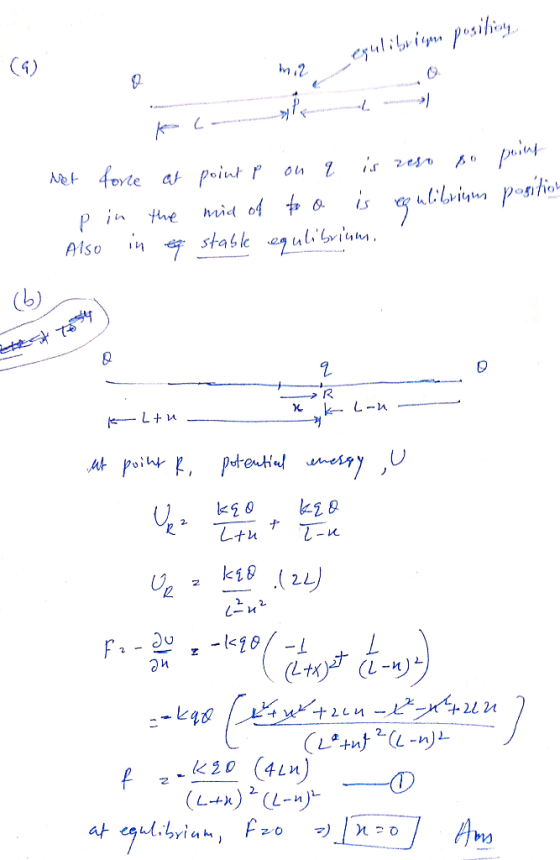
A particle (mass m, charge q) is constrained to move freely along a straight horizontal wire of length L. At one end of the wire is a fixed point charge Q1; at the other end of the wire is a fixed point charge Q2. Assume all three charges are negative, and that Q1 = 4Q2. Determine the particle
A small charge of +1.0 micro-Coulomb (µC) is constrained to move (frictionlessly) along the x-axis. There...
A small charge of +1.0 micro-Coulomb (µC) is constrained to move (frictionlessly) along the x-axis. There is also a charge of +1.0 µC fixed at x = 0, and another charge of +2.0 µC fixed at x = 1.0 m, both fixed charges also on the x-axis. (a) Where is the equilibrium position of the movable charge? (b) Is the equilibrium stable or unstable? Explain.
Two particles of mass m are constrained to move along two horizontal frictionless rails that make...
 Two particles of mass m are constrained to move along two horizontal frictionless rails that make an angle 20 with respect to each other. They are connected by a spring with spring constant k, whose relaxed length is at the position shown in the figure below. What is the frequency of oscillations for the motion where the spring remains parallel to the position shown? meeeeeeeeem
Problem 4 (12 points): Consider the configuration consisting a + charge and two - charges aligned...
 Problem 4 (12 points): Consider the configuration consisting a + charge and two - charges aligned along the c-axis as follows: -9 +4 -9 where the charges are separated by a distance d. In this position, the + charge is in equilibrium since the total force acting on it is zero. (a) Suppose the + charge is displaced perpendicularly by a vertical distance y. Now, what is the total force F acting on it? Sketch the direction of Facting on...
please advice into missing information. A bead of mass m is constrained to slide without friction...
 please advice into missing information.
A bead of mass m is constrained to slide without friction on a circular hoop of radius R. The hoop is oriented vertically and is attached to a motor that rotates it at a constant angular speed o, as shown in the attached figure. The bead experiences a constant gravitational force directed downward, given as mg. Answer the following questions: (a) Find the Lagrangian for this system using appropriate variables. (b) Find the effective potential....
please advice into missing information.
A bead of mass m is constrained to slide without friction on a circular hoop of radius R. The hoop is oriented vertically and is attached to a motor that rotates it at a constant angular speed o, as shown in the attached figure. The bead experiences a constant gravitational force directed downward, given as mg. Answer the following questions: (a) Find the Lagrangian for this system using appropriate variables. (b) Find the effective potential....
A particle of mass m is constrained to move along the x-axis and is subjected to...
 A particle of mass m is constrained to move along the x-axis and
is subjected to a force given by
. Assuming the particle had an initial velocity of Vo and was at
the origin at t = 0, find an equation for the particle's velocity
and set up the integral from which the position equation as a
function of time could be determined. NOTE: You do not need to
evaluate the integral for the position as a function of...
A particle of mass m is constrained to move along the x-axis and
is subjected to a force given by
. Assuming the particle had an initial velocity of Vo and was at
the origin at t = 0, find an equation for the particle's velocity
and set up the integral from which the position equation as a
function of time could be determined. NOTE: You do not need to
evaluate the integral for the position as a function of...
3. A particle of mass is constrained to move without friction along the x-axis, subject to...
 3. A particle of mass is constrained to move without friction along the x-axis, subject to a potential energy siven by Ue) Uo/ constants. Show that for small oscillations about x 0, the particle undergoes simple harmonic motion. What condition on x is required for the oscillations to be "small" (i.e. simple harmonic)? Find the period Tof the oscillations. - 1) where Uo and b are positive
Problem 2: An imaginary particle π has mass m 5 x 10-27 kg and charge q...
 Problem 2: An imaginary particle π has mass m 5 x 10-27 kg and charge q +3c 4.8x 10⁻¹⁹ C. Compare the magnitude of the electric repulsion between two π particles with that of gravitational attraction between them. Problem 3: Two equal charges 22 x 10-6 C are located at -0, y 0.3 m and z 0, V0.3 m respectively. What are the magnitude and direction of the total electric force that q1 and g2 exert on a third charge...
A particle of rest mass mo and charge q is accelerated from rest by a uniform (in the lab frame) electric field Ei. What are the velocity and position of the particle (as a function of time) a. in th...
 A particle of rest mass mo and charge q is accelerated from rest by a uniform (in the lab frame) electric field Ei. What are the velocity and position of the particle (as a function of time) a. in the lab frame? b. in the rest frame of an observer moving with a velocity vok relative to the lab? c. (Optional) Plot the position and speed of an electron in a uniform field of magnitude 1 MV/m for the time...
Consider a particle with a mass m subject to a force F(x) = ax - bx3...
Consider a particle with a mass m subject to a force F(x) = ax - bx3 where x is the displacement of the origin of the reference system and a and b are positive constants. a) Find an expression of the particle's total energy. Show that this total energy is constant. b) Find the equilibrium points and determine if they are stable or unstable.
 Two particles of mass m are constrained to move along two horizontal frictionless rails that make an angle 20 with respect to each other. They are connected by a spring with spring constant k, whose relaxed length is at the position shown in the figure below. What is the frequency of oscillations for the motion where the spring remains parallel to the position shown? meeeeeeeeem
 Problem 4 (12 points): Consider the configuration consisting a + charge and two - charges aligned along the c-axis as follows: -9 +4 -9 where the charges are separated by a distance d. In this position, the + charge is in equilibrium since the total force acting on it is zero. (a) Suppose the + charge is displaced perpendicularly by a vertical distance y. Now, what is the total force F acting on it? Sketch the direction of Facting on...
 please advice into missing information.
A bead of mass m is constrained to slide without friction on a circular hoop of radius R. The hoop is oriented vertically and is attached to a motor that rotates it at a constant angular speed o, as shown in the attached figure. The bead experiences a constant gravitational force directed downward, given as mg. Answer the following questions: (a) Find the Lagrangian for this system using appropriate variables. (b) Find the effective potential....
please advice into missing information.
A bead of mass m is constrained to slide without friction on a circular hoop of radius R. The hoop is oriented vertically and is attached to a motor that rotates it at a constant angular speed o, as shown in the attached figure. The bead experiences a constant gravitational force directed downward, given as mg. Answer the following questions: (a) Find the Lagrangian for this system using appropriate variables. (b) Find the effective potential....
 A particle of mass m is constrained to move along the x-axis and
is subjected to a force given by
. Assuming the particle had an initial velocity of Vo and was at
the origin at t = 0, find an equation for the particle's velocity
and set up the integral from which the position equation as a
function of time could be determined. NOTE: You do not need to
evaluate the integral for the position as a function of...
A particle of mass m is constrained to move along the x-axis and
is subjected to a force given by
. Assuming the particle had an initial velocity of Vo and was at
the origin at t = 0, find an equation for the particle's velocity
and set up the integral from which the position equation as a
function of time could be determined. NOTE: You do not need to
evaluate the integral for the position as a function of...
 3. A particle of mass is constrained to move without friction along the x-axis, subject to a potential energy siven by Ue) Uo/ constants. Show that for small oscillations about x 0, the particle undergoes simple harmonic motion. What condition on x is required for the oscillations to be "small" (i.e. simple harmonic)? Find the period Tof the oscillations. - 1) where Uo and b are positive
 Problem 2: An imaginary particle π has mass m 5 x 10-27 kg and charge q +3c 4.8x 10⁻¹⁹ C. Compare the magnitude of the electric repulsion between two π particles with that of gravitational attraction between them. Problem 3: Two equal charges 22 x 10-6 C are located at -0, y 0.3 m and z 0, V0.3 m respectively. What are the magnitude and direction of the total electric force that q1 and g2 exert on a third charge...
 A particle of rest mass mo and charge q is accelerated from rest by a uniform (in the lab frame) electric field Ei. What are the velocity and position of the particle (as a function of time) a. in the lab frame? b. in the rest frame of an observer moving with a velocity vok relative to the lab? c. (Optional) Plot the position and speed of an electron in a uniform field of magnitude 1 MV/m for the time...
Most questions answered within 3 hours.
-
Where is the error in this code sequence?
String s1 = "Hello";
String s2 = "ello";...
asked 11 months ago -
Financial data for Joel de Paris, Inc., for last year
follow:
Joel de Paris, Inc.
Balance...
asked 11 months ago -
Consider this reaction:
Al2(SO4)3 (aq)+ BaCl3
(aq) Al2Cl6 (aq)- +
3BaSO4(s) . What is the...
asked 11 months ago -
Suppose that Savneet is considering increasing her
recent random sample from 20 car rentals to 40...
asked 11 months ago -
Trucks arrive at an unloading terminal at an average rate of 120
per hour.
Trucks arrive...
asked 11 months ago -
Why are methanol and ethanol completely soluble in water while
octanol is not very little soluble....
asked 11 months ago -
A facilities manager at a university reads in a research report
that the mean amount of...
asked 11 months ago -
When the CuSO4 is rehydrated by adding water to the anhydrous
compound, is this an endothermic...
asked 11 months ago -
A ray of sunlight is passing from diamond into crown glass; the
angle of incidence is...
asked 11 months ago -
A block of mass 0.249 kg is placed on top of a light, vertical
spring of...
asked 11 months ago -
how do the kidneys compensate in the presences of acidosis
a) trigger hyperventilate
b) reserve acid...
asked 11 months ago -
Question 501 pts
The rental rate of capital to the firm increases. Which of the
following...
asked 11 months ago