
Homework Answers


Add Answer to:
Two particles of mass m are constrained to move along two horizontal frictionless rails that make...
Consider two masses, both with mass M, attached to a spring with spring constant k. They...
 Consider two masses, both with mass M, attached to a spring with
spring constant k. They slide along angled rails, and the angle
between the rails is theta. There is no friction: the masses slide
freely along the rails. Assume that the masses move together so
that the spring remains parallel to its equilibrium position. The
masses are initially moving upwards such that the spring is being
stretched past its equilibrium length. Describe what happens next,
by using Newton's second...
Consider two masses, both with mass M, attached to a spring with
spring constant k. They slide along angled rails, and the angle
between the rails is theta. There is no friction: the masses slide
freely along the rails. Assume that the masses move together so
that the spring remains parallel to its equilibrium position. The
masses are initially moving upwards such that the spring is being
stretched past its equilibrium length. Describe what happens next,
by using Newton's second...
Give me explanation and Answer for Q15 Two particles of mass m each are connected by...
 Give me explanation and Answer for Q15
Two particles of mass m each are connected by Q15 a mass less spring of length / and spring constant k. The system is lying (in the relaxed state) on a frictionless horizontal table, A very short impulse P is applied to the first mass (along the axis of the system) at t = 0. When would the second mass first come to rest? 2m (b) t = 27T. k 2m (a) t...
Give me explanation and Answer for Q15
Two particles of mass m each are connected by Q15 a mass less spring of length / and spring constant k. The system is lying (in the relaxed state) on a frictionless horizontal table, A very short impulse P is applied to the first mass (along the axis of the system) at t = 0. When would the second mass first come to rest? 2m (b) t = 27T. k 2m (a) t...
Three spheres of equal mass m are constrained to move in one dimension along the line...
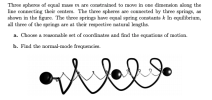 Three spheres of equal mass m are constrained to move in one dimension along the line connecting their centers. The three spheres are connected by three springs, as shown in the figure. The three springs have equal spring constants k In equilibrium, all three of the springs are at their respective natural lengths a. Choose a reasonable set of coordinates and find the equations of motion. b. Find the normal-mode frequencies.
Q3-(25 pts) A small bead of mass m can move on a fixed horizontal wire without...
 Q3-(25 pts) A small bead of mass m can move on a fixed horizontal wire without friction as in the figure. The bead is connected to an ideal spring of spring constant k, and the other end of the spring is connected to a fixed point at a perpendicular distance d from the wire. Unstretched length of the spring is very small, and can be taken to be zero. a) What is the period of oscillations of the bead around...
A cannon is rigidly attached to a carriage, which can move along horizontal rails, but is...
 A cannon is rigidly attached to a carriage, which can move along horizontal rails, but is connected to a post by a large spring, initially unstretched and with force constant 50,000 N/m, as shown above. The cannon fires a 25 kg projectile at a velocity of 1,000 m/s directed at 34° above the horizontal. The mass of the cannon and its carriage is 4,500 kg , find the initial cannon horizontal recoil velocity to the nearest meter per second. Your...
A cannon is rigidly attached to a carriage, which can move along horizontal rails, but is...
 A cannon is rigidly attached to a carriage, which can move along horizontal rails, but is connected to a post by a large spring, initially unstretched and with force constant 110,000 N/m, as shown above. The cannon fires a 15 kg projectile at a velocity of 800 m/s directed at 44º above the horizontal. The mass of the cannon and its carriage is 4,500 kg , find the initial cannon horizontal recoil velocity to the nearest meter per second. Your...
I need to rescale (4) from the first page to the equation on the second page. 2.[60pts.] A bead of mass m is constrained to slide along a straight rigid horizontal wire. A spring with natural len...
 I
need to rescale (4) from the first page to the equation on the
second page.
2.[60pts.] A bead of mass m is constrained to slide along a straight rigid horizontal wire. A spring with natural length Lo and spring constant k is attached to the bead and to a support point a distance h from the wire. See Figure 1. Let z(t) denote the position of the bead on the wire at time t. (Note that x is measured...
I
need to rescale (4) from the first page to the equation on the
second page.
2.[60pts.] A bead of mass m is constrained to slide along a straight rigid horizontal wire. A spring with natural length Lo and spring constant k is attached to the bead and to a support point a distance h from the wire. See Figure 1. Let z(t) denote the position of the bead on the wire at time t. (Note that x is measured...
A conducting bar moves along frictionless conducting rails connected to a 4.00 omega resistor. The length...
 A conducting bar moves along frictionless conducting rails
connected to a 4.00 omega resistor. The length of the bar is 1.60m
and a uniform magnetic field of 2.20T is applied perpendicular to
the paper pointing outward as shown
a) What is the applied force required to move the bar to the
right with a constant speed of 6.00 m/s?
b) At what rate is energy dissipated in the 4.00 ohm
resistor?
A conducting bar moves along frictionless conducting rails connected...
A conducting bar moves along frictionless conducting rails
connected to a 4.00 omega resistor. The length of the bar is 1.60m
and a uniform magnetic field of 2.20T is applied perpendicular to
the paper pointing outward as shown
a) What is the applied force required to move the bar to the
right with a constant speed of 6.00 m/s?
b) At what rate is energy dissipated in the 4.00 ohm
resistor?
A conducting bar moves along frictionless conducting rails connected...
PLEASE DON'T ANSWER PREVIOUSLY ASKED QUESTION, TRIED DELETING IT BUT THAT DIDN'T WORK. (Question about: Consider...
PLEASE DON'T ANSWER PREVIOUSLY ASKED QUESTION, TRIED DELETING IT BUT THAT DIDN'T WORK. (Question about: Consider two masses, both with mass M, attached to a spring with spring constant k. They slide along angled rails, and the angle between the rails is theta...)There is no friction: the masses slide freely along the rails. Assume that the masses move together so that the spring remains parallel to its equilibrium position. The masses are initially moving upwards such that the spring is...
4. A particle of mass m and charge q is constrained to move along a straight...
 4. A particle of mass m and charge q is constrained to move along a straight line between two point charges of equal charge Q separated by distance 2L. The sign of all three charges is the same so that the charge q is repelled by the other two particles. (a) (5 points) What is equilibrium position of charge q? Use the symmetry of the system. Is the equilibrium stable or unstable? (b) (5 points) Chose the origin of your...
 Consider two masses, both with mass M, attached to a spring with
spring constant k. They slide along angled rails, and the angle
between the rails is theta. There is no friction: the masses slide
freely along the rails. Assume that the masses move together so
that the spring remains parallel to its equilibrium position. The
masses are initially moving upwards such that the spring is being
stretched past its equilibrium length. Describe what happens next,
by using Newton's second...
Consider two masses, both with mass M, attached to a spring with
spring constant k. They slide along angled rails, and the angle
between the rails is theta. There is no friction: the masses slide
freely along the rails. Assume that the masses move together so
that the spring remains parallel to its equilibrium position. The
masses are initially moving upwards such that the spring is being
stretched past its equilibrium length. Describe what happens next,
by using Newton's second...
 Give me explanation and Answer for Q15
Two particles of mass m each are connected by Q15 a mass less spring of length / and spring constant k. The system is lying (in the relaxed state) on a frictionless horizontal table, A very short impulse P is applied to the first mass (along the axis of the system) at t = 0. When would the second mass first come to rest? 2m (b) t = 27T. k 2m (a) t...
Give me explanation and Answer for Q15
Two particles of mass m each are connected by Q15 a mass less spring of length / and spring constant k. The system is lying (in the relaxed state) on a frictionless horizontal table, A very short impulse P is applied to the first mass (along the axis of the system) at t = 0. When would the second mass first come to rest? 2m (b) t = 27T. k 2m (a) t...
 Three spheres of equal mass m are constrained to move in one dimension along the line connecting their centers. The three spheres are connected by three springs, as shown in the figure. The three springs have equal spring constants k In equilibrium, all three of the springs are at their respective natural lengths a. Choose a reasonable set of coordinates and find the equations of motion. b. Find the normal-mode frequencies.
 Q3-(25 pts) A small bead of mass m can move on a fixed horizontal wire without friction as in the figure. The bead is connected to an ideal spring of spring constant k, and the other end of the spring is connected to a fixed point at a perpendicular distance d from the wire. Unstretched length of the spring is very small, and can be taken to be zero. a) What is the period of oscillations of the bead around...
 A cannon is rigidly attached to a carriage, which can move along horizontal rails, but is connected to a post by a large spring, initially unstretched and with force constant 50,000 N/m, as shown above. The cannon fires a 25 kg projectile at a velocity of 1,000 m/s directed at 34° above the horizontal. The mass of the cannon and its carriage is 4,500 kg , find the initial cannon horizontal recoil velocity to the nearest meter per second. Your...
 A cannon is rigidly attached to a carriage, which can move along horizontal rails, but is connected to a post by a large spring, initially unstretched and with force constant 110,000 N/m, as shown above. The cannon fires a 15 kg projectile at a velocity of 800 m/s directed at 44º above the horizontal. The mass of the cannon and its carriage is 4,500 kg , find the initial cannon horizontal recoil velocity to the nearest meter per second. Your...
 I
need to rescale (4) from the first page to the equation on the
second page.
2.[60pts.] A bead of mass m is constrained to slide along a straight rigid horizontal wire. A spring with natural length Lo and spring constant k is attached to the bead and to a support point a distance h from the wire. See Figure 1. Let z(t) denote the position of the bead on the wire at time t. (Note that x is measured...
I
need to rescale (4) from the first page to the equation on the
second page.
2.[60pts.] A bead of mass m is constrained to slide along a straight rigid horizontal wire. A spring with natural length Lo and spring constant k is attached to the bead and to a support point a distance h from the wire. See Figure 1. Let z(t) denote the position of the bead on the wire at time t. (Note that x is measured...
 A conducting bar moves along frictionless conducting rails
connected to a 4.00 omega resistor. The length of the bar is 1.60m
and a uniform magnetic field of 2.20T is applied perpendicular to
the paper pointing outward as shown
a) What is the applied force required to move the bar to the
right with a constant speed of 6.00 m/s?
b) At what rate is energy dissipated in the 4.00 ohm
resistor?
A conducting bar moves along frictionless conducting rails connected...
A conducting bar moves along frictionless conducting rails
connected to a 4.00 omega resistor. The length of the bar is 1.60m
and a uniform magnetic field of 2.20T is applied perpendicular to
the paper pointing outward as shown
a) What is the applied force required to move the bar to the
right with a constant speed of 6.00 m/s?
b) At what rate is energy dissipated in the 4.00 ohm
resistor?
A conducting bar moves along frictionless conducting rails connected...
 4. A particle of mass m and charge q is constrained to move along a straight line between two point charges of equal charge Q separated by distance 2L. The sign of all three charges is the same so that the charge q is repelled by the other two particles. (a) (5 points) What is equilibrium position of charge q? Use the symmetry of the system. Is the equilibrium stable or unstable? (b) (5 points) Chose the origin of your...
Most questions answered within 3 hours.
-
Where is the error in this code sequence?
String s1 = "Hello";
String s2 = "ello";...
asked 10 months ago -
Financial data for Joel de Paris, Inc., for last year
follow:
Joel de Paris, Inc.
Balance...
asked 10 months ago -
Consider this reaction:
Al2(SO4)3 (aq)+ BaCl3
(aq) Al2Cl6 (aq)- +
3BaSO4(s) . What is the...
asked 10 months ago -
Suppose that Savneet is considering increasing her
recent random sample from 20 car rentals to 40...
asked 10 months ago -
Trucks arrive at an unloading terminal at an average rate of 120
per hour.
Trucks arrive...
asked 10 months ago -
Why are methanol and ethanol completely soluble in water while
octanol is not very little soluble....
asked 10 months ago -
A facilities manager at a university reads in a research report
that the mean amount of...
asked 10 months ago -
When the CuSO4 is rehydrated by adding water to the anhydrous
compound, is this an endothermic...
asked 10 months ago -
A ray of sunlight is passing from diamond into crown glass; the
angle of incidence is...
asked 10 months ago -
A block of mass 0.249 kg is placed on top of a light, vertical
spring of...
asked 10 months ago -
how do the kidneys compensate in the presences of acidosis
a) trigger hyperventilate
b) reserve acid...
asked 10 months ago -
Question 501 pts
The rental rate of capital to the firm increases. Which of the
following...
asked 10 months ago