A cue ball (mass = 0.160 kg) is at rest on a frictionless pool table. The...
A cue ball (mass = 0.160 kg) is at rest on a frictionless pool table. The ball is hit dead center by a pool stick, which applies an impulse of +1.50 N · s to the ball. The ball then slides along the table and makes an elastic head-on collision with a second ball of equal mass that is initially at rest. Find the velocity of the second ball just after it is struck.
Homework Answers
 We are given an
impulse applied to the cue ball. We can interpret this impulse as
the ball's change in momentum:
We are given an
impulse applied to the cue ball. We can interpret this impulse as
the ball's change in momentum:
J=Δp
J=pf − pi
Initially, the cue ball is at rest, so pi=0. Our equation becomes:
J = pf − 0
1.50 Ns = pf
So, the cue ball moves with a momentum of 1.50 kg.m/s. This is the total momentum of the system, and it will be conserved durin the collision with the second ball.
We can also use this momentum to find the velocity at which the cue ball moves:
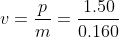

And, next, we can use this velocity to find the ball's kinetic energy.


Now, let's consider the collision. This is an elastic collision, so momentum and kinetic energy are both conserved. We can express the momentum as:


The two balls have equal mass, so this equation simplifies to:



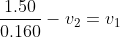

Now, let's consider energy conservation. The sum of each ball's kinetic energy after the collision must equal the total energy of the system:

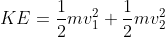


We have an expression for the first ball's velocity, so let's substitute that into our expression.




Add Answer to:
A cue ball (mass = 0.160 kg) is at rest on a frictionless pool
table. The...
In a game of pool, the cue ball strikes another ball of the same mass and...
In a game of pool, the cue ball strikes another ball of the same mass and initially at rest. After the collision, the cue ball moves at 2.10 m/s along a line making an angle of 12.0° with its original direction of motion, and the second ball has a speed of 1.50 m/s. Find (a) the angle between the direction of motion of the second ball and the original direction of motion of the cue ball and (b) the original...
velocity of cue ball initially is 23cm/s TU POCOLM Pool Balls Innervated to Boot Complete each...
 velocity of cue ball initially is 23cm/s
TU POCOLM Pool Balls Innervated to Boot Complete each problem in the space provided; show all work in logical, detailed form and highlight numerical answers. Include diagrams wherever possible. On any problem where an FBD is appropriate, it must be included for mazimum credit. All numerical results should be stated to 3.00 or 4.000 significant figures and mks units unless otherwise noted. 1. You are hovering above a pool table looking down at...
velocity of cue ball initially is 23cm/s
TU POCOLM Pool Balls Innervated to Boot Complete each problem in the space provided; show all work in logical, detailed form and highlight numerical answers. Include diagrams wherever possible. On any problem where an FBD is appropriate, it must be included for mazimum credit. All numerical results should be stated to 3.00 or 4.000 significant figures and mks units unless otherwise noted. 1. You are hovering above a pool table looking down at...
In a game of pool, the cue ball strikes another ball of the same mass and...
In a game of pool, the cue ball strikes another ball of the same mass and initially at rest. After the collision, the cue ball moves at 4.10 m/s along a line making an angle of 18.0° with its original direction of motion, and the second ball has a speed of 2.90 m/s. Find (a) the angle between the direction of motion of the second ball and the original direction of motion of the cue ball and (b) the original...
In a game of pool, the cue ball strikes another ball of the same mass and...
In a game of pool, the cue ball strikes another ball of the same mass and initially at rest. After the collision, the cue ball moves at 3.70 m/s along a line making an angle of 24.0° with its original direction of motion, and the second ball has a speed of 1.70 m/s. (a) Find the angle between the direction of motion of the second ball and the original direction of motion of the cue ball. ° (b) Find the...
A cue ball of mass m1 = 0.375 kg is shot at another billiard ball, with mass m2 = 0.53 kg, which is at rest. The cue ball has an initial speed of v = 5.5 m/s in the positive direction.
 A cue ball of mass m1 = 0.375 kg is shot at another billiard ball, with mass m2 = 0.53 kg, which is at rest. The cue ball has an initial speed of v = 5.5 m/s in the positive direction. Assume that the collision is elastic and exactly head-on.Part (a) Write an expression for the horizontal component of the billiard ball's velocity, v2f, after the collision, in terms of the other variables of the problem. Part (b) What is this velocity, in meters per second? Part (c) Write an expression for...
In a pool game, the cue ball, which has an initial speed of 5.0 m/s, makes...
 In a pool game, the cue ball, which has an initial speed of 5.0 m/s, makes an elastic collision with the eight ball, which is initially at rest. After the collision, the eight ball moves at an angle of 30 degree to the original direction of the cue ball. Find the direction of the cue ball after the collision. Each ball has the same mass.
In a pool table game you hit a red ball with a cue ball at velocity...
In a pool table game you hit a red ball with a cue ball at velocity of 4 m/s to send it in a pocket which is at an angle of 300 with the direction of your hit. Recall that when the masses of the balls are equal as in pool table the cue ball then goes off at an angle 600 with its original direction before the collision. What are the velocities of the red ball and the cue...
On a billiards table a cue ball is initially at rest at the point O on...
 On a billiards table a cue ball is initially at rest at the point O on the table. It is struck by the stick so that it leaves the stick with a center of mass speed vo and reverse spin of angular speed oo. A kinetic friction force acts on the ball as it skids initially across the table. o da e a) Explain why the ball's angular momentum is conserved about the point。. b) Using the conservation of the...
a) A billiard ball at rest is struck by another billiard ball of the same mass...
a) A billiard ball at rest is struck by another billiard ball of the same mass whose speed is 6.0m/s. After an elastic collision the striking ball goes off at an angle of 25 degree with respect to its original direction of motion. Find the angle the struck ball makes with this direction and the final speeds of both balls. b) A particle of mass m, moving with a velocity u, makes a head on collision with a particle of...
A ball with a mass of 0.615 kg is initially at rest. It is struck by...
A ball with a mass of 0.615 kg is initially at rest. It is struck by a second ball having a mass of 0.410 kg , initially moving with a velocity of 0.235 m/s toward the right along the x axis. After the collision, the 0.410 kg ball has a velocity of 0.200 m/s at an angle of 36.8 ∘ above the x axis in the first quadrant. Both balls move on a frictionless, horizontal surface. What is the magnitude...
 velocity of cue ball initially is 23cm/s
TU POCOLM Pool Balls Innervated to Boot Complete each problem in the space provided; show all work in logical, detailed form and highlight numerical answers. Include diagrams wherever possible. On any problem where an FBD is appropriate, it must be included for mazimum credit. All numerical results should be stated to 3.00 or 4.000 significant figures and mks units unless otherwise noted. 1. You are hovering above a pool table looking down at...
velocity of cue ball initially is 23cm/s
TU POCOLM Pool Balls Innervated to Boot Complete each problem in the space provided; show all work in logical, detailed form and highlight numerical answers. Include diagrams wherever possible. On any problem where an FBD is appropriate, it must be included for mazimum credit. All numerical results should be stated to 3.00 or 4.000 significant figures and mks units unless otherwise noted. 1. You are hovering above a pool table looking down at...
 A cue ball of mass m1 = 0.375 kg is shot at another billiard ball, with mass m2 = 0.53 kg, which is at rest. The cue ball has an initial speed of v = 5.5 m/s in the positive direction. Assume that the collision is elastic and exactly head-on.Part (a) Write an expression for the horizontal component of the billiard ball's velocity, v2f, after the collision, in terms of the other variables of the problem. Part (b) What is this velocity, in meters per second? Part (c) Write an expression for...
 In a pool game, the cue ball, which has an initial speed of 5.0 m/s, makes an elastic collision with the eight ball, which is initially at rest. After the collision, the eight ball moves at an angle of 30 degree to the original direction of the cue ball. Find the direction of the cue ball after the collision. Each ball has the same mass.
 On a billiards table a cue ball is initially at rest at the point O on the table. It is struck by the stick so that it leaves the stick with a center of mass speed vo and reverse spin of angular speed oo. A kinetic friction force acts on the ball as it skids initially across the table. o da e a) Explain why the ball's angular momentum is conserved about the point。. b) Using the conservation of the...
Most questions answered within 3 hours.
-
Where is the error in this code sequence?
String s1 = "Hello";
String s2 = "ello";...
asked 11 months ago -
Financial data for Joel de Paris, Inc., for last year
follow:
Joel de Paris, Inc.
Balance...
asked 11 months ago -
Consider this reaction:
Al2(SO4)3 (aq)+ BaCl3
(aq) Al2Cl6 (aq)- +
3BaSO4(s) . What is the...
asked 11 months ago -
Suppose that Savneet is considering increasing her
recent random sample from 20 car rentals to 40...
asked 11 months ago -
Trucks arrive at an unloading terminal at an average rate of 120
per hour.
Trucks arrive...
asked 11 months ago -
Why are methanol and ethanol completely soluble in water while
octanol is not very little soluble....
asked 11 months ago -
A facilities manager at a university reads in a research report
that the mean amount of...
asked 11 months ago -
When the CuSO4 is rehydrated by adding water to the anhydrous
compound, is this an endothermic...
asked 11 months ago -
A ray of sunlight is passing from diamond into crown glass; the
angle of incidence is...
asked 11 months ago -
A block of mass 0.249 kg is placed on top of a light, vertical
spring of...
asked 11 months ago -
how do the kidneys compensate in the presences of acidosis
a) trigger hyperventilate
b) reserve acid...
asked 11 months ago -
Question 501 pts
The rental rate of capital to the firm increases. Which of the
following...
asked 11 months ago