During inflammation fluids will passively diffuse out of blood vessels into the nearby, infected tissues. This...
During inflammation fluids will passively diffuse out of blood vessels into the nearby, infected tissues. This implies all of the following except ________.
Homework Answers
During inflammation fluids will passively move out of blood vessels into the nearby, infected tissues. This implies all of the following except B-lymphocytes will differentiate to become plasma cells
Add Answer to:
During inflammation fluids will passively diffuse out of blood
vessels into the nearby, infected tissues. This...
All of the following fluids from HIV-infected person can transmit HIV except: Blood Rectal fluids Sweat
All of the following fluids from HIV-infected person can transmit HIV except: Blood Rectal fluids Sweat
10 In the area of inflammation, can blood cells come out from the vessels to the...
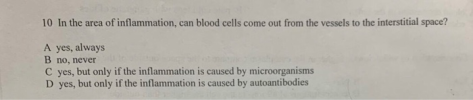 10 In the area of inflammation, can blood cells come out from the vessels to the interstitial space? A yes, always B no, never C yes, but only if the inflammation is caused by microorganisms D yes, but only if the inflammation is caused by autoantibodies
QUESTION 19 During internal respiration, the oxygen diffuses from the blood vessels into the tissues because...
 QUESTION 19 During internal respiration, the oxygen diffuses from the blood vessels into the tissues because the concentration of oxygen is higher in the blood than the tissues of the body the concentration of oxygen is lower in the blood than the tissues of the body the concentration of carbon dioxide is higher in the blood than the tissues of the body the concentration of carbon dioxide is lower in the blood than the tissues of the body
Acute inflammation is a defense mechanism of the immune system. All of the following is a...
 Acute inflammation is a defense mechanism of the immune system. All of the following is a benefit of inflammation except ONE. Select the exception. increases the rate of tisssue repair enlargement of blood vessels diapedesis inflammation triggers antimicrobial peptides
can someone help me Question 7 1 pts Acute inflammation is a defense mechanism of the...
 can someone help me
Question 7 1 pts Acute inflammation is a defense mechanism of the immune system. All of the following is a benefit of inflammation except ONE. Select the exception. enlargement of blood vessels inflammation triggers antimicrobial peptides O increases the rate of tisssue repair diapedesis
can someone help me
Question 7 1 pts Acute inflammation is a defense mechanism of the immune system. All of the following is a benefit of inflammation except ONE. Select the exception. enlargement of blood vessels inflammation triggers antimicrobial peptides O increases the rate of tisssue repair diapedesis
BIOL 1307.001 GENERAL BIOLOGY II Homework no. 7. Blood and Immune System Blood. For veins, (C)...
 BIOL 1307.001 GENERAL BIOLOGY II Homework no. 7. Blood and Immune System Blood. For veins, (C) if to veins fach description below, write in the blank (A) if the description best applies to arteries. (V) ( capillaries, (R) red blood cells, (W) white blood cells, (P) platelets, or (B) blood plasma. 1. back-flow valves carries dissolved carbon dioxide (CO2) and waste products for removal 3. carry blood away from heart 4. carry blood toward heart 5. cells that carry oxygen...
Name 13. During gas exchange in the lungs, several factors affect the rate of gas diffusion acros...
 Name 13. During gas exchange in the lungs, several factors affect the rate of gas diffusion across alveolar (the alveoli are tiny air sacs in the lungs) and tissue membranes. One of the factors is the difference in partial pressures of the gases across the membranes. The gases will diffuse from an area of high partial pressure to an area of low partial pressure, Look at the illustration below and note which blood vessels carry blood away from the lungs...
Identify the two ways chemokines affect the trafficking of lymphocytes from the blood vessel into the...
Identify the two ways chemokines affect the trafficking of lymphocytes from the blood vessel into the infected tissue. a. Strengthen the binding between the integrin and ICAM b. Directly mediate diapedesis c. Facilitate the start of the rolling process by binding to carbohydrates expressed on the immune cell d. Create a gradient for the immune cell to follow after moving through the blood vessel True or False: Macrophages migrate in response to inflammation faster than neutrophils. Which of the following...
At what stage in the development of cancer do the cancerous cells grow out of control,...
At what stage in the development of cancer do the cancerous cells grow out of control, grow their own blood vessels, and invade surrounding tissues? At what stage in the development of cancer do the cancerous cells grow out of control, grow their own blood vessels, and invade surrounding tissues? A. progression B. initiation C. promotion D. metastasis Which of the following terms is synonymous with the word malignant? Which of the following terms is synonymous with the word malignant?...
List and describe all named blood vessels and pertinent structures that the red blood cell will...
 List and describe all named blood vessels and pertinent structures that the red blood cell will pass through on its trip (arterioles, venules, and capillary beds can be handwaved); it is assumed to start from a small venule feeding directly to the brachial vein. Remember that the trips requires a visit through the pulmonary circuit before and after each of the four steps listed above the apex of the heart is reached through the coronary circulation). 7. An oxygen molecule...
 10 In the area of inflammation, can blood cells come out from the vessels to the interstitial space? A yes, always B no, never C yes, but only if the inflammation is caused by microorganisms D yes, but only if the inflammation is caused by autoantibodies
 QUESTION 19 During internal respiration, the oxygen diffuses from the blood vessels into the tissues because the concentration of oxygen is higher in the blood than the tissues of the body the concentration of oxygen is lower in the blood than the tissues of the body the concentration of carbon dioxide is higher in the blood than the tissues of the body the concentration of carbon dioxide is lower in the blood than the tissues of the body
 Acute inflammation is a defense mechanism of the immune system. All of the following is a benefit of inflammation except ONE. Select the exception. increases the rate of tisssue repair enlargement of blood vessels diapedesis inflammation triggers antimicrobial peptides
 can someone help me
Question 7 1 pts Acute inflammation is a defense mechanism of the immune system. All of the following is a benefit of inflammation except ONE. Select the exception. enlargement of blood vessels inflammation triggers antimicrobial peptides O increases the rate of tisssue repair diapedesis
can someone help me
Question 7 1 pts Acute inflammation is a defense mechanism of the immune system. All of the following is a benefit of inflammation except ONE. Select the exception. enlargement of blood vessels inflammation triggers antimicrobial peptides O increases the rate of tisssue repair diapedesis
 BIOL 1307.001 GENERAL BIOLOGY II Homework no. 7. Blood and Immune System Blood. For veins, (C) if to veins fach description below, write in the blank (A) if the description best applies to arteries. (V) ( capillaries, (R) red blood cells, (W) white blood cells, (P) platelets, or (B) blood plasma. 1. back-flow valves carries dissolved carbon dioxide (CO2) and waste products for removal 3. carry blood away from heart 4. carry blood toward heart 5. cells that carry oxygen...
 Name 13. During gas exchange in the lungs, several factors affect the rate of gas diffusion across alveolar (the alveoli are tiny air sacs in the lungs) and tissue membranes. One of the factors is the difference in partial pressures of the gases across the membranes. The gases will diffuse from an area of high partial pressure to an area of low partial pressure, Look at the illustration below and note which blood vessels carry blood away from the lungs...
 List and describe all named blood vessels and pertinent structures that the red blood cell will pass through on its trip (arterioles, venules, and capillary beds can be handwaved); it is assumed to start from a small venule feeding directly to the brachial vein. Remember that the trips requires a visit through the pulmonary circuit before and after each of the four steps listed above the apex of the heart is reached through the coronary circulation). 7. An oxygen molecule...
Most questions answered within 3 hours.
-
Where is the error in this code sequence?
String s1 = "Hello";
String s2 = "ello";...
asked 10 months ago -
Financial data for Joel de Paris, Inc., for last year
follow:
Joel de Paris, Inc.
Balance...
asked 10 months ago -
Consider this reaction:
Al2(SO4)3 (aq)+ BaCl3
(aq) Al2Cl6 (aq)- +
3BaSO4(s) . What is the...
asked 10 months ago -
Suppose that Savneet is considering increasing her
recent random sample from 20 car rentals to 40...
asked 10 months ago -
Trucks arrive at an unloading terminal at an average rate of 120
per hour.
Trucks arrive...
asked 10 months ago -
Why are methanol and ethanol completely soluble in water while
octanol is not very little soluble....
asked 10 months ago -
A facilities manager at a university reads in a research report
that the mean amount of...
asked 10 months ago -
When the CuSO4 is rehydrated by adding water to the anhydrous
compound, is this an endothermic...
asked 10 months ago -
A ray of sunlight is passing from diamond into crown glass; the
angle of incidence is...
asked 10 months ago -
A block of mass 0.249 kg is placed on top of a light, vertical
spring of...
asked 10 months ago -
how do the kidneys compensate in the presences of acidosis
a) trigger hyperventilate
b) reserve acid...
asked 10 months ago -
Question 501 pts
The rental rate of capital to the firm increases. Which of the
following...
asked 10 months ago