Can you please answer the following question You suspect that an unscrupulous employee at a casino...
Can you please answer the following question
You suspect that an unscrupulous employee at a casino has tampered with a die; that is, he is using a loaded die. In order to test this claim, you roll the die 200 times and obtain the following frequencies: (You may find it useful to reference the appropriate table: chi-square table or F table)
Click here for the Excel Data File
| Category | 1 | 2 | 3 | 4 | 5 | 6 |
| Frequency | 40 | 35 | 33 | 30 | 33 | 29 |
a. Choose the appropriate alternative hypothesis to test if the population proportions differ.
-
All population proportions differ from 1/6.
-
Not all population proportions are equal to 1/6.
b. Calculate the value of the test statistic. (Round intermediate calculations to at least 4 decimal places and final answer to 3 decimal places.)
c. Find the p-value.
-
p-value < 0.01
-
0.01 ≤ p-value < 0.025
-
0.025 ≤ p-value < 0.05
-
0.05 ≤ p-value < 0.10
-
p-value ≥ 0.10
d. At the 10% significance level, can you conclude that the die is loaded?
-
Yes, since the p-value is less than significance level.
-
Yes, since the p-value is more than significance level.
-
No, since the p-value is less than significance level.
-
No, since the p-value is more than significance level.
Homework Answers
The statistical software output for this problem is:
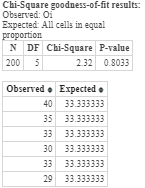
Hence,
a) Not all population proportions are equal to 1/6.
b) Test statistic = 2.320
c) p-value ≥ 0.10
d) No, since the p-value is more than significance level.
Add Answer to:
Can you please answer the following question
You suspect that an unscrupulous employee at a casino...
You suspect that an unscrupulous employee at a casino has tampered with a die; that is,...
 You suspect that an unscrupulous employee at a casino has tampered with a die; that is, he is using a loaded die. In order to test this claim, you roll the die 294 times and obtain the following frequencies: 2 58 3 57 4 40 54 54 31 (Use Table 3) Click here for the Excel Data File a. Choose the appropriate alternative hypothesis to test if the population proportions differ Not all population proportions are equal to 1/6 All...
Consider the following competing hypotheses and accompanying sample data. (You may find it useful to reference...
Consider the following competing hypotheses and accompanying sample data. (You may find it useful to reference the appropriate table: z table or t table) H0: p1 − p2 ≥ 0 HA: p1 − p2 < 0 x1 = 250 x2 = 275 n1 = 400 n2 = 400 a. Calculate the value of the test statistic. (Negative value should be indicated by a minus sign. Round intermediate calculations to at least 4 decimal places and final answer to 2 decimal...
Consider the following competing hypotheses and accompanying sample data (You may find it useful to reference...
 Consider the following competing hypotheses and accompanying sample data (You may find it useful to reference the appropriate table: z table or t table) Ho: Pi - P22 MA: P1 - P2 @ X1 - 238 nu - 425 X2 - 263 n2 - 425 a. Calculate the value of the test statistic (Negative value should be indicated by a minus sign. Round intermediate calculations to at least 4 decimal places and final answer to 2 decimal places.) Test statistic...
A multinomial experiment produced the following results: (You may find it useful to reference the appropriate...
 A multinomial experiment produced the following results:
(You may find it useful to reference the appropriate table:
chi-square table or F table)
Category
1
2
3
Frequency
117
100
83
a. Choose the appropriate alternative
hypothesis at H0: p1 =
0.50, p2 = 0.30, and p3 =
0.20.
All population proportions differ from their hypothesized
values.
At least one of the population proportions differs from its
hypothesized value.
b. Calculate the value of the test statistic.
(Round intermediate calculations to...
A multinomial experiment produced the following results:
(You may find it useful to reference the appropriate table:
chi-square table or F table)
Category
1
2
3
Frequency
117
100
83
a. Choose the appropriate alternative
hypothesis at H0: p1 =
0.50, p2 = 0.30, and p3 =
0.20.
All population proportions differ from their hypothesized
values.
At least one of the population proportions differs from its
hypothesized value.
b. Calculate the value of the test statistic.
(Round intermediate calculations to...
Consider the following competing hypotheses and accompanying sample data drawn independently from normally distributed populations. (You may find it useful to reference the appropriate table: z table or t table)
 Consider the following competing hypotheses and accompanying sample data drawn independently from normally distributed populations. (You may find it useful to reference the appropriate table: z table or t table) H0: μ1 − μ2 ≥ 0HA: μ1 − μ2 < 0 x¯1x¯1= 249x−2x−2= 262s1 = 35s2 = 23n1 = 10n2 = 10a-1. Calculate the value of the test statistic under the assumption that the population variances are equal. (Negative values should be indicated by a minus sign. Round all intermediate calculations to at least 4 decimal places and final answer to 3 decimal places.) a-2. Find the p-value. multiple choice 1p-value < 0.010.01 ≤ p-value...
Consider the following competing hypotheses and accompanying sample data drawn independently from normally distributed populations. (You...
 Consider the following competing hypotheses and accompanying sample data drawn independently from normally distributed populations. (You may find it useful to reference the appropriate table: z table or t table) Ho: H1-Hu2 0 HA: H1 Hz< e 251 252 s1 39 s=19 n1=7 n 7 a-1. Calculate the value of the test statistic under the assumption that the population variances are equal. (Negative values should be indicated by a minus sign. Round all intermediate calculations to at least 4 decimal...
Consider a multinomial experiment with n = 260 and k = 4. The null hypothesis to...
Consider a multinomial experiment with n = 260 and k = 4. The null hypothesis to be tested is H0: p1 = p2 = p3 = p4 = 0.25. The observed frequencies resulting from the experiment are: (You may find it useful to reference the appropriate table: chi-square table or F table) Category 1 2 3 4 Frequency 73 44 75 68 a. Choose the appropriate alternative hypothesis. All population proportions differ from 0.25. Not all population proportions are equal...
Exercise 9-15 Algo Consider the following hypotheses: H0: μ ≥ 130 HA: μ < 130 A...
Exercise 9-15 Algo Consider the following hypotheses: H0: μ ≥ 130 HA: μ < 130 A sample of 74 observations results in a sample mean of 125. The population standard deviation is known to be 31. (You may find it useful to reference the appropriate table: z table or t table) a-1. Calculate the value of the test statistic. (Negative value should be indicated by a minus sign. Round intermediate calculations to at least 4 decimal places and final answer...
Consider the following hypotheses: Hot 208 RAM 208 A sample of 74 observations results in a...
 Consider the following hypotheses: Hot 208 RAM 208 A sample of 74 observations results in a sample mean of 202. The population standard deviation is known to be 26. (You may find it useful to reference the appropriate table: z table or table) a-1. Calculate the value of the test statistic. (Negative value should be indicated by a minus sign. Round intermediate calculations to at least 4 decimal places and final answer to 2 decimal places.) Test statistic a-2. Find...
Consider the following hypotheses: H0: μ ≥ 220 HA: μ < 220 A sample of 72...
Consider the following hypotheses: H0: μ ≥ 220 HA: μ < 220 A sample of 72 observations results in a sample mean of 209. The population standard deviation is known to be 18. (You may find it useful to reference the appropriate table: z table or t table) a-1. Calculate the value of the test statistic. (Negative value should be indicated by a minus sign. Round intermediate calculations to at least 4 decimal places and final answer to 2 decimal...
 You suspect that an unscrupulous employee at a casino has tampered with a die; that is, he is using a loaded die. In order to test this claim, you roll the die 294 times and obtain the following frequencies: 2 58 3 57 4 40 54 54 31 (Use Table 3) Click here for the Excel Data File a. Choose the appropriate alternative hypothesis to test if the population proportions differ Not all population proportions are equal to 1/6 All...
 Consider the following competing hypotheses and accompanying sample data (You may find it useful to reference the appropriate table: z table or t table) Ho: Pi - P22 MA: P1 - P2 @ X1 - 238 nu - 425 X2 - 263 n2 - 425 a. Calculate the value of the test statistic (Negative value should be indicated by a minus sign. Round intermediate calculations to at least 4 decimal places and final answer to 2 decimal places.) Test statistic...
 A multinomial experiment produced the following results:
(You may find it useful to reference the appropriate table:
chi-square table or F table)
Category
1
2
3
Frequency
117
100
83
a. Choose the appropriate alternative
hypothesis at H0: p1 =
0.50, p2 = 0.30, and p3 =
0.20.
All population proportions differ from their hypothesized
values.
At least one of the population proportions differs from its
hypothesized value.
b. Calculate the value of the test statistic.
(Round intermediate calculations to...
A multinomial experiment produced the following results:
(You may find it useful to reference the appropriate table:
chi-square table or F table)
Category
1
2
3
Frequency
117
100
83
a. Choose the appropriate alternative
hypothesis at H0: p1 =
0.50, p2 = 0.30, and p3 =
0.20.
All population proportions differ from their hypothesized
values.
At least one of the population proportions differs from its
hypothesized value.
b. Calculate the value of the test statistic.
(Round intermediate calculations to...
 Consider the following competing hypotheses and accompanying sample data drawn independently from normally distributed populations. (You may find it useful to reference the appropriate table: z table or t table) Ho: H1-Hu2 0 HA: H1 Hz< e 251 252 s1 39 s=19 n1=7 n 7 a-1. Calculate the value of the test statistic under the assumption that the population variances are equal. (Negative values should be indicated by a minus sign. Round all intermediate calculations to at least 4 decimal...
 Consider the following hypotheses: Hot 208 RAM 208 A sample of 74 observations results in a sample mean of 202. The population standard deviation is known to be 26. (You may find it useful to reference the appropriate table: z table or table) a-1. Calculate the value of the test statistic. (Negative value should be indicated by a minus sign. Round intermediate calculations to at least 4 decimal places and final answer to 2 decimal places.) Test statistic a-2. Find...
Most questions answered within 3 hours.
-
Where is the error in this code sequence?
String s1 = "Hello";
String s2 = "ello";...
asked 10 months ago -
Financial data for Joel de Paris, Inc., for last year
follow:
Joel de Paris, Inc.
Balance...
asked 10 months ago -
Consider this reaction:
Al2(SO4)3 (aq)+ BaCl3
(aq) Al2Cl6 (aq)- +
3BaSO4(s) . What is the...
asked 10 months ago -
Suppose that Savneet is considering increasing her
recent random sample from 20 car rentals to 40...
asked 10 months ago -
Trucks arrive at an unloading terminal at an average rate of 120
per hour.
Trucks arrive...
asked 10 months ago -
Why are methanol and ethanol completely soluble in water while
octanol is not very little soluble....
asked 10 months ago -
A facilities manager at a university reads in a research report
that the mean amount of...
asked 10 months ago -
When the CuSO4 is rehydrated by adding water to the anhydrous
compound, is this an endothermic...
asked 10 months ago -
A ray of sunlight is passing from diamond into crown glass; the
angle of incidence is...
asked 10 months ago -
A block of mass 0.249 kg is placed on top of a light, vertical
spring of...
asked 10 months ago -
how do the kidneys compensate in the presences of acidosis
a) trigger hyperventilate
b) reserve acid...
asked 10 months ago -
Question 501 pts
The rental rate of capital to the firm increases. Which of the
following...
asked 10 months ago