If 3.50 ✕ 10−3 kg of gold is deposited on the negative electrode of an electrolytic...
If 3.50 ✕ 10−3 kg of gold is deposited on the negative electrode of an electrolytic cell in a period of 2.83 h, what is the current in the cell during that period? Assume the gold ions carry one elementary unit of positive charge. (answer in mA)
Homework Answers
3.50 × 10⁻³ Kg gold = 0.018 mole gold
Total charge in this amount of gold ion is
Q = 0.018× 6.022×1023×1.6×10-19 C
= 1.73 × 10² C
I = Q ÷ t
= { 1.73 ×10² ÷ (2.83×3600)} amp
= 0.01698 amp
= 16.98 mA
Add Answer to:
If 3.50 ✕ 10−3 kg of gold is deposited on the
negative electrode of an electrolytic...
1A. If 4.00 ✕ 10−3 kg of gold is deposited on the negative electrode of an...
1A. If 4.00 ✕ 10−3 kg of gold is deposited on the negative electrode of an electrolytic cell in a period of 2.93 h, what is the current in the cell during that period? Assume the gold ions carry one elementary unit of positive charge. ___ mA 1B. Gold is the most ductile of all metals. For example, one gram of gold can be drawn into a wire 2.12 km long. The density of gold is 19.3 ✕ 103 kg/m3,...
The heating element of a coffeemaker operates at 120 V and carries a current of 5.50...
 The heating element of a coffeemaker operates at 120 V and carries a current of 5.50 A. Assuming the water absorbs all of the energy converted by the resistor, calculate how long it takes to heat 0.710 kg of water from room temperature (23.0°C) to the boiling point. min Need Help? Read It Master It -/10 Points] DETAILS SERCP11 17.2.P.005. A certain laboratory experiment requires an aluminum wire of length of 27.0 m and a resistance of 4.30 at 20.0°C....
An electrochemical cell consists of two silver electrodes placed in aqueous solution of silver nitrate. The...
 An electrochemical cell consists of two silver electrodes placed in aqueous solution of silver nitrate. The positive electrode is called anode, whereas the negative electrode is called cathode. A constant current of 0.5 A is passed through the cell for 1 hour. a) What is the total charge q transported through the cell? b) If one electron is needed to discharge one positively charged silver ion (that is, to neutralize the ion and deposit it on the cathode), how many...
Given the following electrolytic cell: The current is discharged into the electrolytic cell containing the solution CuSO4(aq) 1.0M at 25 oC. During the operation of the cell, copper Cu(s) is deposite...
 Given the following electrolytic cell:
The current is discharged into the electrolytic cell containing
the solution CuSO4(aq) 1.0M at 25 oC. During
the operation of the cell, copper Cu(s) is deposited on
one electrode and oxygen O2(g) gas is released, near the
second electrode.
O2(g) + 4H3O+(aq) +
4e-
6H2O(l) Eo= 1.23V
Cu2+(aq) + 2e- Cu(s)
Eo= 0.34V
A. Write the direction of the flow of electrons in the
cell.
B. Write the electrolysis equation that occurs in the cell....
Given the following electrolytic cell:
The current is discharged into the electrolytic cell containing
the solution CuSO4(aq) 1.0M at 25 oC. During
the operation of the cell, copper Cu(s) is deposited on
one electrode and oxygen O2(g) gas is released, near the
second electrode.
O2(g) + 4H3O+(aq) +
4e-
6H2O(l) Eo= 1.23V
Cu2+(aq) + 2e- Cu(s)
Eo= 0.34V
A. Write the direction of the flow of electrons in the
cell.
B. Write the electrolysis equation that occurs in the cell....
Reduction occurs, the electrode is negative and iron metal is formed. QUESTION 10 Which of the...
 Reduction occurs, the electrode is negative and iron metal is formed. QUESTION 10 Which of the following metals would slow down the rate of corrosion of iron metal if placed in electrical contact with the iron? Note that this is a multiple answer question, you can select more than one answer. Mg(s) Ag(s) Al(s) Sn(s) Cu(s) QUESTION 11 Match the voltaic and electrolytic cell concepts A. 4 Requires energy input A. Electrolytic
Given the following electrolytic cell: The current is discharged into the electrolytic cell containing the solution CuS...
 Given the following electrolytic cell:
The current is discharged into the electrolytic cell containing
the solution CuSO4(aq) 1.0M at 25 oC. During
the operation of the cell, copper Cu(s) is deposited on
one electrode and oxygen O2(g) gas is released, near the
second electrode.
O2(g) + 4H3O+(aq) +
4e-
6H2O(l) Eo= 1.23V
Cu2+(aq) + 2e- Cu(s)
Eo= 0.34V
A. The current in the cell is 1.5 amperes. The current is
streamed in 40 minutes.
i. Calculate the mass of copper...
Given the following electrolytic cell:
The current is discharged into the electrolytic cell containing
the solution CuSO4(aq) 1.0M at 25 oC. During
the operation of the cell, copper Cu(s) is deposited on
one electrode and oxygen O2(g) gas is released, near the
second electrode.
O2(g) + 4H3O+(aq) +
4e-
6H2O(l) Eo= 1.23V
Cu2+(aq) + 2e- Cu(s)
Eo= 0.34V
A. The current in the cell is 1.5 amperes. The current is
streamed in 40 minutes.
i. Calculate the mass of copper...
How many grams of chromium metal will be deposited from a solution that contains Cr^3+ ions...
How many grams of chromium metal will be deposited from a solution that contains Cr^3+ ions if a current of 1.01 A is applied for 40.2 minutes. Answer in______________ grams? How many grams of cobalt metal will be deposited from a solution that contains Co^2+ ions if a current of 0.517 A is applied for 40.5 minutes. Answer in_____________ grams? How many grams of cobalt metal will be deposited from a solution that contains Co^2+ ions if a current of...
3. Solid lithium (Li) is obtained in an electrolytic processing of a dissolved salt. The current...
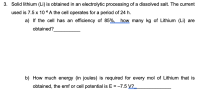 3. Solid lithium (Li) is obtained in an electrolytic processing of a dissolved salt. The current used is 7.5 x 10 4 A the cell operates for a period of 24 h. a) If the cell has an efficiency of 85%, how many kg of Lithium (Li) are obtained? b) How much energy (in joules) is required for every mol of Lithium that is obtained, the emf or cell potential is E = -7.5 V?
3. The apparatus in Figure I is used for electrolytic deposition of 0.0500 M Cu2 ion from a solut...
 3. The apparatus in Figure I is used for electrolytic deposition of 0.0500 M Cu2 ion from a solution which is buffered to pH 3.00. Oxygen is evolved at the anode at 1.00 atm. E07% = 0.000 V. (a) Given that Ecu 2+/Cu 6 to 12 V de -0.337 V,E:2/H20 7 V, E02/H,o 1.229 V and the internal resistance of the cell is 15.0 Ω. current(A Calculate the potential that must be applied to cause an Voltmeter electrolytic current of...
A common primary battery for pacemakers is the lithium–iodine cell. The negative electrode is lithium metal,...
A common primary battery for pacemakers is the lithium–iodine cell. The negative electrode is lithium metal, the positive electrode is a paste made with I2 and a small amount of polyvinylpyridine (PVP), and the separator is the ionic salt LiI. The overall reaction is 2Li + I2 « 2LiI(s) Write out the half-cell reactions and using the DG°f,LiI = -270.3 kJ mol-1 calculate the equilibrium potential and the theoretical capacity in A·h·g−1. You may treat the positive electrode paste as...
 The heating element of a coffeemaker operates at 120 V and carries a current of 5.50 A. Assuming the water absorbs all of the energy converted by the resistor, calculate how long it takes to heat 0.710 kg of water from room temperature (23.0°C) to the boiling point. min Need Help? Read It Master It -/10 Points] DETAILS SERCP11 17.2.P.005. A certain laboratory experiment requires an aluminum wire of length of 27.0 m and a resistance of 4.30 at 20.0°C....
 An electrochemical cell consists of two silver electrodes placed in aqueous solution of silver nitrate. The positive electrode is called anode, whereas the negative electrode is called cathode. A constant current of 0.5 A is passed through the cell for 1 hour. a) What is the total charge q transported through the cell? b) If one electron is needed to discharge one positively charged silver ion (that is, to neutralize the ion and deposit it on the cathode), how many...
 Given the following electrolytic cell:
The current is discharged into the electrolytic cell containing
the solution CuSO4(aq) 1.0M at 25 oC. During
the operation of the cell, copper Cu(s) is deposited on
one electrode and oxygen O2(g) gas is released, near the
second electrode.
O2(g) + 4H3O+(aq) +
4e-
6H2O(l) Eo= 1.23V
Cu2+(aq) + 2e- Cu(s)
Eo= 0.34V
A. Write the direction of the flow of electrons in the
cell.
B. Write the electrolysis equation that occurs in the cell....
Given the following electrolytic cell:
The current is discharged into the electrolytic cell containing
the solution CuSO4(aq) 1.0M at 25 oC. During
the operation of the cell, copper Cu(s) is deposited on
one electrode and oxygen O2(g) gas is released, near the
second electrode.
O2(g) + 4H3O+(aq) +
4e-
6H2O(l) Eo= 1.23V
Cu2+(aq) + 2e- Cu(s)
Eo= 0.34V
A. Write the direction of the flow of electrons in the
cell.
B. Write the electrolysis equation that occurs in the cell....
 Reduction occurs, the electrode is negative and iron metal is formed. QUESTION 10 Which of the following metals would slow down the rate of corrosion of iron metal if placed in electrical contact with the iron? Note that this is a multiple answer question, you can select more than one answer. Mg(s) Ag(s) Al(s) Sn(s) Cu(s) QUESTION 11 Match the voltaic and electrolytic cell concepts A. 4 Requires energy input A. Electrolytic
 Given the following electrolytic cell:
The current is discharged into the electrolytic cell containing
the solution CuSO4(aq) 1.0M at 25 oC. During
the operation of the cell, copper Cu(s) is deposited on
one electrode and oxygen O2(g) gas is released, near the
second electrode.
O2(g) + 4H3O+(aq) +
4e-
6H2O(l) Eo= 1.23V
Cu2+(aq) + 2e- Cu(s)
Eo= 0.34V
A. The current in the cell is 1.5 amperes. The current is
streamed in 40 minutes.
i. Calculate the mass of copper...
Given the following electrolytic cell:
The current is discharged into the electrolytic cell containing
the solution CuSO4(aq) 1.0M at 25 oC. During
the operation of the cell, copper Cu(s) is deposited on
one electrode and oxygen O2(g) gas is released, near the
second electrode.
O2(g) + 4H3O+(aq) +
4e-
6H2O(l) Eo= 1.23V
Cu2+(aq) + 2e- Cu(s)
Eo= 0.34V
A. The current in the cell is 1.5 amperes. The current is
streamed in 40 minutes.
i. Calculate the mass of copper...
 3. Solid lithium (Li) is obtained in an electrolytic processing of a dissolved salt. The current used is 7.5 x 10 4 A the cell operates for a period of 24 h. a) If the cell has an efficiency of 85%, how many kg of Lithium (Li) are obtained? b) How much energy (in joules) is required for every mol of Lithium that is obtained, the emf or cell potential is E = -7.5 V?
 3. The apparatus in Figure I is used for electrolytic deposition of 0.0500 M Cu2 ion from a solution which is buffered to pH 3.00. Oxygen is evolved at the anode at 1.00 atm. E07% = 0.000 V. (a) Given that Ecu 2+/Cu 6 to 12 V de -0.337 V,E:2/H20 7 V, E02/H,o 1.229 V and the internal resistance of the cell is 15.0 Ω. current(A Calculate the potential that must be applied to cause an Voltmeter electrolytic current of...
Most questions answered within 3 hours.
-
Where is the error in this code sequence?
String s1 = "Hello";
String s2 = "ello";...
asked 11 months ago -
Financial data for Joel de Paris, Inc., for last year
follow:
Joel de Paris, Inc.
Balance...
asked 11 months ago -
Consider this reaction:
Al2(SO4)3 (aq)+ BaCl3
(aq) Al2Cl6 (aq)- +
3BaSO4(s) . What is the...
asked 11 months ago -
Suppose that Savneet is considering increasing her
recent random sample from 20 car rentals to 40...
asked 11 months ago -
Trucks arrive at an unloading terminal at an average rate of 120
per hour.
Trucks arrive...
asked 11 months ago -
Why are methanol and ethanol completely soluble in water while
octanol is not very little soluble....
asked 11 months ago -
A facilities manager at a university reads in a research report
that the mean amount of...
asked 11 months ago -
When the CuSO4 is rehydrated by adding water to the anhydrous
compound, is this an endothermic...
asked 11 months ago -
A ray of sunlight is passing from diamond into crown glass; the
angle of incidence is...
asked 11 months ago -
A block of mass 0.249 kg is placed on top of a light, vertical
spring of...
asked 11 months ago -
how do the kidneys compensate in the presences of acidosis
a) trigger hyperventilate
b) reserve acid...
asked 11 months ago -
Question 501 pts
The rental rate of capital to the firm increases. Which of the
following...
asked 11 months ago