What is the Control Procurements Process? What are the eight inputs of Control Procurements? Describe the...
- What is the Control Procurements Process?
- What are the eight inputs of Control Procurements?
- Describe the Control Procurements Tools and Techniques.
please i need good information
Homework Answers
“Control Procurements is the process of managing procurement
relationships; monitoring contract performance, and making changes
and corrections as appropriate; and closing out contracts. The key
benefit of this process is that it ensures that both the seller’s
and buyer’s performance meet the project’s requirements according
to the terms of the legal agreement. This process is performed
throughout the project as needed.” (PMBOK Guide p492)
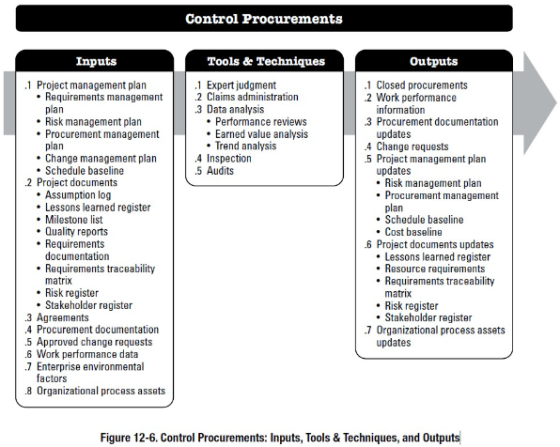
When you think of controlling procurements -- even after reading the introduction to this chapter -- it’s very easy to think of just contracts and agreements, and of authorizing payments, and chasing after late or incorrect deliverables.
But did you notice the very first sentence in the introduction?
“Control Procurements is the process of managing procurement relationships”
And so, in the exam you can expect questions related to contracts and agreements, and to authorizing payments and chasing after late or incorrect deliverables.But the underlying focus is largely concerned with managing the relationships between the buyer and the seller.
Who is the buyer?
And as I mentioned in previous lessons; in the exam, you will be considered to be on the buyer’s side of the contract relationship, unless the question clearly says otherwise.
There are binding legal aspects to contracts and so everyone involved, both buyer and seller needs to be aware of this and make all reasonable efforts to ensure that they don’t unwittingly trigger a legal trap.However, although there are legal remedies built into contracts, using them is something to be done with fear and trepidation.
There are two old sayings that spring to mind,“only a fool rushes into Court”, and “the only thing certain in law is that there is nothing certain in law.”
Another important point to consider is that usually sellers are much more familiar with selling than buyers are with buying, because sellers are in the business of contracting, but buyers are involved in procurement contracts only when they need to be. And this means that sellers often have a lot more experience with contract law, than the buyers have.
To illustrate this point; I was interviewing a lady once for a Project Management position. She had worked as a Project Manager with a major international software developer.
She told me that Project Managers in her organization were instructed, that from day one of the contract they were to relentlessly document every possible contractual failure, or contractual impediment, made by the client. And then if things went badly wrong in the contract and it ended up in Court, the seller would be represented with barristers, pushing carts of incriminating documents, but the client would arrrive with a lawyer armed mainly with unsubstantiated rumour and innuendo.
In Court; cases are won or lost on documentation.Your organization may have its own legal department, especially if the organization is large, but you have to make sure you provide them with the right ammunition.
And this is another great reason for recording lessons learned as you find them.
But even if your organization doesn’t have a legal department, it is recommended that the legal aspects of contract management are handled outside the project. Likewise, procurement management is usually managed by a department or function outside the project, otherwise trying to manage multiple interfaces at multiple levels within the project, would overburden the team. However, although contracts can be administered outside the project, the project management processes related to the contract work must occur within the project.
When you are managing multiple sellers, you will spend a large amount of time communicating with them and trying to correct miscommunications.You may recall from Communications Management that a Project Manager spends 90% of their time communicating (this is a frequent exam question), but if you have multiple contracts and vendors, you are in danger on under-communicating in the other parts of the project, because there is just one Project Manager.
So, what activities can be administered outside the project?
They may include:
- Collection of data and managing project records, including maintenance of detailed records of physical andfinancial performance and establishment of measurable procurement performance indicators. As I have said several times, if you can’t measure it, you can’t manage it;
- Refinement of procurement plans and schedules. This is not unlike the general administrative support that can be provided to a Project Manager by the PMO, e.g. creating and maintaining project schedules and reports;
- Set up for gathering, analyzing, and reporting procurement-related project data and preparation of periodicreports to the organization. For the exam please remember that data is a raw material. Reports and charts convert the data into information. And using the information converts information into knowledge;
- Monitoring the procurement environment so that implementation can be facilitated or adjustments made; and
- Payment of invoices
And although the PMBOK Guide is not specific in this area, the instruction to make the payment should come from the project team.
The PMBOK Guide says on page 494
“The quality of the controls, including the independence and credibility of procurement audits, is critical to the reliabilityof the procurement system.
The organization’s code of ethics, its legal counsel, and external legal advisory arrangements,including any ongoing anti-corruption initiatives, can contribute to proper procurement controls.
Control Procurements also involves monitoring payments to the seller.
Thisensures that payment terms defined within the contract are met and that compensation is linked to the seller’s progressas defined in the contract.
A principal concern when making payments is to ensure there is a close relationship ofpayments made to the work accomplished.
A contract that requires payments linked to project output and deliverablesrather than inputs such as labor hours has better controls.
Agreements can be amended at any time prior to contract closure by mutual consent, in accordance with the changecontrol terms of the agreement.
Such amendments are typically captured in writing.”
CONTROL PROCUREMENTS: INPUTS
The Project management plan
As I have mentioned before, the Project management plan (aka the Project plan) is not just a project schedule. The Project management plan is a collection of 18 components, made of up 12 sub-plans, 4 baselines (including the schedule baseline), the project life cycle, and the development approach.
You will find a full description in Table 4-1, on page 89 of the PMBOK Guide
TheProject management plan components of interest to the Control Procurements process include:
- Requirements management plan
This describeshow contractor requirements will be analyzed, documented, and managed.
- Risk management plan
Describes how risk activitiescreated by sellers will be structured and performed for the project.
Please note the wording of this for the exam, “risk activities created by sellers”. There are a number of causes of risks in the Control Procurements process, and it seems strange to me that just the seller risks have been highlighted. But as I have mentioned before, the exam creators like testing you on exceptions.
- Procurement management plan
To inform you ofthe activities to be performed during the Control Procurement process
- Change management plan
For instructions on processing seller-created changes.
- Schedule baseline
If there are slippages created by sellers that impact overallproject performance, the schedule may need to be updated and approved to reflect the current expectations.
Normally the PMBOK Guide reminds you that the schedule baseline (or any baseline) can only be updated by raising a change request, and having the change request approving through Integrated Change Control.
They forgot to remind you this time, so I did instead :)
Stop for a moment!
Why aren’t we using the project schedule as an input? Surely it would tell us when contracts start, wouldn’t it?
If you are thinking that I might be right about the schedule, you have fallen into a common exam trap.
As I have mentioned before in the course, PMI grew out of gigantic projects in the 1960’s, such Apollo and Polaris projects. And in the exam, unless it clearly says otherwise, that is the size of project being considered in the question.
And so, a schedule would also be vast, which means that you wouldn’t “see the forest for the trees”. You would spend hours just searching for contracts. A much better way would be if you just had a chart of the just main touchpoints of the schedule, in any easy to find format.
The good news is that we do!
It’s called the Milestone list!
I guess your next question might be, if the Milestone list is what we need, then why is it not shown as in input from the Project management plan?
The simple answer is, the Milestone list is actually a Project Document. There are 33 Project Documents used in a project, but they are not included in the Project management plan.
Please study Table 4-1, on page 89 of the PMBOK Guide, which shows the 18 components of the Project management plan and the 33 Project Documents.
But for the exam -- especially when you are felling stressed -- be extremely careful not to confuse project business documents, with project documents.
There are just two project business documents -- and no! I’m, not going to tell you them again, you are going to have to find them in the PMBOK Guide yourself this time, so you won’t forget them again. Hint: look on page 29.
One of the main differences, which often appears in the exam, is that the Project Manager *can* change the Project Documents, but *can’t* change the Project Business Documents
Just as an aside - did you know that the PMP exam existed before the first PMBOK Guide was written?
Eleven people took the very first PMP exam, but only about 4 passed. And so the PMBOK Guide was developed as a study guide for the exam.
PROJECT DOCUMENTS
Project documents that can be considered as inputs to this process include:
- Assumption log
The assumption log documents the assumptions that have beenmade during the procurement process. But the PMBOK Guide forgot to mention that the Assumption Log, also documents the constraints.
- Lessons learned register
For the exam please remember that lessons learned on this project are recorded in the Lessons Learned Register, and should be recorded as they are learned (or you will forget/misremember them).
Lessons learned on *previous* projects are recorded in the Lessons Learned Repository.
At the end of the project (or termination of a failed project), the project team will edit the Lessons Learned Register and copy it into Lessons Learned Repository.
Also for the exam, please note that this means, that at any time on the project you have access to two sets of lessons learned, the repository (previous lessons) and the register (current lessons).
- Milestone list
This list of major milestones shows when the sellers are expectedto deliver their results.
And as I mentioned earlier, this is much easier to use for this process, than the project schedule.
Do you remember the exam trap about the project schedule I mentioned earlier in the course?
And it is important to know that you don’t use the project schedule to manage your project. The schedule is for reporting to management. It is just a snapshot of the schedule model (the CPM/PDM network). It is the schedule model that you use for managing your project.
The “schedule” created by your software application is not the same as the schedule in the exam. The “schedule” created by your software application is actually a combination of the schedule model and the schedule.
- Quality reports
These identify seller processes, procedures,or products that are out of compliance.
- Requirements documentation
May include:
-
- Technical requirements the seller is required to satisfy, and
- Requirements with contractual and legal implications that may include health, safety, security, performance,environmental, insurance, intellectual property rights, equal employment opportunity, licenses, permits, and other nontechnical requirements.
- Requirements traceability matrix
The requirements traceability matrix linksproduct requirements from their origin to the deliverables that satisfy them.
- Risk register
Each approved seller comes with its own unique set of risks,depending on the seller’s organization, the duration of the contract, the external environment, the project deliverymethod, the type of contracting vehicle chosen, and the final agreed-upon price.
As you become aware of the risks, they will need to be registered and assessed.
- Stakeholder register
Includes information aboutidentified stakeholders, including contracted team members, selected sellers, contracting officers, and otherstakeholders who are involved in procurements.
There is an input missing from the Control Procurements. I don’t know why it is missing.
And this is the Project Communications plan. The Control Procurement process is heavy on communications, and the Project Communications plan defines how it should be done.
AGREEMENTS
Agreements are understandings between parties, including understanding of theduties of each party
The relevant agreements are reviewed to verify terms and conditions are met
Agreements can *include* contracts, but not all agreement are contracts.
For example, your project might have agreements with other departments of your organization, but it can’t have contracts with other departments.
Because an organization is a single legal entity, and a contract must be between at least 2 separate entities, because it would be impossible for an entity to sue itself in Court.
PROCUREMENT DOCUMENTATION
This contains complete supporting records for administration of the procurement processes, and would include the statement of work, payment information, contractor work performanceinformation, plans, drawings, and other correspondence.
APPROVED CHANGE REQUESTS
These can include modifications to the terms and conditions ofthe contract, including the procurement statement of work (SOW), pricing, and descriptions of the products, services, orresults to be provided.
All procurement-related changes are formally documented in writing and approved before beingimplemented through the Control Procurements process.
The project should have the capability ofidentifying, communicating, and resolving changes that impact the work of multiple sellers.
WORK PERFORMANCE
Contains seller data on project status for e.g.:
- technicalperformance;
- activities that have started, are in progress, or have completed;
- costs that have been incurred orcommitted;and
- seller invoices that have been paid
ENTERPRISE ENVIRONMENTAL FACTORS
The enterprise environmental factors that can influence the Control Procurements process include:
- Contract change control system,
- Marketplace conditions,
- Financial management and accounts payable system. You might remember from the lesson “Create WBS” in the Project Scope Management module that the work packages, planning packages and control accounts have a numbering system called the “Code of Accounts”, which is mapped to the organization’s Chart of Accounts in the Accounts Payable system, and this will be used to link contracts to payments.
- Buying organization’s code of ethics. This is most likely to be of interest if the seller is located in another country.
ORGANIZATIONAL PROCESS ASSETS
The organizational process assets that can influence the Control Procurements process include are the procurement policies
CONTROL PROCUREMENTS: TOOLS AND TECHNIQUES
EXPERT JUDGMENT
Expertise should be considered from individuals or groups with specialized knowledgeor training in the following topics:
- Relevant functional areas such as finance, engineering, design, development, supply chain management, etc.;
- Laws, regulations, and compliance requirements; and
- Claims administration
Many organizations will have their own legal and procurement departments, or at least experts in these fields, and so they will provide much of the expert judgment.
However, in that exam, watch out for contracts and procurements in areas where the organization has little experience, because then experts will be required from outside the organization.
CLAIMS ADMINISTRATION
A “claim” arises when the buyerrefuses to pay for constructive changes, because:
- the buyer and seller can’t agree the price, or
- the buyer alleges that the work was never actually done.
When they cannot be resolved, they become “disputes” and finally they become“appeals”, which may have to be handled in accordance with alternative dispute resolution (ADR) procedures established in the contract.
Settlement of all claims and disputes through negotiation is the preferred method, but as a last resort, the appeal may be heard in Court.
Claimsare documented, processed, monitored, and managed throughout the contract life cycle, usually in accordance with theterms of the contract.
DATA ANALYSIS
Techniques that can be used to monitor and control procurements include:
- Performance Reviews, to measure, compare, and analyze quality, resource,schedule, and cost performance of the contract against the agreement. This includes identifying work packages that are aheador behind schedule, over or under budget, or have resource or quality issues.
- Earned Value Analysis (EVA) Schedule and cost variances along with scheduleand cost performance indexes are calculated to determine the degree of variance from target.
- Trend Analysis This can develop a forecast estimate at completion(EAC) for cost performance to see if performance is improving or deteriorating.
If you are confused by Earned Value Analysis, please revise the lesson on Control Costs.
INSPECTION
An inspection is a structured review of the work being performed by the contractor.
This may involve a simple reviewof the deliverables or an actual physical review of the work itself.
On a construction/engineering/infrastructure project,inspections involve walkthroughs of the site by both the buyer and the contractor to ensure a mutual understanding ofthe work in progress. Nowadays, some walkthroughs on remote or hazardous sites, can be successfully performed using drones with video streaming.
AUDITS
Please note for the exam that Audits are a structured reviews of the procurement *process*, not of individual procurements, following the rights andobligations related to audits, if described in the procurement contract.
Resulting audit observations should bebrought to the attention of the buyer’s project manager and the seller’s project manager for adjustments to the project,when necessary.
CONTROL PROCUREMENTS: OUTPUTS
CLOSED PROCUREMENTS
The PMBOK Guide says that the buyer, usually through its authorized procurement administrator, provides the seller with formal written noticethat the contract has been completed.
Requirements for formal procurement closure are usually defined in the termsand conditions of the contract and are included in the procurement management plan.
Typically, all deliverables shouldhave been provided on time and meet technical and quality requirements, there should be no outstanding claims orinvoices, and all final payments should have been made.
The project management team should have approved alldeliverables prior to closure.
WORK PERFORMANCE INFORMATION
Includes information on how a seller is performing bycomparing the deliverables received, the technical performance achieved, and the costs incurred and accepted againstthe SOW budget for the work performed.
PROCUREMENT DOCUMENTATION UPDATES
Procurement documentation that may be updated includes the contract with all supporting schedules, requestedunapproved contract changes, and approved change requests.
Procurement documentation also includes anyseller-developed technical documentation and other work performance information such as deliverables, sellerperformance reports and warranties, financial documents including invoices and payment records, and the results ofcontract-related inspections.
CHANGE REQUESTS
Change requests to the project management plan, its subsidiary plans, and othercomponents such as the cost baseline, schedule baseline, and procurement management plan, may result from theControl Procurements process.
I find this to be slightly confusing, and you may do too, because the Project management plan is a collection of sub-plans, baselines, life cycle and management approach. And so they only way you can change the Project management plan is by changing one of its components.
As always, change requests are processed for review and action through the Perform IntegratedChange Control process.
Requested but unresolved changes can include direction provided by the buyer or actions taken by the seller, whichthe other party considers a constructive change to the contract.
A constructive change is an informal change, i.e. is has been performed, but has not gone through the Integrated change control system.
Since any of these constructive changes may be disputedby one party and can lead to a claim against the other party, such changes are uniquely identified and documented byproject correspondence.
PROJECT MANAGEMENT PLAN UPDATES
Any change to the project management plan goes through the organization’s change control process via a changerequest.
Components that may require a change request for the project management plan include:
- Risk management plan
Specific risks are incorporated into the risk register.And if significant unexpected risks occur during theexecution of the contract, the risk management plan may require updating. - Procurement management plan
This containsthe activities to be undertaken during the procurement process.
Updates may be required depending on theresults of the performance of the sellers during execution of the work.
For example you might find some sellers, especially the larger ones, may refuse to play be the rules of your organizations, whilst still following the terms of the contract. You might decide that the procurement management plan is too restrictive and modify it accordingly, so that you don’t waste time on needless arguments. - Schedule baseline
If there are significant schedule changes created by sellersthat impact overall project schedule performance, the baseline schedule may need to be updated and approvedto reflect the current expectations.
The buyer should be aware of any cascading impacts of schedule delayscreated by a seller that impact other sellers.
Sometimes I have found it to be a false economy using different sellers for several contracts. At the start you can make significant savings by “cherry-picking” the best deal for each procurement item, but this will create more interfaces to me managed -- which takes time and money -- and can create dependencies between sellers. - Cost baseline
Contractor and material costs can change frequently during thedelivery of a project.
These changes can occur because of fluctuating materials and labor prices created by theexternal economic environment and need to be incorporated into the cost baseline.
But this depends upon whether or not cost fluctuations are included in the terms of the contract.
One of the biggest risks -- both positive and negative -- is from overseas sellers, because large changes in exchange rates are not under the control of the seller. And risks not under the control of the seller can be transferred to them by the contract.
PROJECT DOCUMENTS UPDATES
Project documents that may be updated as a result of carrying out this process include:
- Lessons learned register
The lessons learned register can be updated withtechniques that were effective in maintaining the scope, schedule, and cost of the procured items.
Where variances occurred, the register should show the corrective actions that were used to respond to variancesand how effective those actions were.
If there are any claims, information should be documented to avoidrecurrences.
Additional information on how to improve the procurement process can also be recorded.
It’s important to note that information in the lessons learned register may be truly recorded, but it may not be true.
What I mean by this is that you record something that you believe to be true, but it later proves to be false. And this is one of the reasons why you need to edit the lessons learned register at the end of a project before transferring it to the lessons learned repository. - Resource requirements
To recordchanges resulting from work being done that is not in accordance with the plannedwork schedule. - Requirements traceability matrix
The requirements traceability matrix is updatedwith information on requirements that have been satisfied. - Risk register
Each approved seller comes with its own unique set of risks,depending on the seller’s organization, the duration of the contract, the external environment, the project deliverymethod, the type of contracting vehicle chosen, and the final agreed-upon price.
Changes are made to the riskregister during the execution of the project, as early risks may no longer be applicable and new risks occur. - Stakeholder register
To record changes to the stakeholders.
ORGANIZATIONAL PROCESS ASSETS UPDATES
Organizational process assets that can be updated as a result of the Control Procurements process include:
- Payment schedules and requests
All payments should be made in accordance with the procurement contractterms and conditions. And when these payments are made, you will need to update both the payment schedules and requests information. - Seller performance evaluation
documentation
Seller performance evaluation documentation is prepared bythe buyer and documents: - the seller’s ability to continue to perform work on the current contract,
- if the seller should be allowed to perform work on future projects, or
- rates how well the seller is performingthe project work or has performed in the past.
- Prequalified seller lists updates
Prequalified seller lists are lists of potential sellers who are previously qualified(approved).
These lists will be updated according to the Procurement Control process outcomes because sellerscould be disqualified and removed from the lists based on poor performance.
Prequalified seller lists are common practice in Government agencies, and in large organizations.
But please remember to edit this list to remove, or add notation to, and sellers in the Seller performance evaluation documentation, who are underperforming, or where there is a recommendation that they should to be allowed to perform future work. - Lessons learned repository
Lessons learned should be archived in the lessons learned repository to improveprocurements on future projects.
As I mentioned before, the lessons learned on the current project are stored in the Lessons Learned Register.
At the end of a contract, the actual results of the procurement are comparedwith the projected results in the original procurement management plan.
These lessons learned state ifthe project objectives were achieved and, if not, provides the reasons why they were not - Procurement file
A complete set of indexed contract documentation, including the closed contract, is preparedfor inclusion with the final project files.
That brings us to the end of Control Procurements, and also to the end of the Project Procurement Management module.
The next module is “13 Project Stakeholder Management”
Please read the corresponding chapter in the PMBOK Guide before watching the video.
CLOSE PROCUREMENTS
Procurements are closed when a contract is completed OR when a contract is terminated before the work is completed. The Close Procurements is a part of Closing Process Group. All procurements must be closed out, no matter the circumstances under which they stop, are terminated, or are completed.
Work that must be performed during Close Procurement phase:
- Product verification: Involves checking to see if all the work is done correctly and satisfactorily.
- Negotiated settlement: Final settlement of all claims, invoices and other issues.
- Financial closure: Involves making final payments and completing cost records.
- Procurement audit: Structured review of only the procurements process.
- Updates to records: Making sure all of the records of the project are complete and are accessible in the records management system.
- Final contract performance reporting: This is creating a final report.
- Lessons learned: Lessons learned from everyone including the seller are documented for the project.
- Procurement file: The file includes contract, changes, submittals from the seller, financial information, inspection results, lessons learnt.
Administer Procurements
Managing the relationship between the buyer and the seller and assuring both parties perform as required by the contract is termed as Administer procurements. The specific actions involved while Administering Procurements are reviewing invoices, completing integrated change control, documenting every record, managing changes, authorizing payments to the seller, interpreting what is and what is not in the contract, resolving disputes, procurement performance reviews, performance reports, monitor cost, schedule and technical performance against the contract, understanding the legal implications of the contract, controlling quality, among others.
Add Answer to:
What is the Control Procurements Process?
What are the eight inputs of Control Procurements?
Describe the...
Project Management:- This exercise pertains to the Validate Scope and Control Scope processes. Pl...
Project Management:- This exercise pertains to the Validate Scope and Control Scope processes. Please answer the following questions: a. Identify the inputs of the Validate Scope process. How are these inputs used to fulfill the purpose of this process? b. Discuss the tools and techniques used in the Validate Scope process as well as the outputs of the process. c. What inputs of Control Scope can you use to help determine if a scope change has occurred or should occur?...
What are the process of managing procurement relationships and How do they inform the Control Procurements...
What are the process of managing procurement relationships and How do they inform the Control Procurements process?
Based on the flowchart below: Identify any control weaknesses in the process. Describe the risks associated...
 Based on the flowchart below:
Identify any control weaknesses in the process.
Describe the risks associated with the control weaknesses.
Describe the control techniques needed to reduce the
risks.
Based on the flowchart below:
Identify any control weaknesses in the process.
Describe the risks associated with the control weaknesses.
Describe the control techniques needed to reduce the
risks.
Compare and contrast 2 tools/ techniques of the control quality process.
Compare and contrast 2 tools/ techniques of the control quality process.
Consider the student registration business process at your college: 1.)Describe the steps necessary for you to...
Consider the student registration business process at your college: 1.)Describe the steps necessary for you to register for your classes each semester. 2.)What inputs and outputs does the process have? What organizational resources are used in the process? I already understand #1, it is #2 that i need help with. The definitions of each: Inputs: Materials, services, and information that fl ow through and are transformed as a result of process activities Outputs: The product or a service created by...
18. Describe the process of DNA cloning. What do we need? Describe what a vector is....
 18. Describe the process of DNA cloning. What do we need? Describe what a vector is. Describe what the vector needs to have to be a good vector. How do you know when it works? Make sure to describe how we make recombinant DNA. I
Describe the story of quality design and control as seen it unfold up to this point....
Describe the story of quality design and control as seen it unfold up to this point. Include descriptions of the various tools and techniques we’ve covered so far and – more importantly – convey the meaning and significance of these tools in helping us better manage our processes.
What real-world process could Excel's solver be used to improve? Describe the data inputs and optimization...
What real-world process could Excel's solver be used to improve? Describe the data inputs and optimization you would seek. You might be maximizing the number of fish caught, minimizing food leftovers, etc. Example Post It takes way too long to go through airport security. Solver could be used to optimize airport security processes. Inputs would be the time it takes people to take off shoes, unpack luggage, go through the scanner, etc. Other inputs would be the number of guards...
Stop, Think, and Discuss 11.2 Remember the management process—inputs, throughputs, and outputs—discussed in the first chapter. How might the three types of control relate to the management process? What types of control can you identify in the opening vig
 Stop, Think, and Discuss 11.2 Remember the management process—inputs, throughputs, and outputs—. How might the three types of control relate to the management process? What types of control can you identify in the opening vignette? Be able to explain your answers
Describe an industry application, a process that satisfies the first law of thermodynamics, but not the...
Describe an industry application, a process that satisfies the first law of thermodynamics, but not the second law. Describe a product or system that manufacturers claim to minimize entropy generation for that process. Think outside the box as to how the entropy generation could be decreased further. (Design ideas cost more to incorporate than the money saved by the corporation.) How is entropy affected by processes? NOTE:- PLEASE ANSWER IT BY COMPUTER TYPING AND DON'T COPY FROM ANYWHERE NOT EVEN...
 18. Describe the process of DNA cloning. What do we need? Describe what a vector is. Describe what the vector needs to have to be a good vector. How do you know when it works? Make sure to describe how we make recombinant DNA. I
Most questions answered within 3 hours.
-
Where is the error in this code sequence?
String s1 = "Hello";
String s2 = "ello";...
asked 10 months ago -
Financial data for Joel de Paris, Inc., for last year
follow:
Joel de Paris, Inc.
Balance...
asked 10 months ago -
Consider this reaction:
Al2(SO4)3 (aq)+ BaCl3
(aq) Al2Cl6 (aq)- +
3BaSO4(s) . What is the...
asked 10 months ago -
Suppose that Savneet is considering increasing her
recent random sample from 20 car rentals to 40...
asked 10 months ago -
Trucks arrive at an unloading terminal at an average rate of 120
per hour.
Trucks arrive...
asked 10 months ago -
Why are methanol and ethanol completely soluble in water while
octanol is not very little soluble....
asked 10 months ago -
A facilities manager at a university reads in a research report
that the mean amount of...
asked 10 months ago -
When the CuSO4 is rehydrated by adding water to the anhydrous
compound, is this an endothermic...
asked 10 months ago -
A ray of sunlight is passing from diamond into crown glass; the
angle of incidence is...
asked 10 months ago -
A block of mass 0.249 kg is placed on top of a light, vertical
spring of...
asked 10 months ago -
how do the kidneys compensate in the presences of acidosis
a) trigger hyperventilate
b) reserve acid...
asked 10 months ago -
Question 501 pts
The rental rate of capital to the firm increases. Which of the
following...
asked 10 months ago