Marginal cost curves are often not linear, as we have assumed in this chapter for simplicity....
Marginal cost curves are often not linear, as we have assumed in
this chapter for simplicity. Why might this be
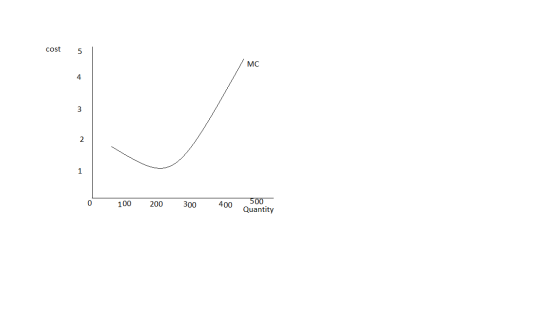
the case? Draw a marginal cost curve for a firm that cannot
increase its output beyond 500 units per month
Homework Answers
Part A
This shape is illustrative of some genuine bends where the slope at first decreases at that point rises once more. This shape will be seen when, at low degrees of output, the limit of the plant isn't completely utilized. Increments in output in this range will bring down minimal expenses as increasingly more of the limit is utilized. In the end minor costs start to ascend as limit use rises. More data sources must be utilized to create the extra output. The key point is that in the end the negligible cost bend must be upward slanting and may to be sure turned out to be vertical to demonstrate that no more output is conceivable.
Part B
Add Answer to:
Marginal cost curves are often not linear, as we have assumed in
this chapter for simplicity....
The graph to the right depicts the average cost curves and the marginal cost curve for...
 The graph to the right depicts the average cost curves and the marginal cost curve for a typical firm in a competitive industry. 1.) Using the line drawing fool, draw the firm's demand curve at a market price such that the firm is breaking even. Label your curved, 2.) Using the line drawing tool, draw the firm's demand curve at a market price such that the firm is at its shutdown price. Label your curved, Carefully follow the instructions above,...
What do a firm’s Marginal Revenue (MR) and Demand curves look like in perfect competition? Draw...
What do a firm’s Marginal Revenue (MR) and Demand curves look like in perfect competition? Draw them in a Quantity-Price/MR diagram (don’t forget to label the axes). Why do the MR and Demand curves look the way you draw? Briefly explain. Now add a Marginal Cost curve (MC) to the diagram you drew above. How is the profit-maximizing output in perfect competition determined? Mark this output as q* in the diagram. What is the price a firm in perfect competition...
UH Answer the following questions using the cost curves for the price-taking firm shown in the...
 UH Answer the following questions using the cost curves for the price-taking firm shown in the figure below. Is SMC Price and costs (dollars) TITTTTT ATC AVC LILLO 800 1.000 1.200 200 400 600 Quantity 1. If the price is $70 per unit of output, draw the marginal revenue curve and answer the following: a. How many units should be produced at this price? Explain why? b. Calculate: ATC, AVC, and AFC. c. Calculate the total cost of production at...
TOT D. Construct different cost curves Refer to the factors causing a shift of cost curves...
 TOT D. Construct different cost curves Refer to the factors causing a shift of cost curves on P.26 of lecture notes (topic 6), you are required to draw the average total cost curves (ATC), average variable cost curves (AVC), and marginal cost curves (MC) of a firm to indicate the possible impacts of the given changes Given that there is an increase in rent. (Draft work) Diagram Group discussion Given that there is an increase in wage rate. (Draft work)...
9. The following diagram shows the long-run average and marginal cost curves for a firm. AC...
 9. The following diagram shows the long-run average and marginal cost curves for a firm. AC SMC (K = 150) MC SMC (K=300 It also shows the short-run marginal cost curve for two levels of fixed capital: K = 150 and K=300. For each plant size, draw the corresponding short-run average cost curve and explain briefly why that curve should be where you drew it and how it is consistent with the other curves.
Draw the graph for a monopoly with demand, marginal revenue, and marginal cost curves. Identify the...
Draw the graph for a monopoly with demand, marginal revenue, and marginal cost curves. Identify the profit-maximizing output level (Qm) and price (Pm). Suppose the monopolist sells Qm units of output at the regular price and then puts the product on sale at a lower price, Ps. Show the new price and quantity. Identify the consumer surplus of the additional sales. What happens to the firm’s profits? Does price discrimination lead to a more efficient or less efficient outcome? Why...
Draw the graph for a monopoly with demand, marginal revenue, and marginal cost curves. Identify the...
Draw the graph for a monopoly with demand, marginal revenue, and marginal cost curves. Identify the profit-maximizing output level (Qm) and price (Pm). Suppose the monopolist sells Qm units of output at the regular price and then puts the product on sale at a lower price, Ps. Show the new price and quantity. Identify the consumer surplus of the additional sales. What happens to the firm’s profits? Does price discrimination lead to a more efficient or less efficient outcome? Why...
Price Discrimination Draw the graph for a monopoly with demand, marginal revenue, and marginal cost curves....
 Price Discrimination Draw the graph for a monopoly with demand, marginal revenue, and marginal cost curves. Identify the profit-maximizing output level (Qm) and price (Pm). Suppose the monopolist sells Qm units of output at the regular price and then puts the product on sale at a lower price, Ps. Show the new price and quantity. Identify the consumer surplus of the additional sales. What happens to the firm's profits? Does price discrimination lead to a more efficient or less efficient...
When marginal cost of production rises above the average total cost of production, we know that:...
When marginal cost of production rises above the average total cost of production, we know that: A. the firm has economies of scale B. average total cost is decreasing C. marginal cost is negative D. average total cost is increasing Average total cost curves are usually depicted as downward sloping at low levels of output because: A. Average fixed costs are declining B. Opportunity costs decline as output (Q) increases C. Average fixed...
Part II: Study Problem Answer the following questions using the cost curves for the price-taking firm...
 Part II: Study Problem Answer the following questions using the cost curves for the price-taking firm shown in the figure below SMC 3.50 3.00 2.50 ATC AVC 2.00 1.50 1.00 0.50 0 1,000 2,000 4.000 3000 Quantity 13. If price is $3 per unit of output, draw the marginal revenue curve. The manager should produce units. 2 14. Since average total cost is S S for this output, total cost is 15. The firm makes a profit of S 16....
 The graph to the right depicts the average cost curves and the marginal cost curve for a typical firm in a competitive industry. 1.) Using the line drawing fool, draw the firm's demand curve at a market price such that the firm is breaking even. Label your curved, 2.) Using the line drawing tool, draw the firm's demand curve at a market price such that the firm is at its shutdown price. Label your curved, Carefully follow the instructions above,...
 UH Answer the following questions using the cost curves for the price-taking firm shown in the figure below. Is SMC Price and costs (dollars) TITTTTT ATC AVC LILLO 800 1.000 1.200 200 400 600 Quantity 1. If the price is $70 per unit of output, draw the marginal revenue curve and answer the following: a. How many units should be produced at this price? Explain why? b. Calculate: ATC, AVC, and AFC. c. Calculate the total cost of production at...
 TOT D. Construct different cost curves Refer to the factors causing a shift of cost curves on P.26 of lecture notes (topic 6), you are required to draw the average total cost curves (ATC), average variable cost curves (AVC), and marginal cost curves (MC) of a firm to indicate the possible impacts of the given changes Given that there is an increase in rent. (Draft work) Diagram Group discussion Given that there is an increase in wage rate. (Draft work)...
 9. The following diagram shows the long-run average and marginal cost curves for a firm. AC SMC (K = 150) MC SMC (K=300 It also shows the short-run marginal cost curve for two levels of fixed capital: K = 150 and K=300. For each plant size, draw the corresponding short-run average cost curve and explain briefly why that curve should be where you drew it and how it is consistent with the other curves.
 Price Discrimination Draw the graph for a monopoly with demand, marginal revenue, and marginal cost curves. Identify the profit-maximizing output level (Qm) and price (Pm). Suppose the monopolist sells Qm units of output at the regular price and then puts the product on sale at a lower price, Ps. Show the new price and quantity. Identify the consumer surplus of the additional sales. What happens to the firm's profits? Does price discrimination lead to a more efficient or less efficient...
 Part II: Study Problem Answer the following questions using the cost curves for the price-taking firm shown in the figure below SMC 3.50 3.00 2.50 ATC AVC 2.00 1.50 1.00 0.50 0 1,000 2,000 4.000 3000 Quantity 13. If price is $3 per unit of output, draw the marginal revenue curve. The manager should produce units. 2 14. Since average total cost is S S for this output, total cost is 15. The firm makes a profit of S 16....
Most questions answered within 3 hours.
-
Where is the error in this code sequence?
String s1 = "Hello";
String s2 = "ello";...
asked 10 months ago -
Financial data for Joel de Paris, Inc., for last year
follow:
Joel de Paris, Inc.
Balance...
asked 10 months ago -
Consider this reaction:
Al2(SO4)3 (aq)+ BaCl3
(aq) Al2Cl6 (aq)- +
3BaSO4(s) . What is the...
asked 10 months ago -
Suppose that Savneet is considering increasing her
recent random sample from 20 car rentals to 40...
asked 10 months ago -
Trucks arrive at an unloading terminal at an average rate of 120
per hour.
Trucks arrive...
asked 10 months ago -
Why are methanol and ethanol completely soluble in water while
octanol is not very little soluble....
asked 10 months ago -
A facilities manager at a university reads in a research report
that the mean amount of...
asked 10 months ago -
When the CuSO4 is rehydrated by adding water to the anhydrous
compound, is this an endothermic...
asked 10 months ago -
A ray of sunlight is passing from diamond into crown glass; the
angle of incidence is...
asked 10 months ago -
A block of mass 0.249 kg is placed on top of a light, vertical
spring of...
asked 10 months ago -
how do the kidneys compensate in the presences of acidosis
a) trigger hyperventilate
b) reserve acid...
asked 10 months ago -
Question 501 pts
The rental rate of capital to the firm increases. Which of the
following...
asked 10 months ago