Translate the following code to java with comments x0 = 1 # The initial guess f(x)...
Translate the following code to java with comments
x0 = 1  # The initial guess
f(x) = x^2 - 2  # The function whose root we are trying to find
fprime(x) = 2 * x  # The derivative of the function
tolerance = 10^(-7)  # 7 digit accuracy is desired
epsilon = 10^(-14)  # Do not divide by a number smaller than this
maxIterations = 20  # Do not allow the iterations to continue indefinitely
solutionFound = false  # Have not converged to a solution yet

for i = 1:maxIterations
  y = f(x0)
  yprime = fprime(x0)

  if abs(yprime) < epsilon  # Stop if the denominator is too small
    break
  end

  global x1 = x0 - y/yprime  # Do Newton's computation

  if abs(x1 - x0) <= tolerance  # Stop when the result is within the desired tolerance
    global solutionFound = true
    break
  end

  global x0 = x1  # Update x0 to start the process again
end

if solutionFound
  println("Solution: ", x1)  # x1 is a solution within tolerance and maximum number of iterations
else
  println("Did not converge")  # Newton's method did not converge
endHomework Answers
`Hey,
Note: Brother if you have any queries related the answer please do comment. I would be very happy to resolve all your queries.
public class HelloWorld{
public static double f(double x)
{
return x*x-2.0;
}
public static double fprime(double x)
{
return x*2.0;
}
public static void main(String []args){
double x0 = 1; //The initial guess
double tolerance = 1e-7; // 7 digit accuracy is desired
double epsilon = 1e-14; // Do not divide by a number smaller than
this
int maxIterations = 20; // Do not allow the iterations to continue
indefinitely
boolean solutionFound = false; // Have not converged to a solution
yet
double x1=x0;
for(int i=1;i<=maxIterations;i++)
{
double y=f(x0);
double yprime = fprime(x0);
if(Math.abs(yprime) < epsilon)
{
break;
}
x1 = x0 - y/yprime;
if(Math.abs(x1 - x0) <= tolerance) // Stop when the result is
within the desired tolerance
{
solutionFound = true;
break;
}
x0 = x1;
}
if(solutionFound)
{
System.out.println("Solution: "+x1); // x1 is a solution within
tolerance and
}
else
System.out.println("Did not converge"); // Newton's method did not
converge
}
}
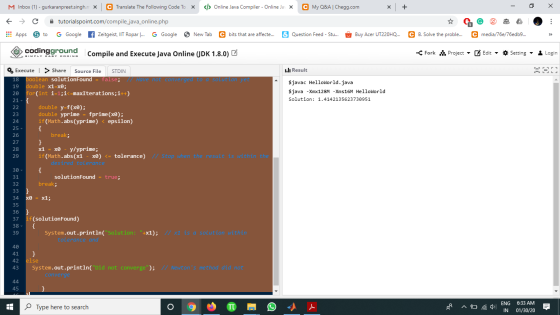
Kindly revert for any queries
Thanks.
Add Answer to:
Translate the following code to java with comments
x0 = 1 # The initial guess
f(x)...
in matlab -Consider the equation f(x) = x-2-sin x = 0 on the interval x E [0.1,4 π] Use a plot to approximately locate the roots of f. To which roots do the fol- owing initial guesses converge wh...
 in
matlab
-Consider the equation f(x) = x-2-sin x = 0 on the interval x E [0.1,4 π] Use a plot to approximately locate the roots of f. To which roots do the fol- owing initial guesses converge when using Function 4.3.1? Is the root obtained the one that is closest to that guess? )xo = 1.5, (b) x0 = 2, (c) x.-3.2, (d) xo = 4, (e) xo = 5, (f) xo = 27. Function 4.3.1 (newton) Newton's method...
in
matlab
-Consider the equation f(x) = x-2-sin x = 0 on the interval x E [0.1,4 π] Use a plot to approximately locate the roots of f. To which roots do the fol- owing initial guesses converge when using Function 4.3.1? Is the root obtained the one that is closest to that guess? )xo = 1.5, (b) x0 = 2, (c) x.-3.2, (d) xo = 4, (e) xo = 5, (f) xo = 27. Function 4.3.1 (newton) Newton's method...
Problem 4 (programming): Create a MATLAB function named mynewton.m to estimate the root for any a...
 Problem 4 (programming): Create a MATLAB function named mynewton.m to estimate the root for any arbitrary function f given an initial guess xo, an absolute error tolerance e and a maximum number of iterations max iter. Follow mynewton.m template posted in homework 2 folder on TritonED for guidance. You are not required to use the template. The function should return the approximated root ^n and the number of steps n taken to reach the solution. Use function mynewton.m to perform...
can some one edit this code p(1)=0.4 p(2)=0.5 e=0.00001 *secant metod >> syms x; f=(1/x) -2;...
 can some one edit this code
p(1)=0.4
p(2)=0.5
e=0.00001
*secant metod
>> syms x; f=(1/x) -2; e=input('Enter the epsilon: \n'); p(1)=input('Enter xo(1st guess) : '); p(2)=input('Enter x1(2nd guess): '); i=3; Error(i)=1; while Error(i)>=e p(i)=P(i-1)-(f(p(i-1))*(p(i-1)-p(1-2))/(f(p(i-1))-f(p(i- 2)))); Error(i)=abs(p(i-1)-p(i-2)); i=i+1; end fprintf('The Root is : %f \n', root); fprintf('No. of Iterations : %d\n',i); Enter the epsilon: 0.00001 Enter x (1st guess): 0.4 Enter x1(2nd guess): 0.5 Array indices must be positive integers or logical values. Error in sym/subsref (line 900) R_tilde = builtin('subsref',...
can some one edit this code
p(1)=0.4
p(2)=0.5
e=0.00001
*secant metod
>> syms x; f=(1/x) -2; e=input('Enter the epsilon: \n'); p(1)=input('Enter xo(1st guess) : '); p(2)=input('Enter x1(2nd guess): '); i=3; Error(i)=1; while Error(i)>=e p(i)=P(i-1)-(f(p(i-1))*(p(i-1)-p(1-2))/(f(p(i-1))-f(p(i- 2)))); Error(i)=abs(p(i-1)-p(i-2)); i=i+1; end fprintf('The Root is : %f \n', root); fprintf('No. of Iterations : %d\n',i); Enter the epsilon: 0.00001 Enter x (1st guess): 0.4 Enter x1(2nd guess): 0.5 Array indices must be positive integers or logical values. Error in sym/subsref (line 900) R_tilde = builtin('subsref',...
Use the following pseudocode for the Newton-Raphson method to write MATLAB code to approximate the cube...
Use the following pseudocode for the Newton-Raphson method to write MATLAB code to approximate the cube root (a)1/3 of a given number a with accuracy roughly within 10-8 using x0 = a/2. Use at most 100 iterations. Explain steps by commenting on them. Use f(x) = x3 − a. Choose a = 2 + w, where w = 3 Algorithm : Newton-Raphson Iteration Input: f(x)=x3−a, x0 =a/2, tolerance 10-8, maximum number of iterations100 Output: an approximation (a)1/3 within 10-8 or...
Looking for Muller Method MatLab coding for these following equations: This is the code I currently...
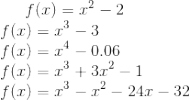 Looking for Muller Method MatLab coding for these following
equations:
This is the code I currently have but is not working
fun = @(x) x.^2-2;
x1 = 0;
x2 = 1;
tol = 0.0001;
kmax = 100;
function [x, y] = Muller(fun, x1, x2, tol, kmax)
x(1) = x1;
x(2) = x2;
x(3) = (x(2)+x(1))/2;
y(1) = feval(fun, x1);
y(2) = feval(fun, x2);
y(3) = feval(fun, x(3));
c(1) = (y(2)-y(1))/(x(2)-x(1));
for k = 3 : kmax
c(k-1) = (y(k)-y(k-1))/(x(k)-x(k-1));
d(k-2)...
Looking for Muller Method MatLab coding for these following
equations:
This is the code I currently have but is not working
fun = @(x) x.^2-2;
x1 = 0;
x2 = 1;
tol = 0.0001;
kmax = 100;
function [x, y] = Muller(fun, x1, x2, tol, kmax)
x(1) = x1;
x(2) = x2;
x(3) = (x(2)+x(1))/2;
y(1) = feval(fun, x1);
y(2) = feval(fun, x2);
y(3) = feval(fun, x(3));
c(1) = (y(2)-y(1))/(x(2)-x(1));
for k = 3 : kmax
c(k-1) = (y(k)-y(k-1))/(x(k)-x(k-1));
d(k-2)...
Write a MATLAB code employing Secant method and for loop to calculate the root for the following function: ?=?6−?−1 Use 7 iterations with initial guesses x0 = 2 and x1 = 1.
Write a MATLAB code employing Secant method and for loop to calculate the root for the following function: f=x6-x-1Use 7 iterations with initial guesses x0 = 2 and x1 = 1
Matlab Regula Falsi Method A zero of f(x) = x^2 -4x-12.2 is known to exist on...
 Matlab Regula Falsi Method
A zero of f(x) = x^2 -4x-12.2 is known to exist on the interval
[1.2 , 2.2 , 3.2,...9.2] and respective right endpoints x1 =[2.2
,3.2, 4.2....10.2], find the sub-interval in which the zero exists.
Set the left endpoint of this sub-interval =a and the right
endpoint=b
With tolerance of 10^-9, use the Regular Falsi method to compute
the root of (f) in [a,b]
User input is required at #####
CONTENTS Close Courses LMS Integration Documentation...
Matlab Regula Falsi Method
A zero of f(x) = x^2 -4x-12.2 is known to exist on the interval
[1.2 , 2.2 , 3.2,...9.2] and respective right endpoints x1 =[2.2
,3.2, 4.2....10.2], find the sub-interval in which the zero exists.
Set the left endpoint of this sub-interval =a and the right
endpoint=b
With tolerance of 10^-9, use the Regular Falsi method to compute
the root of (f) in [a,b]
User input is required at #####
CONTENTS Close Courses LMS Integration Documentation...
45-3. Modify the code used in Example 4 to find the root only at f(x)<0.01 using...
 45-3. Modify the code used in Example 4 to find the root only at f(x)<0.01 using Newton-Rephson Method without showing any iteration. Also find the root of equation, f(x) = x 9-3x -10, take initial guess, Xo=2 العقدة College of 9:05 mybb.qu.edu.ca Numerical Methods (Lab.) GENG 300 Summer 2020 5.1.2 Open Methods - Newton-Raphson Method f(x) *1+1 = x; - Matlab Code Example:4 function mynewtraph.t1.x0,-) XXO for ilin x - x - x)/1 x) disp 1 x) <0.01 break end...
5.1.2 Open Methods - Newton-Raphson Method Xi+1= xi – FOTO Matlab Code Example:4 function mynewtraph (f,...
 5.1.2 Open Methods - Newton-Raphson Method Xi+1= xi – FOTO Matlab Code Example:4 function mynewtraph (f, f1,x0,n) Xx0; for ilin x = x - f(x)/f1(x); disp (li if f(x) <0.01 f(x))) break end end end Matlab Code from Chapra function [root, ea, iter)=newtraph (func,dfunc, xr, es,maxit,varargin) newtraph: Newton-Raphson root location zeroes 8 [root, ea, iter)-newtraph (func, dfunc, xr, es,maxit,pl,p2, ...): $uses Newton-Raphson method to find the root of fune input: func- name of function 8dfunc = name of derivative of...
*3. Consider a function, f(x,y) = x3 + 3(y-1)2 . Starting from an initial point, X0 = [1 1] T , perform 2 iterations of...
*3. Consider a function, f(x,y) = x3 + 3(y-1)2 . Starting from an initial point, X0 = [1 1] T , perform 2 iterations of conjugate gradient method (also known as Fletcher-Reeves method) to minimize the above function. Also, please check for convergence after each iteration.
 in
matlab
-Consider the equation f(x) = x-2-sin x = 0 on the interval x E [0.1,4 π] Use a plot to approximately locate the roots of f. To which roots do the fol- owing initial guesses converge when using Function 4.3.1? Is the root obtained the one that is closest to that guess? )xo = 1.5, (b) x0 = 2, (c) x.-3.2, (d) xo = 4, (e) xo = 5, (f) xo = 27. Function 4.3.1 (newton) Newton's method...
in
matlab
-Consider the equation f(x) = x-2-sin x = 0 on the interval x E [0.1,4 π] Use a plot to approximately locate the roots of f. To which roots do the fol- owing initial guesses converge when using Function 4.3.1? Is the root obtained the one that is closest to that guess? )xo = 1.5, (b) x0 = 2, (c) x.-3.2, (d) xo = 4, (e) xo = 5, (f) xo = 27. Function 4.3.1 (newton) Newton's method...
 Problem 4 (programming): Create a MATLAB function named mynewton.m to estimate the root for any arbitrary function f given an initial guess xo, an absolute error tolerance e and a maximum number of iterations max iter. Follow mynewton.m template posted in homework 2 folder on TritonED for guidance. You are not required to use the template. The function should return the approximated root ^n and the number of steps n taken to reach the solution. Use function mynewton.m to perform...
 can some one edit this code
p(1)=0.4
p(2)=0.5
e=0.00001
*secant metod
>> syms x; f=(1/x) -2; e=input('Enter the epsilon: \n'); p(1)=input('Enter xo(1st guess) : '); p(2)=input('Enter x1(2nd guess): '); i=3; Error(i)=1; while Error(i)>=e p(i)=P(i-1)-(f(p(i-1))*(p(i-1)-p(1-2))/(f(p(i-1))-f(p(i- 2)))); Error(i)=abs(p(i-1)-p(i-2)); i=i+1; end fprintf('The Root is : %f \n', root); fprintf('No. of Iterations : %d\n',i); Enter the epsilon: 0.00001 Enter x (1st guess): 0.4 Enter x1(2nd guess): 0.5 Array indices must be positive integers or logical values. Error in sym/subsref (line 900) R_tilde = builtin('subsref',...
can some one edit this code
p(1)=0.4
p(2)=0.5
e=0.00001
*secant metod
>> syms x; f=(1/x) -2; e=input('Enter the epsilon: \n'); p(1)=input('Enter xo(1st guess) : '); p(2)=input('Enter x1(2nd guess): '); i=3; Error(i)=1; while Error(i)>=e p(i)=P(i-1)-(f(p(i-1))*(p(i-1)-p(1-2))/(f(p(i-1))-f(p(i- 2)))); Error(i)=abs(p(i-1)-p(i-2)); i=i+1; end fprintf('The Root is : %f \n', root); fprintf('No. of Iterations : %d\n',i); Enter the epsilon: 0.00001 Enter x (1st guess): 0.4 Enter x1(2nd guess): 0.5 Array indices must be positive integers or logical values. Error in sym/subsref (line 900) R_tilde = builtin('subsref',...
 Looking for Muller Method MatLab coding for these following
equations:
This is the code I currently have but is not working
fun = @(x) x.^2-2;
x1 = 0;
x2 = 1;
tol = 0.0001;
kmax = 100;
function [x, y] = Muller(fun, x1, x2, tol, kmax)
x(1) = x1;
x(2) = x2;
x(3) = (x(2)+x(1))/2;
y(1) = feval(fun, x1);
y(2) = feval(fun, x2);
y(3) = feval(fun, x(3));
c(1) = (y(2)-y(1))/(x(2)-x(1));
for k = 3 : kmax
c(k-1) = (y(k)-y(k-1))/(x(k)-x(k-1));
d(k-2)...
Looking for Muller Method MatLab coding for these following
equations:
This is the code I currently have but is not working
fun = @(x) x.^2-2;
x1 = 0;
x2 = 1;
tol = 0.0001;
kmax = 100;
function [x, y] = Muller(fun, x1, x2, tol, kmax)
x(1) = x1;
x(2) = x2;
x(3) = (x(2)+x(1))/2;
y(1) = feval(fun, x1);
y(2) = feval(fun, x2);
y(3) = feval(fun, x(3));
c(1) = (y(2)-y(1))/(x(2)-x(1));
for k = 3 : kmax
c(k-1) = (y(k)-y(k-1))/(x(k)-x(k-1));
d(k-2)...
 Matlab Regula Falsi Method
A zero of f(x) = x^2 -4x-12.2 is known to exist on the interval
[1.2 , 2.2 , 3.2,...9.2] and respective right endpoints x1 =[2.2
,3.2, 4.2....10.2], find the sub-interval in which the zero exists.
Set the left endpoint of this sub-interval =a and the right
endpoint=b
With tolerance of 10^-9, use the Regular Falsi method to compute
the root of (f) in [a,b]
User input is required at #####
CONTENTS Close Courses LMS Integration Documentation...
Matlab Regula Falsi Method
A zero of f(x) = x^2 -4x-12.2 is known to exist on the interval
[1.2 , 2.2 , 3.2,...9.2] and respective right endpoints x1 =[2.2
,3.2, 4.2....10.2], find the sub-interval in which the zero exists.
Set the left endpoint of this sub-interval =a and the right
endpoint=b
With tolerance of 10^-9, use the Regular Falsi method to compute
the root of (f) in [a,b]
User input is required at #####
CONTENTS Close Courses LMS Integration Documentation...
 45-3. Modify the code used in Example 4 to find the root only at f(x)<0.01 using Newton-Rephson Method without showing any iteration. Also find the root of equation, f(x) = x 9-3x -10, take initial guess, Xo=2 العقدة College of 9:05 mybb.qu.edu.ca Numerical Methods (Lab.) GENG 300 Summer 2020 5.1.2 Open Methods - Newton-Raphson Method f(x) *1+1 = x; - Matlab Code Example:4 function mynewtraph.t1.x0,-) XXO for ilin x - x - x)/1 x) disp 1 x) <0.01 break end...
 5.1.2 Open Methods - Newton-Raphson Method Xi+1= xi – FOTO Matlab Code Example:4 function mynewtraph (f, f1,x0,n) Xx0; for ilin x = x - f(x)/f1(x); disp (li if f(x) <0.01 f(x))) break end end end Matlab Code from Chapra function [root, ea, iter)=newtraph (func,dfunc, xr, es,maxit,varargin) newtraph: Newton-Raphson root location zeroes 8 [root, ea, iter)-newtraph (func, dfunc, xr, es,maxit,pl,p2, ...): $uses Newton-Raphson method to find the root of fune input: func- name of function 8dfunc = name of derivative of...
Most questions answered within 3 hours.
-
Where is the error in this code sequence?
String s1 = "Hello";
String s2 = "ello";...
asked 11 months ago -
Financial data for Joel de Paris, Inc., for last year
follow:
Joel de Paris, Inc.
Balance...
asked 11 months ago -
Consider this reaction:
Al2(SO4)3 (aq)+ BaCl3
(aq) Al2Cl6 (aq)- +
3BaSO4(s) . What is the...
asked 11 months ago -
Suppose that Savneet is considering increasing her
recent random sample from 20 car rentals to 40...
asked 11 months ago -
Trucks arrive at an unloading terminal at an average rate of 120
per hour.
Trucks arrive...
asked 11 months ago -
Why are methanol and ethanol completely soluble in water while
octanol is not very little soluble....
asked 11 months ago -
A facilities manager at a university reads in a research report
that the mean amount of...
asked 11 months ago -
When the CuSO4 is rehydrated by adding water to the anhydrous
compound, is this an endothermic...
asked 11 months ago -
A ray of sunlight is passing from diamond into crown glass; the
angle of incidence is...
asked 11 months ago -
A block of mass 0.249 kg is placed on top of a light, vertical
spring of...
asked 11 months ago -
how do the kidneys compensate in the presences of acidosis
a) trigger hyperventilate
b) reserve acid...
asked 11 months ago -
Question 501 pts
The rental rate of capital to the firm increases. Which of the
following...
asked 11 months ago