Show that the logistic sigmoid function σ(a) = 1/1+exp(-a) satisfies the property σ(-a)= 1-σ(a) and that...
Show that the logistic sigmoid function σ(a) = 1/1+exp(-a) satisfies the property σ(-a)= 1-σ(a) and that its inverse is given by σ-1(y) = ln {y/(1 y)}.
Homework Answers


Add Answer to:
Show that the logistic sigmoid function σ(a) = 1/1+exp(-a)
satisfies the property σ(-a)= 1-σ(a) and that...
2. Consider a case of two classes, with class conditional probabilities p(x|Ck) and class priors p(Ck)....
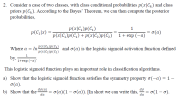 2. Consider a case of two classes, with class conditional probabilities p(x|Ck) and class priors p(Ck). According to the Bayes' Theorem, we can then compute the posterior probabilities, p(C1|x) = p(x|Cup(C) 1 p(x|C1)p(C1) + p(x|C2)p(C2) 1+ exp (-a) = = o(a) Where a = P(x(1)P(C1) In and o(a) is the logistic sigmoid activation function defined P(x|C2)p(C2) 1 by, 1+exp(-a) This logistic sigmoid function plays an important role in classification algorithms. a) Show that the logistic sigmoid function satisfies the symmetry...
1. Suppose that a function f, defined for all real numbers, satisfies the property that, for...
 1. Suppose that a function f, defined for all real numbers, satisfies the property that, for all x and y, f(x + y) = f(x) + f(y). (*) (a) (2 points) Name a function that satisfies property (*). Name another that doesn't. Justify your answers. (b) (3 points) Prove that any function that satisfies property (*) also satisfies f(3x) = 3f(x). (c) (5 points) Prove that any function that satisfies property (*) also satisfies f(x - y) = f(x) –...
1. Suppose that a function f, defined for all real numbers, satisfies the property that, for...
 1. Suppose that a function f, defined for all real numbers, satisfies the property that, for all x and y, f(x + y) = f(x) + f(y). (*) (a) (2 points) Name a function that satisfies property (*). Name another that doesn't. Justify your answers. (b) (3 points) Prove that any function that satisfies property (*) also satisfies f(3x) = 3f(x). (c) (5 points) Prove that any function that satisfies property (*) also satisfies f(x - y) = f(x) –...
Show that the function y = cos (ln(x)] satisfies the differential equation 22 day dy +2...
 Show that the function y = cos (ln(x)] satisfies the differential equation 22 day dy +2 dx +y = 0. dc2
3. (15 marks) (a) (3 marks) What is a logistic sigmoidal function and what can it be used for? Assign values to the the necessary parameters in the logistic sigmoidal curve and use these to complete...
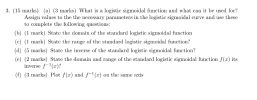 3. (15 marks) (a) (3 marks) What is a logistic sigmoidal function and what can it be used for? Assign values to the the necessary parameters in the logistic sigmoidal curve and use these to complete the following questions: (b) (1 mark) State the domain of the standard logistic sigmoidal function (c) (1 mark) State the range of the standard logistic sigmoidal function? (d) (5 marks) State the inverse of the standard logistic sigmoidal function? (e) (2 marks) State the...
Suppose X = Exp(1) and Y= -ln(x) (a)Find the cumulative distribution function of Y . (b)...
 Suppose X = Exp(1) and Y= -ln(x)
(a)Find the cumulative distribution function of Y .
(b) Find the probability density function of Y .
(c) Let X1, X2, ... , Xk be i.i.d. Exp(1), and let Mk =
max{X1,..... , Xk)(Maximum of X1, ..., Xk). Find the probability
density function of Mk.(Hint: P(min(X1, X2, X3) > k) = P(X1
>= k, X2 >= k, X3 >= kq, how about max ?)
(d) Show that as k → 00, the CDF...
Suppose X = Exp(1) and Y= -ln(x)
(a)Find the cumulative distribution function of Y .
(b) Find the probability density function of Y .
(c) Let X1, X2, ... , Xk be i.i.d. Exp(1), and let Mk =
max{X1,..... , Xk)(Maximum of X1, ..., Xk). Find the probability
density function of Mk.(Hint: P(min(X1, X2, X3) > k) = P(X1
>= k, X2 >= k, X3 >= kq, how about max ?)
(d) Show that as k → 00, the CDF...
Given a covariate Z, suppose that the log survival time Y follows a linear model with...
 Given a covariate Z, suppose that the log survival time Y follows a linear model with a logistic error distribution, that is, Y = ln(X) = μ + βΖ + σ W where the pdf of W is given by eu f(w) = (1 + ewy, (a) For an individual with covariate Z, find the conditional survival function of the survival time X, given Z, namely, S(x |Z). (b) The odds that an individual will die prior to time x...
2. Suppose a population P(t) satisfies the logistic differential equation dP dt = 0.1P 1 −...
 2. Suppose a population P(t) satisfies the logistic differential
equation dP dt = 0.1P 1 − P 2000 P(0) = 100 Find the following: a)
P(20) b) When will the population reach 1200?
2. Suppose a population P(t) satisfies the logistic differential equation 2P = 0.1P (1–2000) = 0.1P | P(0) = 100 2000 Find the following: a) P(20) b) When will the population reach 1200?
2. Suppose a population P(t) satisfies the logistic differential
equation dP dt = 0.1P 1 − P 2000 P(0) = 100 Find the following: a)
P(20) b) When will the population reach 1200?
2. Suppose a population P(t) satisfies the logistic differential equation 2P = 0.1P (1–2000) = 0.1P | P(0) = 100 2000 Find the following: a) P(20) b) When will the population reach 1200?
(10 pts). Show that the within-cluster variation (WCV) satisfies k=1 C(i)=k,C(j)-k equals to Σ Σ 1x,-제12,...
 (10 pts). Show that the within-cluster variation (WCV) satisfies k=1 C(i)=k,C(j)-k equals to Σ Σ 1x,-제12, where X,-1 Σα i) =k Xi ん
(a) Show that the function defined by the power series 20+1 y=(-1)" 2n +1 n=0 satisfies...
 (a) Show that the function defined by the power series 20+1 y=(-1)" 2n +1 n=0 satisfies the differential equation: (1+2?)y = 1. (b) Find the radius of convergence and the interval of convergence of the power series "-3 (x - 3)" 72 nao
 2. Consider a case of two classes, with class conditional probabilities p(x|Ck) and class priors p(Ck). According to the Bayes' Theorem, we can then compute the posterior probabilities, p(C1|x) = p(x|Cup(C) 1 p(x|C1)p(C1) + p(x|C2)p(C2) 1+ exp (-a) = = o(a) Where a = P(x(1)P(C1) In and o(a) is the logistic sigmoid activation function defined P(x|C2)p(C2) 1 by, 1+exp(-a) This logistic sigmoid function plays an important role in classification algorithms. a) Show that the logistic sigmoid function satisfies the symmetry...
 1. Suppose that a function f, defined for all real numbers, satisfies the property that, for all x and y, f(x + y) = f(x) + f(y). (*) (a) (2 points) Name a function that satisfies property (*). Name another that doesn't. Justify your answers. (b) (3 points) Prove that any function that satisfies property (*) also satisfies f(3x) = 3f(x). (c) (5 points) Prove that any function that satisfies property (*) also satisfies f(x - y) = f(x) –...
 1. Suppose that a function f, defined for all real numbers, satisfies the property that, for all x and y, f(x + y) = f(x) + f(y). (*) (a) (2 points) Name a function that satisfies property (*). Name another that doesn't. Justify your answers. (b) (3 points) Prove that any function that satisfies property (*) also satisfies f(3x) = 3f(x). (c) (5 points) Prove that any function that satisfies property (*) also satisfies f(x - y) = f(x) –...
 Show that the function y = cos (ln(x)] satisfies the differential equation 22 day dy +2 dx +y = 0. dc2
 3. (15 marks) (a) (3 marks) What is a logistic sigmoidal function and what can it be used for? Assign values to the the necessary parameters in the logistic sigmoidal curve and use these to complete the following questions: (b) (1 mark) State the domain of the standard logistic sigmoidal function (c) (1 mark) State the range of the standard logistic sigmoidal function? (d) (5 marks) State the inverse of the standard logistic sigmoidal function? (e) (2 marks) State the...
 Suppose X = Exp(1) and Y= -ln(x)
(a)Find the cumulative distribution function of Y .
(b) Find the probability density function of Y .
(c) Let X1, X2, ... , Xk be i.i.d. Exp(1), and let Mk =
max{X1,..... , Xk)(Maximum of X1, ..., Xk). Find the probability
density function of Mk.(Hint: P(min(X1, X2, X3) > k) = P(X1
>= k, X2 >= k, X3 >= kq, how about max ?)
(d) Show that as k → 00, the CDF...
Suppose X = Exp(1) and Y= -ln(x)
(a)Find the cumulative distribution function of Y .
(b) Find the probability density function of Y .
(c) Let X1, X2, ... , Xk be i.i.d. Exp(1), and let Mk =
max{X1,..... , Xk)(Maximum of X1, ..., Xk). Find the probability
density function of Mk.(Hint: P(min(X1, X2, X3) > k) = P(X1
>= k, X2 >= k, X3 >= kq, how about max ?)
(d) Show that as k → 00, the CDF...
 Given a covariate Z, suppose that the log survival time Y follows a linear model with a logistic error distribution, that is, Y = ln(X) = μ + βΖ + σ W where the pdf of W is given by eu f(w) = (1 + ewy, (a) For an individual with covariate Z, find the conditional survival function of the survival time X, given Z, namely, S(x |Z). (b) The odds that an individual will die prior to time x...
 2. Suppose a population P(t) satisfies the logistic differential
equation dP dt = 0.1P 1 − P 2000 P(0) = 100 Find the following: a)
P(20) b) When will the population reach 1200?
2. Suppose a population P(t) satisfies the logistic differential equation 2P = 0.1P (1–2000) = 0.1P | P(0) = 100 2000 Find the following: a) P(20) b) When will the population reach 1200?
2. Suppose a population P(t) satisfies the logistic differential
equation dP dt = 0.1P 1 − P 2000 P(0) = 100 Find the following: a)
P(20) b) When will the population reach 1200?
2. Suppose a population P(t) satisfies the logistic differential equation 2P = 0.1P (1–2000) = 0.1P | P(0) = 100 2000 Find the following: a) P(20) b) When will the population reach 1200?
 (10 pts). Show that the within-cluster variation (WCV) satisfies k=1 C(i)=k,C(j)-k equals to Σ Σ 1x,-제12, where X,-1 Σα i) =k Xi ん
 (a) Show that the function defined by the power series 20+1 y=(-1)" 2n +1 n=0 satisfies the differential equation: (1+2?)y = 1. (b) Find the radius of convergence and the interval of convergence of the power series "-3 (x - 3)" 72 nao
Most questions answered within 3 hours.
-
Where is the error in this code sequence?
String s1 = "Hello";
String s2 = "ello";...
asked 11 months ago -
Financial data for Joel de Paris, Inc., for last year
follow:
Joel de Paris, Inc.
Balance...
asked 11 months ago -
Consider this reaction:
Al2(SO4)3 (aq)+ BaCl3
(aq) Al2Cl6 (aq)- +
3BaSO4(s) . What is the...
asked 11 months ago -
Suppose that Savneet is considering increasing her
recent random sample from 20 car rentals to 40...
asked 11 months ago -
Trucks arrive at an unloading terminal at an average rate of 120
per hour.
Trucks arrive...
asked 11 months ago -
Why are methanol and ethanol completely soluble in water while
octanol is not very little soluble....
asked 11 months ago -
A facilities manager at a university reads in a research report
that the mean amount of...
asked 11 months ago -
When the CuSO4 is rehydrated by adding water to the anhydrous
compound, is this an endothermic...
asked 11 months ago -
A ray of sunlight is passing from diamond into crown glass; the
angle of incidence is...
asked 11 months ago -
A block of mass 0.249 kg is placed on top of a light, vertical
spring of...
asked 11 months ago -
how do the kidneys compensate in the presences of acidosis
a) trigger hyperventilate
b) reserve acid...
asked 11 months ago -
Question 501 pts
The rental rate of capital to the firm increases. Which of the
following...
asked 11 months ago