A particle moves in two dimensions. The x-position in meters of a particle as a function...
A particle moves in two dimensions. The x-position in meters of a particle as a function of time in seconds is given by x(t) = 3 - 7t + 4t2. The y-position in meters of the same particle as a function of time in seconds is given by y(t) = 1 + 2t +3t2. If the particle's mass is 3.4kg, what force (magnitude and direction) is being applied?
Homework Answers
x-position is given as,
x(t) = 3 - 7t + 4t^2
v(t) = dx(t)/dt = -7 + 4*2t
So, acceleration in the x-direction,
a(t) = dv(t)/dt = 4*2 = 8 m/s^2
Like-wise, acceleration in the y-direction is determined as -
y(t) = 1 + 2t + 3t^2
v(t) = dy(t)/dt = 2 + 3*2t
a(t) = dv(t)/dt = 3*2 = 6 m/s^2
So, the resultant acceleration of the particle is -
a = sqrt[8^2 + 6^2] = sqrt[100] = 10.0 m/s^2
Mass of the particle, m = 3.4 kg
Hence magnitude of the force, F = m*a = 3.4*10.0 = 34.0 N (Answer)
Direction of the force applied = direction of the acceleration.
=>  = tan^-1(6/8) = 36.9 deg. from the positive direction of x - axis
in counter-clockwise direction.
= tan^-1(6/8) = 36.9 deg. from the positive direction of x - axis
in counter-clockwise direction.
Add Answer to:
A particle moves in two dimensions. The x-position in meters of
a particle as a function...
A 0.25 kg particle moves in an xy plane according to x(t) = -15 + 2t...
A 0.25 kg particle moves in an xy plane according to x(t) = -15 + 2t - 4t3 and y(t) = 25 + 7t - 9t2, with x and y in meters and t in seconds. Find formulas at time t<35 sec for the (a) the magnitude and (b) the angle (relative to the positive direction of the x axis) of the net force on the particle (in radians), as well as (c) the angle of the particle's direction of...
a particle moves along the x axis. its position as a function of time is given...
a particle moves along the x axis. its position as a function of time is given by x = 6.8 t + 8.5 t^2 , where t is in seconds and x is in meters. what is the acceleration as a function of time?
A 0.390 kg particle moves in an xy plane according to x(t) = - 12.0 +...
A 0.390 kg particle moves in an xy plane according to x(t) = - 12.0 + 1.00 t - 3.00 t3 and y(t) = 25.0 + 4.00 t - 9.00 t2, with x and y in meters and t in seconds. At t = 0.700 s, what are (a) the magnitude and (b) the angle (within (-180°, 180°] interval relative to the positive direction of the x axis) of the net force on the particle, and (c) what is the...
A particle moves in the x-y plane such that its position is defined by r (2t...
 A particle moves in the x-y plane such that its position is defined by r (2t i+ 4tj) ft, where t is in seconds. Determine the radial and transverse components of the particle's velocity and acceleration whent-2 s.
The function x(r) = _ 2.17e-1.19, r(t)--2.17e-1191 describes the position, in meters, of a particle on...
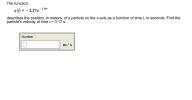 The function x(r) = _ 2.17e-1.19, r(t)--2.17e-1191 describes the position, in meters, of a particle on the x-axis as a function of time t, in seconds. Find the particle's velocity at time t- 3.17 s Number m/ s
A 5.60-kg particle moves along the x axis. Its position varies with time according to x...
A 5.60-kg particle moves along the x axis. Its position varies with time according to x = t + 4.0t3, where x is in meters and t is in seconds. (a) Find the kinetic energy of the particle at any time t. (Use the following as necessary: t.) K = (b) Find the magnitude of the acceleration of the particle and the force acting on it at time t. (Use the following as necessary: t.) a = F = (c)...
Q4 A particle moves so that its position (in meters) as a function of time (in...
 Q4 A particle moves so that its position (in meters) as a function of time (in seconds) is = i +4+29+ tk . Write expressions for (a) its velocity and (b) its acceleration as functions of time. [2+2]
A particle moves along the x axis. Its position is given by the equatio
A particle moves along the x axis. Its position is given by the equation x = 1.5+ 2.5t -3.8t2 with x in meters and t in seconds. (a) Determine its position when it changes direction (b) Determine its velocity when it returns to the position it had at t =0? (Indicate the direction of the velocity with the sign of your answer.)
An object moves along the x-axis with its position x, in meters, given as a function...
 An object moves along the x-axis with its position x, in meters, given as a function of time t, in seconds, by x(-1.417-9.491+ 4.68 r(t)-1.41 t2-9.4% + 4.68 What is the object's velocity at time t 1.01 s? Number m/ s
A particle moves along the x axis. Its position is given by the equation x =...
A particle moves along the x axis. Its position is given by the equation x = 1.5 + 2.9t − 3.6t2 with x in meters and t in seconds. (a) Determine its position when it changes direction. m (b) Determine its velocity when it returns to the position it had at t = 0? (Indicate the direction of the velocity with the sign of your answer.) m/s
 A particle moves in the x-y plane such that its position is defined by r (2t i+ 4tj) ft, where t is in seconds. Determine the radial and transverse components of the particle's velocity and acceleration whent-2 s.
 The function x(r) = _ 2.17e-1.19, r(t)--2.17e-1191 describes the position, in meters, of a particle on the x-axis as a function of time t, in seconds. Find the particle's velocity at time t- 3.17 s Number m/ s
 Q4 A particle moves so that its position (in meters) as a function of time (in seconds) is = i +4+29+ tk . Write expressions for (a) its velocity and (b) its acceleration as functions of time. [2+2]
 An object moves along the x-axis with its position x, in meters, given as a function of time t, in seconds, by x(-1.417-9.491+ 4.68 r(t)-1.41 t2-9.4% + 4.68 What is the object's velocity at time t 1.01 s? Number m/ s
Most questions answered within 3 hours.
-
Where is the error in this code sequence?
String s1 = "Hello";
String s2 = "ello";...
asked 11 months ago -
Financial data for Joel de Paris, Inc., for last year
follow:
Joel de Paris, Inc.
Balance...
asked 11 months ago -
Consider this reaction:
Al2(SO4)3 (aq)+ BaCl3
(aq) Al2Cl6 (aq)- +
3BaSO4(s) . What is the...
asked 11 months ago -
Suppose that Savneet is considering increasing her
recent random sample from 20 car rentals to 40...
asked 11 months ago -
Trucks arrive at an unloading terminal at an average rate of 120
per hour.
Trucks arrive...
asked 11 months ago -
Why are methanol and ethanol completely soluble in water while
octanol is not very little soluble....
asked 11 months ago -
A facilities manager at a university reads in a research report
that the mean amount of...
asked 11 months ago -
When the CuSO4 is rehydrated by adding water to the anhydrous
compound, is this an endothermic...
asked 11 months ago -
A ray of sunlight is passing from diamond into crown glass; the
angle of incidence is...
asked 11 months ago -
A block of mass 0.249 kg is placed on top of a light, vertical
spring of...
asked 11 months ago -
how do the kidneys compensate in the presences of acidosis
a) trigger hyperventilate
b) reserve acid...
asked 11 months ago -
Question 501 pts
The rental rate of capital to the firm increases. Which of the
following...
asked 11 months ago