Solve the thermodynamic equation: B(C_P/K_T)=? where: B= 1/V(dV/dT)_P K_T=-1/V(dV/dP)_T C_P= (dH/dT)_P
Solve the thermodynamic equation:
B(C_P/K_T)=?
where:
B= 1/V(dV/dT)_P
K_T=-1/V(dV/dP)_T
C_P= (dH/dT)_P
Homework Answers
Request Answer!
We need at least 10 more requests to produce the answer.
0 / 10 have requested this problem solution
The more requests, the faster the answer.
Add Answer to:
Solve the thermodynamic equation:
B(C_P/K_T)=?
where:
B= 1/V(dV/dT)_P
K_T=-1/V(dV/dP)_T
C_P= (dH/dT)_P
Starting with an expression for U(S.V), show that m(V) = (dU/dV)T is given by Tt(v)= (dp/dT)V-P.
 Starting with an expression for U(S.V), show that m(V) = (dU/dV)T is given by Tt(v)= (dp/dT)V-P.
The equation dV dV dū 4. The equation ā= dt V + ū, + ū, defines...
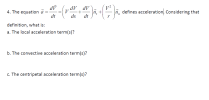 The equation
dV dV dū 4. The equation ā= dt V + ū, + ū, defines acceleration. Considering that ds dt definition, what is: a. The local acceleration term(s)? b. The convective acceleration term(s)? c. The centripetal acceleration term(s)?
The equation
dV dV dū 4. The equation ā= dt V + ū, + ū, defines acceleration. Considering that ds dt definition, what is: a. The local acceleration term(s)? b. The convective acceleration term(s)? c. The centripetal acceleration term(s)?
solve Question 6: Given that v(0) = 2 and dv(0)/dt = 4, solve the following second-order...
 solve
Question 6: Given that v(0) = 2 and dv(0)/dt = 4, solve the following second-order differential equation d- du ( +54 + 60 = 10e-'u(t) dt 4 marks
solve
Question 6: Given that v(0) = 2 and dv(0)/dt = 4, solve the following second-order differential equation d- du ( +54 + 60 = 10e-'u(t) dt 4 marks
use the Euler method to solve the differential equation : dv/dt = ve^(1+t)+0.5v for t, between...
use the Euler method to solve the differential equation : dv/dt = ve^(1+t)+0.5v for t, between 0 and 0.2, in steps of 0.02; with the initial condition, v=1 when t=0. Compare your results to the excel analytical solution in tabular and graphical forms
I don't even know where to start with partials... This is the only information that precedes...
 I don't even know where to start with partials...
This is the only information
that precedes it
Evaluating a derivative of the van der Waals equation using the cyclic rule Find the partial derivatives (partial differential P/partial differential T)_V and (partial differential P/partial differential V)_T, and apply them to the equation derived from the cyclic rule, (partial differential V/partial differential T)_p = -(partial differential P/partial differential T)_V/(partial differential P/partial differential V)_T to find (partial differential_V/partial differential T)_P. Express your answer...
I don't even know where to start with partials...
This is the only information
that precedes it
Evaluating a derivative of the van der Waals equation using the cyclic rule Find the partial derivatives (partial differential P/partial differential T)_V and (partial differential P/partial differential V)_T, and apply them to the equation derived from the cyclic rule, (partial differential V/partial differential T)_p = -(partial differential P/partial differential T)_V/(partial differential P/partial differential V)_T to find (partial differential_V/partial differential T)_P. Express your answer...
1.) The rocket equation in 1 dimension is ert dt dt where u is the exhaust...
 1.) The rocket equation in 1 dimension is ert dt dt where u is the exhaust velocity (in the rocket frame) and Fe is the net external force on the rocket Consider a space probe that is traveling through an interstellar cloud (far from any large gravitational masses). The probe experiences a linear drag force FD - -bv. Let us also assume that u is constant and dm/dt =-γ is constant. (a) The probe runs out of fuel when the...
dx dt 1. For the circuit below determine: a) The initial conditions: iz(0+), dix(0*), v(0+), dv(0+)...
 dx dt 1. For the circuit below determine: a) The initial conditions: iz(0+), dix(0*), v(0+), dv(0+) b) The circuit differential equation and solve for iz(t), t 2 0 (No credit for Transform techniques) ix VI 102 422 + lo 5+10u(t) 10 H 1/4 F V
Problem 3. Background. The Gompertz logistic equation is dP (P) -P(a-b In P) where a, b are posit...
 Differential Equations
Problem 3. Background. The Gompertz logistic equation is dP (P) -P(a-b In P) where a, b are positive constants. dP This model is similar to the usual logistic model, which can be written ab P). f(P)- P(a-b InP) is defined for all P>0. Also, since lim fP)-0,we extend the definition of f(P) so that f(O) Problem 3. a. Verify (by L'Hopital's rule) that lim f(P)-0 b. Show that, if we set B-e, then we can write the equation...
Differential Equations
Problem 3. Background. The Gompertz logistic equation is dP (P) -P(a-b In P) where a, b are positive constants. dP This model is similar to the usual logistic model, which can be written ab P). f(P)- P(a-b InP) is defined for all P>0. Also, since lim fP)-0,we extend the definition of f(P) so that f(O) Problem 3. a. Verify (by L'Hopital's rule) that lim f(P)-0 b. Show that, if we set B-e, then we can write the equation...
Given the first order equation describing the circuit... 4(dv/dt)+v=10 Find the time constant Find the final...
Given the first order equation describing the circuit... 4(dv/dt)+v=10 Find the time constant Find the final value of the voltage If v(0)=2 the function describing v(t) for all time.
Part A Starting with the van der Waals equation of state, find an expression for the...
 Part A Starting with the van der Waals equation of state, find an expression for the total differential dP in terms of dV and dT Match the expressions in the left column to the appropriate blanks in the equations on the right. Help Reset Dr (V-b) Dv V-b RT dT )dV + dP= V RT V-b 2a VD RT (V-b)3 RT In RT V-b Vnt 2(V-b) RT Vtb RT (V-b)
 Starting with an expression for U(S.V), show that m(V) = (dU/dV)T is given by Tt(v)= (dp/dT)V-P.
 The equation
dV dV dū 4. The equation ā= dt V + ū, + ū, defines acceleration. Considering that ds dt definition, what is: a. The local acceleration term(s)? b. The convective acceleration term(s)? c. The centripetal acceleration term(s)?
The equation
dV dV dū 4. The equation ā= dt V + ū, + ū, defines acceleration. Considering that ds dt definition, what is: a. The local acceleration term(s)? b. The convective acceleration term(s)? c. The centripetal acceleration term(s)?
 solve
Question 6: Given that v(0) = 2 and dv(0)/dt = 4, solve the following second-order differential equation d- du ( +54 + 60 = 10e-'u(t) dt 4 marks
solve
Question 6: Given that v(0) = 2 and dv(0)/dt = 4, solve the following second-order differential equation d- du ( +54 + 60 = 10e-'u(t) dt 4 marks
 I don't even know where to start with partials...
This is the only information
that precedes it
Evaluating a derivative of the van der Waals equation using the cyclic rule Find the partial derivatives (partial differential P/partial differential T)_V and (partial differential P/partial differential V)_T, and apply them to the equation derived from the cyclic rule, (partial differential V/partial differential T)_p = -(partial differential P/partial differential T)_V/(partial differential P/partial differential V)_T to find (partial differential_V/partial differential T)_P. Express your answer...
I don't even know where to start with partials...
This is the only information
that precedes it
Evaluating a derivative of the van der Waals equation using the cyclic rule Find the partial derivatives (partial differential P/partial differential T)_V and (partial differential P/partial differential V)_T, and apply them to the equation derived from the cyclic rule, (partial differential V/partial differential T)_p = -(partial differential P/partial differential T)_V/(partial differential P/partial differential V)_T to find (partial differential_V/partial differential T)_P. Express your answer...
 1.) The rocket equation in 1 dimension is ert dt dt where u is the exhaust velocity (in the rocket frame) and Fe is the net external force on the rocket Consider a space probe that is traveling through an interstellar cloud (far from any large gravitational masses). The probe experiences a linear drag force FD - -bv. Let us also assume that u is constant and dm/dt =-γ is constant. (a) The probe runs out of fuel when the...
 dx dt 1. For the circuit below determine: a) The initial conditions: iz(0+), dix(0*), v(0+), dv(0+) b) The circuit differential equation and solve for iz(t), t 2 0 (No credit for Transform techniques) ix VI 102 422 + lo 5+10u(t) 10 H 1/4 F V
 Differential Equations
Problem 3. Background. The Gompertz logistic equation is dP (P) -P(a-b In P) where a, b are positive constants. dP This model is similar to the usual logistic model, which can be written ab P). f(P)- P(a-b InP) is defined for all P>0. Also, since lim fP)-0,we extend the definition of f(P) so that f(O) Problem 3. a. Verify (by L'Hopital's rule) that lim f(P)-0 b. Show that, if we set B-e, then we can write the equation...
Differential Equations
Problem 3. Background. The Gompertz logistic equation is dP (P) -P(a-b In P) where a, b are positive constants. dP This model is similar to the usual logistic model, which can be written ab P). f(P)- P(a-b InP) is defined for all P>0. Also, since lim fP)-0,we extend the definition of f(P) so that f(O) Problem 3. a. Verify (by L'Hopital's rule) that lim f(P)-0 b. Show that, if we set B-e, then we can write the equation...
 Part A Starting with the van der Waals equation of state, find an expression for the total differential dP in terms of dV and dT Match the expressions in the left column to the appropriate blanks in the equations on the right. Help Reset Dr (V-b) Dv V-b RT dT )dV + dP= V RT V-b 2a VD RT (V-b)3 RT In RT V-b Vnt 2(V-b) RT Vtb RT (V-b)
Most questions answered within 3 hours.
-
Where is the error in this code sequence?
String s1 = "Hello";
String s2 = "ello";...
asked 10 months ago -
Financial data for Joel de Paris, Inc., for last year
follow:
Joel de Paris, Inc.
Balance...
asked 10 months ago -
Consider this reaction:
Al2(SO4)3 (aq)+ BaCl3
(aq) Al2Cl6 (aq)- +
3BaSO4(s) . What is the...
asked 10 months ago -
Suppose that Savneet is considering increasing her
recent random sample from 20 car rentals to 40...
asked 10 months ago -
Trucks arrive at an unloading terminal at an average rate of 120
per hour.
Trucks arrive...
asked 10 months ago -
Why are methanol and ethanol completely soluble in water while
octanol is not very little soluble....
asked 10 months ago -
A facilities manager at a university reads in a research report
that the mean amount of...
asked 10 months ago -
When the CuSO4 is rehydrated by adding water to the anhydrous
compound, is this an endothermic...
asked 10 months ago -
A ray of sunlight is passing from diamond into crown glass; the
angle of incidence is...
asked 10 months ago -
A block of mass 0.249 kg is placed on top of a light, vertical
spring of...
asked 10 months ago -
how do the kidneys compensate in the presences of acidosis
a) trigger hyperventilate
b) reserve acid...
asked 10 months ago -
Question 501 pts
The rental rate of capital to the firm increases. Which of the
following...
asked 10 months ago