
Homework Answers


Add Answer to:
Problem 3. Background. The Gompertz logistic equation is dP (P) -P(a-b In P) where a, b are posit...
Problem #7: Suppose that a population P(t) follows the following Gompertz differential equation. dP = 6P(17-InP), di with initial condition P(O) 80. (a) What is the limiting value of the population&#...
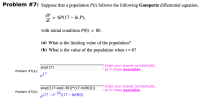 Problem #7: Suppose that a population P(t) follows the following Gompertz differential equation. dP = 6P(17-InP), di with initial condition P(O) 80. (a) What is the limiting value of the population'? (b) What is the value of the population when 62 Enter your answer symbolically as in these examples exp(17) Problem #7(a): e17 Enter your answer symbolically, as in these examples exp(((17-exp(-36))*(17-ln(80))) Problem #7(b): e(17-e-36)(17-in(80))
Problem #7: Suppose that a population P(t) follows the following Gompertz differential equation. dP =...
Problem #7: Suppose that a population P(t) follows the following Gompertz differential equation. dP = 6P(17-InP), di with initial condition P(O) 80. (a) What is the limiting value of the population'? (b) What is the value of the population when 62 Enter your answer symbolically as in these examples exp(17) Problem #7(a): e17 Enter your answer symbolically, as in these examples exp(((17-exp(-36))*(17-ln(80))) Problem #7(b): e(17-e-36)(17-in(80))
Problem #7: Suppose that a population P(t) follows the following Gompertz differential equation. dP =...
Use the solution you found in Part 1f to show that the Gompertz model can be...
 Use the solution you found in
Part 1f to show that the Gompertz model can be rewritten as
dP/dt=−λe^(−rt)P, where λ is a positive constant.
j) Consider grouping the factors in the equation like this:
dP/dt=-(λe^(-rt))P. Make an interpretation of this equation. In
other words, what assumption about tumour growth would lead us to
write down such an equation?
k) Now consider grouping the factors in the equation like this:
dP/dt=−λ(e^(-rt)P). Again, explain what assumption about tumour
growth would lead...
Use the solution you found in
Part 1f to show that the Gompertz model can be rewritten as
dP/dt=−λe^(−rt)P, where λ is a positive constant.
j) Consider grouping the factors in the equation like this:
dP/dt=-(λe^(-rt))P. Make an interpretation of this equation. In
other words, what assumption about tumour growth would lead us to
write down such an equation?
k) Now consider grouping the factors in the equation like this:
dP/dt=−λ(e^(-rt)P). Again, explain what assumption about tumour
growth would lead...
Suppose that a population of hacteria grows according to the logistic differential equation dP =0.01P-0.0002P2 dt...
 Suppose that a population of hacteria grows according to the logistic differential equation dP =0.01P-0.0002P2 dt where Pis the population measured in thousands and t is time measured in days. Logistic growth differential equations are often quite difficult to solve. Instead, you will analyze its direction field to acquire infom ation about the solutions to this differential equation. a) Calculate the maximum population M that the sumounding environment can austain. (Note this is also calked the "canying capacity"). Hint: Rewrite...
A population P obeys the logistic model. It satisfies the equation dp 2 dt = 500...
 A population P obeys the logistic model. It satisfies the equation dp 2 dt = 500 P(5 – P) for P >0. (a) The population is increasing when - Preview <P < 5 Preview (b) The population is decreasing when P > 5 Preview (c) Assume that P(0) = 4. Find P(40). P(40) = 1.93 * Preview
3 pts) Suppose that a population develops according to the logistic equation dP dt = 0.15P...
 3 pts) Suppose that a population develops according to the logistic equation dP dt = 0.15P - 0.0006P2 where t is measured in weeks. a) What is the carriying capacity? b) Is the solution increasing or decreasing when P is between() and the carriying capacity? C) Is the solution increasing or decreasing when P is greater than the carriying capacity? Note: You can earn partial credit on this problem.
dP Consider a rabbit population Pit) satisfying the logistic equation aP-bP, where B-aP is the time...
 dP Consider a rabbit population Pit) satisfying the logistic equation aP-bP, where B-aP is the time rate at which births occur and D bP is the rate at which deaths occur. If the initial population is 220 rabbits and there are 6 deaths per month occurring at time t 0, how many months does it take for P(t) to reach 115 % of the limiting population M? births per month and months (Type an integer or decimal rounded to two...
2. Suppose a population P(t) satisfies the logistic differential equation dP dt = 0.1P 1 −...
 2. Suppose a population P(t) satisfies the logistic differential
equation dP dt = 0.1P 1 − P 2000 P(0) = 100 Find the following: a)
P(20) b) When will the population reach 1200?
2. Suppose a population P(t) satisfies the logistic differential equation 2P = 0.1P (1–2000) = 0.1P | P(0) = 100 2000 Find the following: a) P(20) b) When will the population reach 1200?
2. Suppose a population P(t) satisfies the logistic differential
equation dP dt = 0.1P 1 − P 2000 P(0) = 100 Find the following: a)
P(20) b) When will the population reach 1200?
2. Suppose a population P(t) satisfies the logistic differential equation 2P = 0.1P (1–2000) = 0.1P | P(0) = 100 2000 Find the following: a) P(20) b) When will the population reach 1200?
Logistic Regression In class, we discussed the logistic regression model for binary classification problem. Here, we...
 Logistic Regression
In class, we discussed the logistic regression model for binary classification problem. Here, we consider an alternative model. We have a training set {<n, yn) }n where E RD+1 and yn e {0,1}. Like in logistic regression, we will construct a probabilistic model for the probability that yn belongs to class 0 or 1, given en and the model parameters, 0, and 0 (0o,0, ERD+1). More specifically, we model the target Un as: p(yn = 0[xn;00,0) = Cella...
Logistic Regression
In class, we discussed the logistic regression model for binary classification problem. Here, we consider an alternative model. We have a training set {<n, yn) }n where E RD+1 and yn e {0,1}. Like in logistic regression, we will construct a probabilistic model for the probability that yn belongs to class 0 or 1, given en and the model parameters, 0, and 0 (0o,0, ERD+1). More specifically, we model the target Un as: p(yn = 0[xn;00,0) = Cella...
POPULATION MODELS: PLEASE ANSWSER ASAP: ALL 3 AND WILL RATE U ASAP. The logistic growth model...
 POPULATION MODELS: PLEASE
ANSWSER ASAP: ALL 3 AND WILL RATE U ASAP.
The logistic growth model describes population growth when
resources are constrained. It
is an extension to the exponential growth model that includes an
additional term introducing
the carrying capacity of the habitat.
The differential equation for this model is:
dP/dt=kP(t)(1-P(t)/M)
Where P(t) is the population (or population density) at time t,
k > 0 is a growth constant,
and M is the carrying capacity of the habitat. This...
POPULATION MODELS: PLEASE
ANSWSER ASAP: ALL 3 AND WILL RATE U ASAP.
The logistic growth model describes population growth when
resources are constrained. It
is an extension to the exponential growth model that includes an
additional term introducing
the carrying capacity of the habitat.
The differential equation for this model is:
dP/dt=kP(t)(1-P(t)/M)
Where P(t) is the population (or population density) at time t,
k > 0 is a growth constant,
and M is the carrying capacity of the habitat. This...
(1 point) Any population, P, for which we can ignore immigration, satisfies dP Birth rate –...
 (1 point) Any population, P, for which we can ignore immigration, satisfies dP Birth rate – Death rate. dt For organisms which need a partner for reproduction but rely on a chance encounter for meeting a mate, the birth rate is proportional to the square of the population. Thus, the population of such a type of organism satisfies a differential equation of the form dP аP? — ЬР with a, b > 0. dt This problem investigates the solutions to...
 Problem #7: Suppose that a population P(t) follows the following Gompertz differential equation. dP = 6P(17-InP), di with initial condition P(O) 80. (a) What is the limiting value of the population'? (b) What is the value of the population when 62 Enter your answer symbolically as in these examples exp(17) Problem #7(a): e17 Enter your answer symbolically, as in these examples exp(((17-exp(-36))*(17-ln(80))) Problem #7(b): e(17-e-36)(17-in(80))
Problem #7: Suppose that a population P(t) follows the following Gompertz differential equation. dP =...
Problem #7: Suppose that a population P(t) follows the following Gompertz differential equation. dP = 6P(17-InP), di with initial condition P(O) 80. (a) What is the limiting value of the population'? (b) What is the value of the population when 62 Enter your answer symbolically as in these examples exp(17) Problem #7(a): e17 Enter your answer symbolically, as in these examples exp(((17-exp(-36))*(17-ln(80))) Problem #7(b): e(17-e-36)(17-in(80))
Problem #7: Suppose that a population P(t) follows the following Gompertz differential equation. dP =...
 Use the solution you found in
Part 1f to show that the Gompertz model can be rewritten as
dP/dt=−λe^(−rt)P, where λ is a positive constant.
j) Consider grouping the factors in the equation like this:
dP/dt=-(λe^(-rt))P. Make an interpretation of this equation. In
other words, what assumption about tumour growth would lead us to
write down such an equation?
k) Now consider grouping the factors in the equation like this:
dP/dt=−λ(e^(-rt)P). Again, explain what assumption about tumour
growth would lead...
Use the solution you found in
Part 1f to show that the Gompertz model can be rewritten as
dP/dt=−λe^(−rt)P, where λ is a positive constant.
j) Consider grouping the factors in the equation like this:
dP/dt=-(λe^(-rt))P. Make an interpretation of this equation. In
other words, what assumption about tumour growth would lead us to
write down such an equation?
k) Now consider grouping the factors in the equation like this:
dP/dt=−λ(e^(-rt)P). Again, explain what assumption about tumour
growth would lead...
 Suppose that a population of hacteria grows according to the logistic differential equation dP =0.01P-0.0002P2 dt where Pis the population measured in thousands and t is time measured in days. Logistic growth differential equations are often quite difficult to solve. Instead, you will analyze its direction field to acquire infom ation about the solutions to this differential equation. a) Calculate the maximum population M that the sumounding environment can austain. (Note this is also calked the "canying capacity"). Hint: Rewrite...
 A population P obeys the logistic model. It satisfies the equation dp 2 dt = 500 P(5 – P) for P >0. (a) The population is increasing when - Preview <P < 5 Preview (b) The population is decreasing when P > 5 Preview (c) Assume that P(0) = 4. Find P(40). P(40) = 1.93 * Preview
 3 pts) Suppose that a population develops according to the logistic equation dP dt = 0.15P - 0.0006P2 where t is measured in weeks. a) What is the carriying capacity? b) Is the solution increasing or decreasing when P is between() and the carriying capacity? C) Is the solution increasing or decreasing when P is greater than the carriying capacity? Note: You can earn partial credit on this problem.
 dP Consider a rabbit population Pit) satisfying the logistic equation aP-bP, where B-aP is the time rate at which births occur and D bP is the rate at which deaths occur. If the initial population is 220 rabbits and there are 6 deaths per month occurring at time t 0, how many months does it take for P(t) to reach 115 % of the limiting population M? births per month and months (Type an integer or decimal rounded to two...
 2. Suppose a population P(t) satisfies the logistic differential
equation dP dt = 0.1P 1 − P 2000 P(0) = 100 Find the following: a)
P(20) b) When will the population reach 1200?
2. Suppose a population P(t) satisfies the logistic differential equation 2P = 0.1P (1–2000) = 0.1P | P(0) = 100 2000 Find the following: a) P(20) b) When will the population reach 1200?
2. Suppose a population P(t) satisfies the logistic differential
equation dP dt = 0.1P 1 − P 2000 P(0) = 100 Find the following: a)
P(20) b) When will the population reach 1200?
2. Suppose a population P(t) satisfies the logistic differential equation 2P = 0.1P (1–2000) = 0.1P | P(0) = 100 2000 Find the following: a) P(20) b) When will the population reach 1200?
 Logistic Regression
In class, we discussed the logistic regression model for binary classification problem. Here, we consider an alternative model. We have a training set {<n, yn) }n where E RD+1 and yn e {0,1}. Like in logistic regression, we will construct a probabilistic model for the probability that yn belongs to class 0 or 1, given en and the model parameters, 0, and 0 (0o,0, ERD+1). More specifically, we model the target Un as: p(yn = 0[xn;00,0) = Cella...
Logistic Regression
In class, we discussed the logistic regression model for binary classification problem. Here, we consider an alternative model. We have a training set {<n, yn) }n where E RD+1 and yn e {0,1}. Like in logistic regression, we will construct a probabilistic model for the probability that yn belongs to class 0 or 1, given en and the model parameters, 0, and 0 (0o,0, ERD+1). More specifically, we model the target Un as: p(yn = 0[xn;00,0) = Cella...
 POPULATION MODELS: PLEASE
ANSWSER ASAP: ALL 3 AND WILL RATE U ASAP.
The logistic growth model describes population growth when
resources are constrained. It
is an extension to the exponential growth model that includes an
additional term introducing
the carrying capacity of the habitat.
The differential equation for this model is:
dP/dt=kP(t)(1-P(t)/M)
Where P(t) is the population (or population density) at time t,
k > 0 is a growth constant,
and M is the carrying capacity of the habitat. This...
POPULATION MODELS: PLEASE
ANSWSER ASAP: ALL 3 AND WILL RATE U ASAP.
The logistic growth model describes population growth when
resources are constrained. It
is an extension to the exponential growth model that includes an
additional term introducing
the carrying capacity of the habitat.
The differential equation for this model is:
dP/dt=kP(t)(1-P(t)/M)
Where P(t) is the population (or population density) at time t,
k > 0 is a growth constant,
and M is the carrying capacity of the habitat. This...
 (1 point) Any population, P, for which we can ignore immigration, satisfies dP Birth rate – Death rate. dt For organisms which need a partner for reproduction but rely on a chance encounter for meeting a mate, the birth rate is proportional to the square of the population. Thus, the population of such a type of organism satisfies a differential equation of the form dP аP? — ЬР with a, b > 0. dt This problem investigates the solutions to...
Most questions answered within 3 hours.
-
Where is the error in this code sequence?
String s1 = "Hello";
String s2 = "ello";...
asked 11 months ago -
Financial data for Joel de Paris, Inc., for last year
follow:
Joel de Paris, Inc.
Balance...
asked 11 months ago -
Consider this reaction:
Al2(SO4)3 (aq)+ BaCl3
(aq) Al2Cl6 (aq)- +
3BaSO4(s) . What is the...
asked 11 months ago -
Suppose that Savneet is considering increasing her
recent random sample from 20 car rentals to 40...
asked 11 months ago -
Trucks arrive at an unloading terminal at an average rate of 120
per hour.
Trucks arrive...
asked 11 months ago -
Why are methanol and ethanol completely soluble in water while
octanol is not very little soluble....
asked 11 months ago -
A facilities manager at a university reads in a research report
that the mean amount of...
asked 11 months ago -
When the CuSO4 is rehydrated by adding water to the anhydrous
compound, is this an endothermic...
asked 11 months ago -
A ray of sunlight is passing from diamond into crown glass; the
angle of incidence is...
asked 11 months ago -
A block of mass 0.249 kg is placed on top of a light, vertical
spring of...
asked 11 months ago -
how do the kidneys compensate in the presences of acidosis
a) trigger hyperventilate
b) reserve acid...
asked 11 months ago -
Question 501 pts
The rental rate of capital to the firm increases. Which of the
following...
asked 11 months ago