E-J Assume that initially the IS curve is given by IS1 : Y = 12 −...
E-J
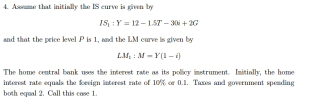
Assume that initially the IS curve is given by
IS1 : Y = 12 − 1.5T − 30i + 2G
and that the price level P is 1, and the LM curve is given by
LM1 : M = Y (1 − i)
The home central bank uses the interest rate as its policy instrument. Initially, the home interest rate equals the foreign interest rate of 10% or 0.1. Taxes and government spending both equal 2. Call this case 1.
E. There is now a foreign demand shock, such that the IS curve shifts left by 1.5 units at all levels of the interest rate, and the new IS curve is given by IS2 : Y = 10.5 − 1.5T − 30i + 2G The government asks the central bank to stabilize the economy at full employment. To stabilize and return output back to the desired level, according to this new IS curve, by how much must the interest rate be lowered from its initial level of 0.1? (Assume taxes and government spending remain at 2.) Call this case 2.
F. At the new lower interest rate and at full employment, on the new LM curve (LM2), what is the new level of the money supply?
G. According to the forex market equilibrium, what is the new level of the spot exchange rate? How large is the depreciation of the home currency?
H. Plot the new IS2 and LM2 curves for case 2 on a chart. Label the axes, and the equilibrium values.
I. Return to question E. Now assume that the central bank refuses to change the interest rate from 10%. In this case, what is the new level of output? What is the money supply? And if the government decides to use fiscal policy instead to stabilize output, then, according to the new IS curve, by how much must government spending be increased to achieve this goal? Call this case 3.
J. Plot the new IS3 and LM3 curves for case 3 on a chart. Label the axes and the equilibrium values
Homework Answers


Add Answer to:
E-J
Assume that initially the IS curve is given by
IS1 : Y = 12 −...
4. Assume that initially the IS curve is given by ısı : Y-12-1.5T-30i + 2G and...
 4. Assume that initially the IS curve is given by ısı : Y-12-1.5T-30i + 2G and that the price level P is 1, and the LM curve is given by The home central bank uses the interest rate as its policy instrument. Initially, the home interest rate equals the foreign interest rate of 10% or 0.1. Taxes and government spending both equal 2. Call this case 1.
5. In the Keynesian-cross analysis, assume that the analysis of taxes is changed so that taxes,...
 5. In the Keynesian-cross analysis, assume that the analysis of taxes is changed so that taxes, T, are made a function of income, as in T=T + tY, where T and t are parameters of the tax code and t is positive but less than 1. As compared to a case where t is zero, the multiplier for government purchases in this case will: A) not change. B) be smaller. C) be bigger. D) be equal to 1. 6. Exhibit:...
The initial graph shows the IS1 and LM1 curves, as well as the initial equilibrium. In this quest...
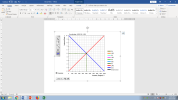 The initial graph shows the IS1 and LM1 curves, as well as the
initial equilibrium. In this question, you will consider the effect
of a spending shock to the economy and consider the different
outcomes that result from different responses in monetary
policy.
a. Suppose there is a decrease in planned investment by firms
equal to 100. Furthermore, assume the marginal propensity to
consume is 0.75. Determine exactly how far the IS curve would
shift, then use the infinite line...
The initial graph shows the IS1 and LM1 curves, as well as the
initial equilibrium. In this question, you will consider the effect
of a spending shock to the economy and consider the different
outcomes that result from different responses in monetary
policy.
a. Suppose there is a decrease in planned investment by firms
equal to 100. Furthermore, assume the marginal propensity to
consume is 0.75. Determine exactly how far the IS curve would
shift, then use the infinite line...
Please give a detailed solution, thank you! 5. Given C 5000.75 (Y T) I = 2,000 -50r G 1,000 T 1,000 - 10Y - 2000r Ms 50,...
 Please give a detailed
solution, thank you!
5. Given C 5000.75 (Y T) I = 2,000 -50r G 1,000 T 1,000 - 10Y - 2000r Ms 50,000 P a. Derive the IS curve and the LM curve, and find the equilibrium interest rate and output b. Government spending increases by 500. If the central bank does not react at all to this change, what is the new equilibrium output and interest rate? If instead the central bank wants to keep...
Please give a detailed
solution, thank you!
5. Given C 5000.75 (Y T) I = 2,000 -50r G 1,000 T 1,000 - 10Y - 2000r Ms 50,000 P a. Derive the IS curve and the LM curve, and find the equilibrium interest rate and output b. Government spending increases by 500. If the central bank does not react at all to this change, what is the new equilibrium output and interest rate? If instead the central bank wants to keep...
1. In an economy which has a national income identity as the following; Y= C+ I + G + NX where C ...
 I need help with this.
1. In an economy which has a national income identity as the following; Y= C+ I + G + NX where C = 400 + 0.6 Yd,; 1 = 1000-4600 r, G-1240 T-200 +0.25 Y; NX-400-0.05Y-8 00 e ( ofcourse, Yd=Y-T) Where e- foreign currency/ domestic currency, and initially set at e 1.25+2.5R The money demand function is Md- 0.75 Y-7500 r, and money supply is set by the Central Bank at 450. All calculation...
I need help with this.
1. In an economy which has a national income identity as the following; Y= C+ I + G + NX where C = 400 + 0.6 Yd,; 1 = 1000-4600 r, G-1240 T-200 +0.25 Y; NX-400-0.05Y-8 00 e ( ofcourse, Yd=Y-T) Where e- foreign currency/ domestic currency, and initially set at e 1.25+2.5R The money demand function is Md- 0.75 Y-7500 r, and money supply is set by the Central Bank at 450. All calculation...
NEED HELP WITH QUESTIONS E TO I Consider a hypothetical economy characterized by the following equations(all...
 NEED HELP WITH QUESTIONS E TO I
Consider a hypothetical economy characterized by the following
equations(all variables as defined in class).
Consumption: C = 700 + 0.95Y Investment: I=500− 30i
Government spending: G=50
Money demand: L(i,Y )=0.75Y − 30i Money supply: Ms/P=400
(a) What is the equation of the IS curve?
(b) What is the equation for the LM curve?
(c) Solve for the equilibrium values of income (Y) and interest
rates (i).
(d) Assume that the government engages in...
NEED HELP WITH QUESTIONS E TO I
Consider a hypothetical economy characterized by the following
equations(all variables as defined in class).
Consumption: C = 700 + 0.95Y Investment: I=500− 30i
Government spending: G=50
Money demand: L(i,Y )=0.75Y − 30i Money supply: Ms/P=400
(a) What is the equation of the IS curve?
(b) What is the equation for the LM curve?
(c) Solve for the equilibrium values of income (Y) and interest
rates (i).
(d) Assume that the government engages in...
I need help with the last part of this questions with the new curve etc A=...
 I need help with the last part
of this questions with the new curve etc
A= C + + G + X - M C = 0.75Y = 1200 - 50 G = 100 X = 300 M= 200 Y = A L = 0.25Y - 25i (M/P) = 250 L = (M/P) Derive the IS equation from the above model. Derive the LM equation from the above model. Derive the equilibrium levels of Income Y and Interest Rate i....
I need help with the last part
of this questions with the new curve etc
A= C + + G + X - M C = 0.75Y = 1200 - 50 G = 100 X = 300 M= 200 Y = A L = 0.25Y - 25i (M/P) = 250 L = (M/P) Derive the IS equation from the above model. Derive the LM equation from the above model. Derive the equilibrium levels of Income Y and Interest Rate i....
Please box answers! Thank you. 11. Monetary policy and the LM curve Aa Aa The following graph shows the demand and supply of real money balances in a hypothetical economy. Use the black point (X point...
 Please box answers! Thank
you.
11. Monetary policy and the LM curve Aa Aa The following graph shows the demand and supply of real money balances in a hypothetical economy. Use the black point (X point) to indicate the equilibrium in this market. Dashed drop lines will automatically extend to both axes. REAL INTEREST RATE [Percent) 10 Equilibrium Supply New Supply New Equilibrium Demand 3 0 10 20 30 40 50 60 70 80 90 100 REAL MONEY BALANCES Help...
Please box answers! Thank
you.
11. Monetary policy and the LM curve Aa Aa The following graph shows the demand and supply of real money balances in a hypothetical economy. Use the black point (X point) to indicate the equilibrium in this market. Dashed drop lines will automatically extend to both axes. REAL INTEREST RATE [Percent) 10 Equilibrium Supply New Supply New Equilibrium Demand 3 0 10 20 30 40 50 60 70 80 90 100 REAL MONEY BALANCES Help...
This is the complete question, no other outside information is given for this. Having trouble with...
 This is the complete question, no other outside information is
given for this. Having trouble with it, please show work.
1. Canada is an open economy that is currently in a recessionary output gap (a) Draw a correctly labeled graph of the long-run aggregate supply, short-run aggregate supply, and aggregate demand curves, and show each of the following (i) The current equilibrium real output and price level, labeled as Y, and PL, respectively (ii) Full-employment output, labeled Y (b) The...
This is the complete question, no other outside information is
given for this. Having trouble with it, please show work.
1. Canada is an open economy that is currently in a recessionary output gap (a) Draw a correctly labeled graph of the long-run aggregate supply, short-run aggregate supply, and aggregate demand curves, and show each of the following (i) The current equilibrium real output and price level, labeled as Y, and PL, respectively (ii) Full-employment output, labeled Y (b) The...
1. (The IS-LM-PC model): Assume the following relations characterize the goods market: (i) 1128 +...
 1. (The IS-LM-PC model): Assume the following relations characterize the goods market: (i) 1128 +0.2Y 300(rt + xt) (iii)G,-215 :T t = 200 (iv)st= 0.15 or 15% e) Derive the IS curve (as a relation between Y and r). (b) Assume the LM curve is given by r 0.16 (ie. in period t, the central bank sets the real interest rate at 16%). What is the short-run equilibrium level of output (Yt )? (c) Suppose that L = 2000 and...
 4. Assume that initially the IS curve is given by ısı : Y-12-1.5T-30i + 2G and that the price level P is 1, and the LM curve is given by The home central bank uses the interest rate as its policy instrument. Initially, the home interest rate equals the foreign interest rate of 10% or 0.1. Taxes and government spending both equal 2. Call this case 1.
 5. In the Keynesian-cross analysis, assume that the analysis of taxes is changed so that taxes, T, are made a function of income, as in T=T + tY, where T and t are parameters of the tax code and t is positive but less than 1. As compared to a case where t is zero, the multiplier for government purchases in this case will: A) not change. B) be smaller. C) be bigger. D) be equal to 1. 6. Exhibit:...
 The initial graph shows the IS1 and LM1 curves, as well as the
initial equilibrium. In this question, you will consider the effect
of a spending shock to the economy and consider the different
outcomes that result from different responses in monetary
policy.
a. Suppose there is a decrease in planned investment by firms
equal to 100. Furthermore, assume the marginal propensity to
consume is 0.75. Determine exactly how far the IS curve would
shift, then use the infinite line...
The initial graph shows the IS1 and LM1 curves, as well as the
initial equilibrium. In this question, you will consider the effect
of a spending shock to the economy and consider the different
outcomes that result from different responses in monetary
policy.
a. Suppose there is a decrease in planned investment by firms
equal to 100. Furthermore, assume the marginal propensity to
consume is 0.75. Determine exactly how far the IS curve would
shift, then use the infinite line...
 Please give a detailed
solution, thank you!
5. Given C 5000.75 (Y T) I = 2,000 -50r G 1,000 T 1,000 - 10Y - 2000r Ms 50,000 P a. Derive the IS curve and the LM curve, and find the equilibrium interest rate and output b. Government spending increases by 500. If the central bank does not react at all to this change, what is the new equilibrium output and interest rate? If instead the central bank wants to keep...
Please give a detailed
solution, thank you!
5. Given C 5000.75 (Y T) I = 2,000 -50r G 1,000 T 1,000 - 10Y - 2000r Ms 50,000 P a. Derive the IS curve and the LM curve, and find the equilibrium interest rate and output b. Government spending increases by 500. If the central bank does not react at all to this change, what is the new equilibrium output and interest rate? If instead the central bank wants to keep...
 I need help with this.
1. In an economy which has a national income identity as the following; Y= C+ I + G + NX where C = 400 + 0.6 Yd,; 1 = 1000-4600 r, G-1240 T-200 +0.25 Y; NX-400-0.05Y-8 00 e ( ofcourse, Yd=Y-T) Where e- foreign currency/ domestic currency, and initially set at e 1.25+2.5R The money demand function is Md- 0.75 Y-7500 r, and money supply is set by the Central Bank at 450. All calculation...
I need help with this.
1. In an economy which has a national income identity as the following; Y= C+ I + G + NX where C = 400 + 0.6 Yd,; 1 = 1000-4600 r, G-1240 T-200 +0.25 Y; NX-400-0.05Y-8 00 e ( ofcourse, Yd=Y-T) Where e- foreign currency/ domestic currency, and initially set at e 1.25+2.5R The money demand function is Md- 0.75 Y-7500 r, and money supply is set by the Central Bank at 450. All calculation...
 NEED HELP WITH QUESTIONS E TO I
Consider a hypothetical economy characterized by the following
equations(all variables as defined in class).
Consumption: C = 700 + 0.95Y Investment: I=500− 30i
Government spending: G=50
Money demand: L(i,Y )=0.75Y − 30i Money supply: Ms/P=400
(a) What is the equation of the IS curve?
(b) What is the equation for the LM curve?
(c) Solve for the equilibrium values of income (Y) and interest
rates (i).
(d) Assume that the government engages in...
NEED HELP WITH QUESTIONS E TO I
Consider a hypothetical economy characterized by the following
equations(all variables as defined in class).
Consumption: C = 700 + 0.95Y Investment: I=500− 30i
Government spending: G=50
Money demand: L(i,Y )=0.75Y − 30i Money supply: Ms/P=400
(a) What is the equation of the IS curve?
(b) What is the equation for the LM curve?
(c) Solve for the equilibrium values of income (Y) and interest
rates (i).
(d) Assume that the government engages in...
 I need help with the last part
of this questions with the new curve etc
A= C + + G + X - M C = 0.75Y = 1200 - 50 G = 100 X = 300 M= 200 Y = A L = 0.25Y - 25i (M/P) = 250 L = (M/P) Derive the IS equation from the above model. Derive the LM equation from the above model. Derive the equilibrium levels of Income Y and Interest Rate i....
I need help with the last part
of this questions with the new curve etc
A= C + + G + X - M C = 0.75Y = 1200 - 50 G = 100 X = 300 M= 200 Y = A L = 0.25Y - 25i (M/P) = 250 L = (M/P) Derive the IS equation from the above model. Derive the LM equation from the above model. Derive the equilibrium levels of Income Y and Interest Rate i....
 Please box answers! Thank
you.
11. Monetary policy and the LM curve Aa Aa The following graph shows the demand and supply of real money balances in a hypothetical economy. Use the black point (X point) to indicate the equilibrium in this market. Dashed drop lines will automatically extend to both axes. REAL INTEREST RATE [Percent) 10 Equilibrium Supply New Supply New Equilibrium Demand 3 0 10 20 30 40 50 60 70 80 90 100 REAL MONEY BALANCES Help...
Please box answers! Thank
you.
11. Monetary policy and the LM curve Aa Aa The following graph shows the demand and supply of real money balances in a hypothetical economy. Use the black point (X point) to indicate the equilibrium in this market. Dashed drop lines will automatically extend to both axes. REAL INTEREST RATE [Percent) 10 Equilibrium Supply New Supply New Equilibrium Demand 3 0 10 20 30 40 50 60 70 80 90 100 REAL MONEY BALANCES Help...
 This is the complete question, no other outside information is
given for this. Having trouble with it, please show work.
1. Canada is an open economy that is currently in a recessionary output gap (a) Draw a correctly labeled graph of the long-run aggregate supply, short-run aggregate supply, and aggregate demand curves, and show each of the following (i) The current equilibrium real output and price level, labeled as Y, and PL, respectively (ii) Full-employment output, labeled Y (b) The...
This is the complete question, no other outside information is
given for this. Having trouble with it, please show work.
1. Canada is an open economy that is currently in a recessionary output gap (a) Draw a correctly labeled graph of the long-run aggregate supply, short-run aggregate supply, and aggregate demand curves, and show each of the following (i) The current equilibrium real output and price level, labeled as Y, and PL, respectively (ii) Full-employment output, labeled Y (b) The...
 1. (The IS-LM-PC model): Assume the following relations characterize the goods market: (i) 1128 +0.2Y 300(rt + xt) (iii)G,-215 :T t = 200 (iv)st= 0.15 or 15% e) Derive the IS curve (as a relation between Y and r). (b) Assume the LM curve is given by r 0.16 (ie. in period t, the central bank sets the real interest rate at 16%). What is the short-run equilibrium level of output (Yt )? (c) Suppose that L = 2000 and...
Most questions answered within 3 hours.
-
Where is the error in this code sequence?
String s1 = "Hello";
String s2 = "ello";...
asked 10 months ago -
Financial data for Joel de Paris, Inc., for last year
follow:
Joel de Paris, Inc.
Balance...
asked 10 months ago -
Consider this reaction:
Al2(SO4)3 (aq)+ BaCl3
(aq) Al2Cl6 (aq)- +
3BaSO4(s) . What is the...
asked 10 months ago -
Suppose that Savneet is considering increasing her
recent random sample from 20 car rentals to 40...
asked 10 months ago -
Trucks arrive at an unloading terminal at an average rate of 120
per hour.
Trucks arrive...
asked 10 months ago -
Why are methanol and ethanol completely soluble in water while
octanol is not very little soluble....
asked 10 months ago -
A facilities manager at a university reads in a research report
that the mean amount of...
asked 10 months ago -
When the CuSO4 is rehydrated by adding water to the anhydrous
compound, is this an endothermic...
asked 10 months ago -
A ray of sunlight is passing from diamond into crown glass; the
angle of incidence is...
asked 10 months ago -
A block of mass 0.249 kg is placed on top of a light, vertical
spring of...
asked 10 months ago -
how do the kidneys compensate in the presences of acidosis
a) trigger hyperventilate
b) reserve acid...
asked 10 months ago -
Question 501 pts
The rental rate of capital to the firm increases. Which of the
following...
asked 10 months ago