Is the Mitichondria the location for krebs cycle occur within cell and oxygen utilzation in the...
Is the Mitichondria the location for krebs cycle occur within cell and oxygen utilzation in the cell in terms of ATP production
Homework Answers
In this case, the Krebs cycle is performed in the mitochondrial matrix. This process is part of the aerobic respiration and it is one of its three steps. In the first step, the carbons of macromolecules forms acetyl-Coa which is going to be used in the second step, Krebs Cycle. In this stage, the acetyl-Coa will be oxidized resulting in production o CO2, reducing power (NADH and FADH) and GTP. These products will be used in the oxidative phosphorylation, where ATP is finally produced.
In conclusion, the Krebs cycle occurs in the mitochondria (specifically in the mitochondrial matrix) but it does not produce energy in form of ATP. The ATP forms in the subsequent step.
Add Answer to:
Is the Mitichondria the location for krebs cycle occur within
cell and oxygen utilzation in the...
Since the Krebs Cycle is a catabolic pathway, its’usefulnessis limited when a cell has sufficient ATP....
Since the Krebs Cycle is a catabolic pathway, its’usefulnessis limited when a cell has sufficient ATP. By what mechanisms (i.e. chain of events) does a surplus of ATP feedback to slow the Krebs Cycle? can the answer be in a paragraph or less and include the mechanism please
In cellular respiration, oxygen is required by: glycolysis electron transport chain Krebs cycle Acetyl CoA production
In cellular respiration, oxygen is required by: glycolysis electron transport chain Krebs cycle Acetyl CoA production
PRE-KREBS/TRANSITION PHASE: In the absence of oxygen the luyunde molecules from glycolysis are converted to lactic...
 PRE-KREBS/TRANSITION PHASE: In the absence of oxygen the luyunde molecules from glycolysis are converted to lactic acid. If oxygen is present, they are instead converted into 2 molecules of _which then enter the mitochondria to undergo anaerob metabolism. During this transition phase, no ATP is produced but are released. and Mitochoadrial CITRIC ACID CYCLE: The citric acid cycle occurs in the matrix Both of the molecules of Adel produced after glycolysis run through the citric acid cycle reactions. At the...
fill in the following table of the products of glycolysis and the krebs cycle Krebs ATP...
 fill in the following table of the products of glycolysis and
the krebs cycle
Krebs ATP 16. Fill in the following table of the products of glycolysis and the krebs cycle: Glycolysis _ATP NADH NADH FADH2 FADH2 Pyruvate Pyruvate CO2 CO2 H20 H2O
fill in the following table of the products of glycolysis and
the krebs cycle
Krebs ATP 16. Fill in the following table of the products of glycolysis and the krebs cycle: Glycolysis _ATP NADH NADH FADH2 FADH2 Pyruvate Pyruvate CO2 CO2 H20 H2O
1. Where does Glycolysis occur in the cell? 2. What is the net production of ATP...
1. Where does Glycolysis occur in the cell? 2. What is the net production of ATP in Glycolysis? 3. After Glycolysis is complete and 2 pyruvate molecules are generated, what happens to pyruvate if no oxygen is present? 4. What enzyme is used in the Prep Reaction? 5. What are NAD+ and FAD+ molecules? 6. Where in the cell does the Kreb's Cycle (Citric Acid Cycle) occur? 7. How many ATP molecules are produced by the Electron Transport Chain? 8....
Which of the following processes occur in the cytoplasm? Citric acid cycle a. Oь. Glycolysis Krebs...
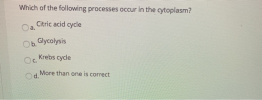 Which of the following processes occur in the cytoplasm? Citric acid cycle a. Oь. Glycolysis Krebs cycle C. d. More than one is correct
Where are the various locations that viral assembly can occur within the cell and how does...
Where are the various locations that viral assembly can occur within the cell and how does the location of assembly relate to the location of the production/synthesis of the viral factors?
113) Adenosine triphosphate is generated during a) glycolysis b) the krebs cycle c) the electron transport chain re...
 113) Adenosine triphosphate is generated during a) glycolysis b) the krebs cycle c) the electron transport chain reaction d) all of the above c) band only 114) During which of the following processes is the greatest amount of ATP produced: Osmosis peptidoglycan synthesis glycolysis electron transport chain reactions lipidolysis 115) The site of the bacterial cell where ATP is produced is the cell wall cell membrane mitochondria nuclear region bande 116) ATP syhtnase: c) is the enzyme the breaks down...
Select ALL of the statements that correctly describe the Krebs cycle. A. Pyruvic acid must be...
Select ALL of the statements that correctly describe the Krebs cycle. A. Pyruvic acid must be converted to acetyl CoA prior to entering the cycle B. The molecule oxaloacetic acid picks up the acetyl group from acetylCoA, and in the last step of the cycle, oxaloacetic acid is regenerated. C. Electrons removed during oxidation steps are picked up by NAD or FAD. D. Each turn of the cycle generates one ATP molecule for a total of two per molecule of...
Place the events related to eukaryotic cellular respiration into the boxes corresponding to each location in...
 Place the events related to eukaryotic cellular respiration into the boxes corresponding to each location in the cell Production of most ATP occurs here Pyruvate is oxidized to acetyl CoA Glycolysis Initial splitting of glucose Electron transport chain Krebs cycle Cytoplasm Mitochondrial matrix Mitochondrial inner membrane
 PRE-KREBS/TRANSITION PHASE: In the absence of oxygen the luyunde molecules from glycolysis are converted to lactic acid. If oxygen is present, they are instead converted into 2 molecules of _which then enter the mitochondria to undergo anaerob metabolism. During this transition phase, no ATP is produced but are released. and Mitochoadrial CITRIC ACID CYCLE: The citric acid cycle occurs in the matrix Both of the molecules of Adel produced after glycolysis run through the citric acid cycle reactions. At the...
 fill in the following table of the products of glycolysis and
the krebs cycle
Krebs ATP 16. Fill in the following table of the products of glycolysis and the krebs cycle: Glycolysis _ATP NADH NADH FADH2 FADH2 Pyruvate Pyruvate CO2 CO2 H20 H2O
fill in the following table of the products of glycolysis and
the krebs cycle
Krebs ATP 16. Fill in the following table of the products of glycolysis and the krebs cycle: Glycolysis _ATP NADH NADH FADH2 FADH2 Pyruvate Pyruvate CO2 CO2 H20 H2O
 Which of the following processes occur in the cytoplasm? Citric acid cycle a. Oь. Glycolysis Krebs cycle C. d. More than one is correct
 113) Adenosine triphosphate is generated during a) glycolysis b) the krebs cycle c) the electron transport chain reaction d) all of the above c) band only 114) During which of the following processes is the greatest amount of ATP produced: Osmosis peptidoglycan synthesis glycolysis electron transport chain reactions lipidolysis 115) The site of the bacterial cell where ATP is produced is the cell wall cell membrane mitochondria nuclear region bande 116) ATP syhtnase: c) is the enzyme the breaks down...
 Place the events related to eukaryotic cellular respiration into the boxes corresponding to each location in the cell Production of most ATP occurs here Pyruvate is oxidized to acetyl CoA Glycolysis Initial splitting of glucose Electron transport chain Krebs cycle Cytoplasm Mitochondrial matrix Mitochondrial inner membrane
Most questions answered within 3 hours.
-
Where is the error in this code sequence?
String s1 = "Hello";
String s2 = "ello";...
asked 10 months ago -
Financial data for Joel de Paris, Inc., for last year
follow:
Joel de Paris, Inc.
Balance...
asked 10 months ago -
Consider this reaction:
Al2(SO4)3 (aq)+ BaCl3
(aq) Al2Cl6 (aq)- +
3BaSO4(s) . What is the...
asked 10 months ago -
Suppose that Savneet is considering increasing her
recent random sample from 20 car rentals to 40...
asked 10 months ago -
Trucks arrive at an unloading terminal at an average rate of 120
per hour.
Trucks arrive...
asked 10 months ago -
Why are methanol and ethanol completely soluble in water while
octanol is not very little soluble....
asked 10 months ago -
A facilities manager at a university reads in a research report
that the mean amount of...
asked 10 months ago -
When the CuSO4 is rehydrated by adding water to the anhydrous
compound, is this an endothermic...
asked 10 months ago -
A ray of sunlight is passing from diamond into crown glass; the
angle of incidence is...
asked 10 months ago -
A block of mass 0.249 kg is placed on top of a light, vertical
spring of...
asked 10 months ago -
how do the kidneys compensate in the presences of acidosis
a) trigger hyperventilate
b) reserve acid...
asked 10 months ago -
Question 501 pts
The rental rate of capital to the firm increases. Which of the
following...
asked 10 months ago