A stone is thrown vertically upward from ground level with an initial velocity of 35.4 ?...
A stone is thrown vertically upward from ground level with an initial velocity of 35.4 ? ? . A) At what subsequent times, relative to the starting point, is it 18 ? above ground level (i.e. on the way up and on the way down), and what are the corresponding velocities at these times? B) What is the highest point reached by the stone?
Homework Answers
Initial Velocity of stone, u = 35.4 m/s
Part A
For this we will use 2nd equation of motion i.e.
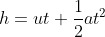
where, h is the total displacement of the stone from its initial position to final position
u is the initial velocity with which stone is travelling initially
a is the acceleration of the stone (which is g (acceleration due to gravity) = 9.8 m/s2 in our case as there is no other force acting on the stone than the gravitational force)
t is the time period of the motion
Now, we will be putting all quantities in the equation with +ve sign if they are measured or acting upward and -ve if measured or acting downward (Note :- Proper sign convention is very important in these equations)
Therefore putting, u = 35.4 m/s , h = 18 m , g = - 9.8m/s2 (because gravity always acts downward)
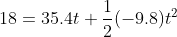


This is an quadratic equation (equation having two solutions) of type At2 + Bt + C
where A = 4.9 , B = - 35.4 and C = 18
and its two solutions will be given by below mentioned formula -
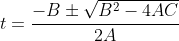


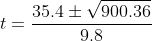
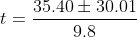



Two positive solutions of this equation means that the stone will pass through this particular point twice. Once on the way up and then on the way down.
Because t = 0.55 sec < t = 6.67 sec, Therefore First encounter of the stone with 18 m height will be at time t = 0.55 sec on the way up and then at time t = 6.67 sec on the way down, relative to the starting point respectively.
Now that we have time at which stone is at 18 m height, for finding the corresponding velocities at these points we will use 1st equation of motion i.e.

where, v is the final velocity of the stone
u is the initial velocity with which stone is travelling initially
a is the acceleration of the stone (which is g)
So putting all values with proper sign conventions i.e. u = 35.4 m/s , g = - 9.8 m/s2 and t = 0.55 sec (1st case)



(Notice the sign of v, it is positive, that shows direction of final velocity of stone at t = 0.55 seconds is still upwards)
Now for t = 6.67 sec



(Notice the sign of v in this case now, it is negative, that shows direction of final velocity of stone at t = 6.67 seconds is downwards which makes sense as the stone is on the way down at this time)
Part B
Now for calculating the highest point reached by the stone we will use 3rd equation of motion

where, v is the final velocity of the stone
u is the initial velocity with which stone is travelling initially
a is the acceleration of the stone (which is g)
and, h is the total displacement of the stone from its initial position to final position
Now as the stone reaches the topmost point, It's final velocity (v) will be equal to ZERO at that particular instant. After that it will start coming down and height will decrease.
Therefore, for highest point, final velocity v = 0
Putting v = 0 m/s , u = 35.4 m/s , a = - 9.8 m/s2


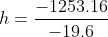

Therefore highest point reached by the stone, h = 63.94 m
Add Answer to:
A stone is thrown vertically upward from ground level with an
initial velocity of 35.4 ?...
A stone with mass m = 0.700 kg is thrown vertically upward into the air with...
A stone with mass m = 0.700 kg is thrown vertically upward into the air with an initial kinetic energy of 610 J. The drag force acting on the stone throughout its flight is constant, independent of the velocity of the stone, and has a magnitude of 0.600 N. What is the maximum height reached by the stone? What is the speed of the stone upon impact with the ground?
A stone thrown from the top of a building is given an initial velocity of 20.0...
A stone thrown from the top of a building is given an initial velocity of 20.0 m/s straight upward. The stone is launched 50.0 m above the ground, and the stone just misses the edge of the roof on the way down. Determine a.) the time needed for the stone to reach the ground b.) the velocity of the stone at t = 5.00s, with the position being -27.5 m
1. A stone is thrown vertically upward. On its way up it passes point A with...
 1.
A stone is thrown vertically upward. On its way up it passes point A with speed v, and point B, 5.10 m higher than A, with speed 1/2v. (a) Calculate the speed v. (Enter your answer to at least two decimal places.) (b) Calculate the maximum height reached by the stone above point B.
1.
A stone is thrown vertically upward. On its way up it passes point A with speed v, and point B, 5.10 m higher than A, with speed 1/2v. (a) Calculate the speed v. (Enter your answer to at least two decimal places.) (b) Calculate the maximum height reached by the stone above point B.
A stone thrown from the top of a building is given an initial velocity straight upward,...
A stone thrown from the top of a building is given an initial velocity straight upward, v0,y= 29ms. The height of the building is 50m. Calculate the maximum height, above the ground, the stone reaches. A stone thrown from the top of a building is given an initial velocity straight upward, v0,y= 29ms. The height of the building is 50m. After how long does the stone reach its maximum height ?
Two stones are thrown vertically upward from the ground, one with three times the initial speed...
Two stones are thrown vertically upward from the ground, one with three times the initial speed of the other. Assume free fall. If the faster stone takes 11.0 s to return to the ground, how long will it take the slower stone to return? If the slower stone reaches a maximum height of H, how high (in terms of H) will the faster stone go?
A stone thrown from the top of a building is given an initial velocity of 20.0...
A stone thrown from the top of a building is given an initial velocity of 20.0 m/s straight upward. The stone is launched 50.0 m above the ground, and the stone just misses the edge of the roof on the way down. 1. Using t=0 s as the time the stone leaves the thrower's hand at position, determine the time at which the stone reaches its maximum height. 2. Find the maximum height of the stone 3. Determine the velocity...
An egg is thrown nearly vertically upward from a point near the cornice of a tall...
An egg is thrown nearly vertically upward from a point near the cornice of a tall building. It just misses the cornice on the way down and passes a point a distance 43.0 m below its starting point at a time 5.00 s after it leaves the thrower's hand. Air resistance may be ignored. A) What is the initial speed of the egg? Express your answer in meters per second. B)How high does it rise above its starting point? Express...
An egg is thrown nearly vertically upward from a point near the cornice of a tall building
An egg is thrown nearly vertically upward from a point near the cornice of a tall building. It just misses the cornice on the way down and passes a point a distance 48.0 m below its starting point at a time 5.00s after it leaves the thrower's hand. Air resistance may be ignored. part A: What is the initial speed of the egg? v= m/s part B: How high does it rise above its starting point? h= m part C:...
If a stone is thrown vertically upward from the surface of the moon with a velocity...
If a stone is thrown vertically upward from the surface of the moon with a velocity of 6 m/s, its height (in meters) after t seconds is h = 6t - 0.83t2. (Round the answers to two decimal places.) a. What is the velocity of the stone after 3 s? b. What is the velocity of the stone after it has risen 8 m?
A stone thrown from the top of a building is given an initial velocity of 40.0...
A stone thrown from the top of a building is given an initial velocity of 40.0 m/s straight upward. The stone is launched 60.0 m above the ground, and the stone just misses the edge of the roof on its way down. a. Find the maximum height of the stone. b. Using t=0 as the time the stone leaves the thrower’s hand, determine the time at which the stone reaches its maximum height c. Find the velocity and position of...
 1.
A stone is thrown vertically upward. On its way up it passes point A with speed v, and point B, 5.10 m higher than A, with speed 1/2v. (a) Calculate the speed v. (Enter your answer to at least two decimal places.) (b) Calculate the maximum height reached by the stone above point B.
1.
A stone is thrown vertically upward. On its way up it passes point A with speed v, and point B, 5.10 m higher than A, with speed 1/2v. (a) Calculate the speed v. (Enter your answer to at least two decimal places.) (b) Calculate the maximum height reached by the stone above point B.
Most questions answered within 3 hours.
-
Where is the error in this code sequence?
String s1 = "Hello";
String s2 = "ello";...
asked 10 months ago -
Financial data for Joel de Paris, Inc., for last year
follow:
Joel de Paris, Inc.
Balance...
asked 10 months ago -
Consider this reaction:
Al2(SO4)3 (aq)+ BaCl3
(aq) Al2Cl6 (aq)- +
3BaSO4(s) . What is the...
asked 10 months ago -
Suppose that Savneet is considering increasing her
recent random sample from 20 car rentals to 40...
asked 10 months ago -
Trucks arrive at an unloading terminal at an average rate of 120
per hour.
Trucks arrive...
asked 10 months ago -
Why are methanol and ethanol completely soluble in water while
octanol is not very little soluble....
asked 10 months ago -
A facilities manager at a university reads in a research report
that the mean amount of...
asked 10 months ago -
When the CuSO4 is rehydrated by adding water to the anhydrous
compound, is this an endothermic...
asked 10 months ago -
A ray of sunlight is passing from diamond into crown glass; the
angle of incidence is...
asked 10 months ago -
A block of mass 0.249 kg is placed on top of a light, vertical
spring of...
asked 10 months ago -
how do the kidneys compensate in the presences of acidosis
a) trigger hyperventilate
b) reserve acid...
asked 10 months ago -
Question 501 pts
The rental rate of capital to the firm increases. Which of the
following...
asked 10 months ago