1-Reactions in cells are generally regulated by regulating the activity of the enzyme that catalyzes that...
1-Reactions in cells are generally regulated by regulating the activity of the enzyme that catalyzes that reaction. Broadly speaking, enzyme can be regulated by (a) changing the amount of enzyme present in the cells, or (b) changing the activity of the existing enzymes.
Mark all the ways in which the amount of enzyme can be regulated in cells.
Group of answer choices
Regulating degradation
Regulating Translation
Regulating Transcription
Binding allosteric regulators
2-
Reactions in cells are generally regulated by regulating the activity of the enzyme that catalyzes that reaction. Broadly speaking, enzyme can be regulated by (a) changing the amount of enzyme present in the cells, or (b) changing the activity of the existing enzymes.
Mark all the ways in which the activity of existing enzymes can be regulated in cells.
Group of answer choices
Covalent modifications like phosphorylation
Regulating Translation
Binding of regulators to the enzyme
Regulating degradation
Homework Answers
1.In order to change the amount of enzymes in cells, rate of enzyme synthesis and rate of degradation has to be regulated .Hence options 1 (regulating degradation),2 (regulating translation) and 3 (regulating transcription) which directly determine amount of enzymes in cells are right answers.Option 4 is wrong because allosteric regulator can only alter the activity of an enzyme.
2.In order to control the catalytic activity of enzyme, cells employ regulators that bind to enzyme and add covalent modifications.Hence, options 1 and 3 are right.Options 2 and 4 determine amount of enzymes in cells, but not enzyme activity.
Add Answer to:
1-Reactions in cells
are generally regulated by regulating the activity of the enzyme
that catalyzes that...
Metabolism can be regulated via Group of answer choices regulating synthesis of particular enzyme. allosteric effectors....
Metabolism can be regulated via Group of answer choices regulating synthesis of particular enzyme. allosteric effectors. feedback inhibition. covalent modification of enzymes. All of the above.
PEK-1 is an enzyme that catalyzes step 3 of glycolysis. The activity of this enzyme is...
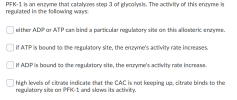 PEK-1 is an enzyme that catalyzes step 3 of glycolysis. The activity of this enzyme is regulated in the following ways: O either ADP or ATP can bind a particular regulatory site on this allosteric enzyme. O if ATP is bound to the regulatory site, the enzyme's activity rate increases. if ADP is bound to the regulatory site, the enzyme's activity rate increase. high levels of citrate indicate that the CAC is not keeping up, citrate binds to the regulatory...
D Each enzyme is specihic of and because its shape catalyzes on certain reactions. The chemical reactions taking place in a cell will most likely speed up if the 3. A genetic material stops re...
 D Each enzyme is specihic of and because its shape catalyzes on certain reactions. The chemical reactions taking place in a cell will most likely speed up if the 3. A genetic material stops replicating. B the size of the cell increases. C the enzymes involved become inactive. D the concentration of the reactants is increased. 4. Enzymes A are able to heat up molecules so that they can react B provide CO2 for chemical reactions. C are biological catalysts....
Part A - Overview of enzyme structure and enzymatic reactions Enzymes are large globular proteins. Much...
 Part A - Overview of enzyme structure and enzymatic reactions Enzymes are large globular proteins. Much of their three dimensional shape is the result of interactions between the R (variable) groups of their amino acids. The active site is the portion of the enzyme that will interact with the substrate the molecule that the enzyme acts upon. The nature and arrangement of amino acids in the active site make each enzyme specific to a substrate and to the reaction it...
1 2 3 4 5 6 7 8 9 Part A Which of the following is/are...
 1
2
3
4
5
6
7
8
9
Part A Which of the following is/are means whereby a catalyst can lower the activation energy of a reaction? quantum tunneling decreasing the number of reactive molecules permanently binding substrates inefficient collisions altering the temperature within the cell to one appropriate for reactions to proceed Subrnit Request Answer Part A An enzyme Obinds substrates in a manner that facilitates the formation of product decreases the rate of a reaction. is always...
1
2
3
4
5
6
7
8
9
Part A Which of the following is/are means whereby a catalyst can lower the activation energy of a reaction? quantum tunneling decreasing the number of reactive molecules permanently binding substrates inefficient collisions altering the temperature within the cell to one appropriate for reactions to proceed Subrnit Request Answer Part A An enzyme Obinds substrates in a manner that facilitates the formation of product decreases the rate of a reaction. is always...
Match the term to the correct description. Choices may only be used once. Group of...
Match the term to the correct description. Choices may only be used once. Group of answer choices [ Choose ] An inhibitor molecule binds to the active site. Part of an enzyme where the substrate binds to Protein molecules that function as biological catalysts An inhibitor molecule binds to an allosteric site and prevents the substrate from binding to the active site. A substance...
Foundations of Biological Sciences 1 Enzymes - 8 PART 4: THE EFFECT OF PH ON ENZYME...
 Foundations of Biological Sciences 1 Enzymes - 8 PART 4: THE EFFECT OF PH ON ENZYME ACTIVITY The pll scale measures the amount Another factor influencing the rate of enzyme catalysis is the pll of the of ons in a solution. The more solution. pH specifies the acidity or basicity of solution by measuring the the more acidic the solution and lower hydrogen ion consentation (H). Like temperature, pH affects the three- pH) dimensional shape of enzymes, thus regulating their...
thats all the information that he gave us to solve the question. Thank you for trying...
 thats all the information that he gave us to solve the question.
Thank you for trying anyways
X C E Question 23 1 pts The free-energy changes for the transfer of individual amino acid residues from a hydrophobic to an aqueous environment are given as follows: Amino acid AG of transfer (kJ/mol Proline -0.8 -12.6 Histidine 6.7 Alanine Methionine 14.3 Based on this information, which of these amino acid pairs is MOST likely to be represented in membrane-spanning alpha helices?...
thats all the information that he gave us to solve the question.
Thank you for trying anyways
X C E Question 23 1 pts The free-energy changes for the transfer of individual amino acid residues from a hydrophobic to an aqueous environment are given as follows: Amino acid AG of transfer (kJ/mol Proline -0.8 -12.6 Histidine 6.7 Alanine Methionine 14.3 Based on this information, which of these amino acid pairs is MOST likely to be represented in membrane-spanning alpha helices?...
Help on prelab NOTE! There are FOUR (4) pages in this pre-lab! PRE-LAB WORKSHEET FOR ENZYME...
 Help on prelab
NOTE! There are FOUR (4) pages in this pre-lab! PRE-LAB WORKSHEET FOR ENZYME LAB To be completed prior to the online prelab esercise 1 ) Suppose that the diagram below represents what occurs during a chemical reaction e) Which letter points tq the prodact? print e ore , d 3) (c) Which letter points to the enzyme? (d) Which letter points to the enzyme's active site? (e) Which letter points to the enzyme's substrate? Note: Some letters...
Help on prelab
NOTE! There are FOUR (4) pages in this pre-lab! PRE-LAB WORKSHEET FOR ENZYME LAB To be completed prior to the online prelab esercise 1 ) Suppose that the diagram below represents what occurs during a chemical reaction e) Which letter points tq the prodact? print e ore , d 3) (c) Which letter points to the enzyme? (d) Which letter points to the enzyme's active site? (e) Which letter points to the enzyme's substrate? Note: Some letters...
Microbiology study guide questions. Please Help! s. which of the following statements about water activity is not true? a) many fungi can tolerate aw levels of 07-0.8 b) many microorganisms grow...
 Microbiology study guide questions. Please Help!
s. which of the following statements about water activity is not true? a) many fungi can tolerate aw levels of 07-0.8 b) many microorganisms grow well at an aw of 0.98 e sear water has an aw of 0.98 e-xerephiles thrive in dry conditions DNA typically becomes disordered below an a of o.90 Which of the following descriptions about ribosome structure is not true? a) 80s is the size of the intact functional ribosome...
Microbiology study guide questions. Please Help!
s. which of the following statements about water activity is not true? a) many fungi can tolerate aw levels of 07-0.8 b) many microorganisms grow well at an aw of 0.98 e sear water has an aw of 0.98 e-xerephiles thrive in dry conditions DNA typically becomes disordered below an a of o.90 Which of the following descriptions about ribosome structure is not true? a) 80s is the size of the intact functional ribosome...
 PEK-1 is an enzyme that catalyzes step 3 of glycolysis. The activity of this enzyme is regulated in the following ways: O either ADP or ATP can bind a particular regulatory site on this allosteric enzyme. O if ATP is bound to the regulatory site, the enzyme's activity rate increases. if ADP is bound to the regulatory site, the enzyme's activity rate increase. high levels of citrate indicate that the CAC is not keeping up, citrate binds to the regulatory...
 D Each enzyme is specihic of and because its shape catalyzes on certain reactions. The chemical reactions taking place in a cell will most likely speed up if the 3. A genetic material stops replicating. B the size of the cell increases. C the enzymes involved become inactive. D the concentration of the reactants is increased. 4. Enzymes A are able to heat up molecules so that they can react B provide CO2 for chemical reactions. C are biological catalysts....
 Part A - Overview of enzyme structure and enzymatic reactions Enzymes are large globular proteins. Much of their three dimensional shape is the result of interactions between the R (variable) groups of their amino acids. The active site is the portion of the enzyme that will interact with the substrate the molecule that the enzyme acts upon. The nature and arrangement of amino acids in the active site make each enzyme specific to a substrate and to the reaction it...
 1
2
3
4
5
6
7
8
9
Part A Which of the following is/are means whereby a catalyst can lower the activation energy of a reaction? quantum tunneling decreasing the number of reactive molecules permanently binding substrates inefficient collisions altering the temperature within the cell to one appropriate for reactions to proceed Subrnit Request Answer Part A An enzyme Obinds substrates in a manner that facilitates the formation of product decreases the rate of a reaction. is always...
1
2
3
4
5
6
7
8
9
Part A Which of the following is/are means whereby a catalyst can lower the activation energy of a reaction? quantum tunneling decreasing the number of reactive molecules permanently binding substrates inefficient collisions altering the temperature within the cell to one appropriate for reactions to proceed Subrnit Request Answer Part A An enzyme Obinds substrates in a manner that facilitates the formation of product decreases the rate of a reaction. is always...
 Foundations of Biological Sciences 1 Enzymes - 8 PART 4: THE EFFECT OF PH ON ENZYME ACTIVITY The pll scale measures the amount Another factor influencing the rate of enzyme catalysis is the pll of the of ons in a solution. The more solution. pH specifies the acidity or basicity of solution by measuring the the more acidic the solution and lower hydrogen ion consentation (H). Like temperature, pH affects the three- pH) dimensional shape of enzymes, thus regulating their...
 thats all the information that he gave us to solve the question.
Thank you for trying anyways
X C E Question 23 1 pts The free-energy changes for the transfer of individual amino acid residues from a hydrophobic to an aqueous environment are given as follows: Amino acid AG of transfer (kJ/mol Proline -0.8 -12.6 Histidine 6.7 Alanine Methionine 14.3 Based on this information, which of these amino acid pairs is MOST likely to be represented in membrane-spanning alpha helices?...
thats all the information that he gave us to solve the question.
Thank you for trying anyways
X C E Question 23 1 pts The free-energy changes for the transfer of individual amino acid residues from a hydrophobic to an aqueous environment are given as follows: Amino acid AG of transfer (kJ/mol Proline -0.8 -12.6 Histidine 6.7 Alanine Methionine 14.3 Based on this information, which of these amino acid pairs is MOST likely to be represented in membrane-spanning alpha helices?...
 Help on prelab
NOTE! There are FOUR (4) pages in this pre-lab! PRE-LAB WORKSHEET FOR ENZYME LAB To be completed prior to the online prelab esercise 1 ) Suppose that the diagram below represents what occurs during a chemical reaction e) Which letter points tq the prodact? print e ore , d 3) (c) Which letter points to the enzyme? (d) Which letter points to the enzyme's active site? (e) Which letter points to the enzyme's substrate? Note: Some letters...
Help on prelab
NOTE! There are FOUR (4) pages in this pre-lab! PRE-LAB WORKSHEET FOR ENZYME LAB To be completed prior to the online prelab esercise 1 ) Suppose that the diagram below represents what occurs during a chemical reaction e) Which letter points tq the prodact? print e ore , d 3) (c) Which letter points to the enzyme? (d) Which letter points to the enzyme's active site? (e) Which letter points to the enzyme's substrate? Note: Some letters...
 Microbiology study guide questions. Please Help!
s. which of the following statements about water activity is not true? a) many fungi can tolerate aw levels of 07-0.8 b) many microorganisms grow well at an aw of 0.98 e sear water has an aw of 0.98 e-xerephiles thrive in dry conditions DNA typically becomes disordered below an a of o.90 Which of the following descriptions about ribosome structure is not true? a) 80s is the size of the intact functional ribosome...
Microbiology study guide questions. Please Help!
s. which of the following statements about water activity is not true? a) many fungi can tolerate aw levels of 07-0.8 b) many microorganisms grow well at an aw of 0.98 e sear water has an aw of 0.98 e-xerephiles thrive in dry conditions DNA typically becomes disordered below an a of o.90 Which of the following descriptions about ribosome structure is not true? a) 80s is the size of the intact functional ribosome...
Most questions answered within 3 hours.
-
Where is the error in this code sequence?
String s1 = "Hello";
String s2 = "ello";...
asked 10 months ago -
Financial data for Joel de Paris, Inc., for last year
follow:
Joel de Paris, Inc.
Balance...
asked 10 months ago -
Consider this reaction:
Al2(SO4)3 (aq)+ BaCl3
(aq) Al2Cl6 (aq)- +
3BaSO4(s) . What is the...
asked 10 months ago -
Suppose that Savneet is considering increasing her
recent random sample from 20 car rentals to 40...
asked 10 months ago -
Trucks arrive at an unloading terminal at an average rate of 120
per hour.
Trucks arrive...
asked 10 months ago -
Why are methanol and ethanol completely soluble in water while
octanol is not very little soluble....
asked 10 months ago -
A facilities manager at a university reads in a research report
that the mean amount of...
asked 10 months ago -
When the CuSO4 is rehydrated by adding water to the anhydrous
compound, is this an endothermic...
asked 10 months ago -
A ray of sunlight is passing from diamond into crown glass; the
angle of incidence is...
asked 10 months ago -
A block of mass 0.249 kg is placed on top of a light, vertical
spring of...
asked 10 months ago -
how do the kidneys compensate in the presences of acidosis
a) trigger hyperventilate
b) reserve acid...
asked 10 months ago -
Question 501 pts
The rental rate of capital to the firm increases. Which of the
following...
asked 10 months ago