What is the molecular mass of an unknown gas if 6.5 liters at 75C and 700...
What is the molecular mass of an unknown gas if 6.5 liters at 75C and 700 mm pressure weigh 30.0 grams?
a. 143 g/mol
b. 121.3 g/mol
c. 87.4 g/mol
d. 54.8 g/mol
e. 30.8 g/mol
Homework Answers

Add Answer to:
What is the molecular mass of an unknown gas if 6.5 liters at
75C and 700...
Experiment 12: Generating Hydrogen Gas Part B: Molar mass of unknown metal Unknown #: Mass of...
 Experiment 12: Generating Hydrogen Gas Part B: Molar mass of unknown metal Unknown #: Mass of unknown metal (X) .29 Volume of H2 gas L mL Temperature of H; gas 20 mm к C Atmospheric pressure (see barometer) Vapor pressure of water mmHg Partial pressure of H; gas mmHg atm Using PV-nRT and your data, calculate the moles of hydrogen gas produced in the experiment: l e epl8 moles H Convert moles of hydrogen gas to moles of the metal...
A gas mixture is made by combining 6.5 g each of Ar, Ne, and an unknown...
 A gas mixture is made by combining 6.5 g each of Ar, Ne, and an unknown diatomic gas. At STP, the mixture occupies a volume of 12.91 L What is the molar mass of the unknown gas? Identify the unknown gas. Number g/mol OOOOO
A gas of unknown molecular mass was allowed to effuse through a small opening under constant...
 A gas of unknown molecular mass was allowed to effuse through a small opening under constant pressure conditions. It required 52 s for 1.0 L of the gas to effuse. Under identical experimental conditions it required 27 s for 1.0 L of O2 gas to effuse. Calculate the molar mass of the unknown gas. (Remember that the faster the rate of effusion, the shorter the time required for effusion of 1.0 L; that is, rate and time are inversely proportional.)...
. 0.275 L of solution is prepared by dissolving 2.50 g of an unknown molecular compound...
. 0.275 L of solution is prepared by dissolving 2.50 g of an unknown molecular compound in enough water. The osmotic pressure of this solution is 1.98 atm at 27 °C. (R = 0.08206 L·atm/mol·K) a) Determine the molar mass of the molecular compound. (7 pts) b) If you need to prepare 0.275 L of AlCl3 solution with the same osmotic pressure of the above solution, what mass of AlCl3 (MW = 133.33 g/mol) would you need to weigh out?
A 2.43 gram sample of an unknown gas is found to occupy a volume of 2.03...
A 2.43 gram sample of an unknown gas is found to occupy a volume of 2.03 L at a pressure of 506 mm Hg and a temperature of 39°C. The molecular weight of the unknown gas is g/mol
A 4.62 gram sample of an unknown gas is found to occupy a volume of 1.50...
A 4.62 gram sample of an unknown gas is found to occupy a volume of 1.50 L at a pressure of 989 mm Hg and a temperature of 30°C. The molecular weight of the unknown gas is g/mol.
a. What is the molecular weight of 3.7 g of an unknown gas that occupies 450...
a. What is the molecular weight of 3.7 g of an unknown gas that occupies 450 mL at 20.0°C and 2.0 atm? The value of R 0.0821 L atm mol K-1 b. Aluminum and oxygen react to form aluminum oxide. How many L of oxygen at 296 K and 1.4 atm of pressure are necessary to form 3.25 g of aluminum oxide?
show work please 5. (2 points) Calcium carbide reacts with water to produce an unknown gas...
 show work please
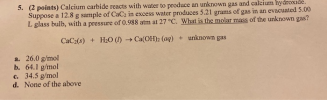
5. (2 points) Calcium carbide reacts with water to produce an unknown gas and calcium hydroxide. Suppose a 12.8 g sample of CaC2 in excess water produces 5.21 grams of gas in an evacuated 5.00 L glass bulb, with a pressure of 0.988 atm at 27 °C. What is the molar mass of the unknown gas? CaC2(s) + H20 (1) Ca(OH)2 (aq) + unknown gas a. 26.0 g/mol b. 64.1 g/mol c. 34.5 g/mol d. None of...
show work please
5. (2 points) Calcium carbide reacts with water to produce an unknown gas and calcium hydroxide. Suppose a 12.8 g sample of CaC2 in excess water produces 5.21 grams of gas in an evacuated 5.00 L glass bulb, with a pressure of 0.988 atm at 27 °C. What is the molar mass of the unknown gas? CaC2(s) + H20 (1) Ca(OH)2 (aq) + unknown gas a. 26.0 g/mol b. 64.1 g/mol c. 34.5 g/mol d. None of...
A sample of N2 gas is contaminated with a gas (A) of unknown molar mass. The...
A sample of N2 gas is contaminated with a gas (A) of unknown molar mass. The partial pressure of each gas is known to be 200. torr at 25°C. The gases are allowed to effuse through a pinhole, and it is found that gas A escapes at 2 times the rate of N2. The molar mass of gas A is: 56 g/mol 14.01 g/mol 7.00 g/mol 112 g/mol none of these
A 2.54 gram sample of an unknown gas is found to occupy a volume of 1.43...
 A 2.54 gram sample of an unknown gas is found to occupy a volume of 1.43 L at a pressure of 989 mm Hg and a temperature of 40°C. The molecular weight of the unknown gas is g/mol. Assume ideal behavior.
 Experiment 12: Generating Hydrogen Gas Part B: Molar mass of unknown metal Unknown #: Mass of unknown metal (X) .29 Volume of H2 gas L mL Temperature of H; gas 20 mm к C Atmospheric pressure (see barometer) Vapor pressure of water mmHg Partial pressure of H; gas mmHg atm Using PV-nRT and your data, calculate the moles of hydrogen gas produced in the experiment: l e epl8 moles H Convert moles of hydrogen gas to moles of the metal...
 A gas mixture is made by combining 6.5 g each of Ar, Ne, and an unknown diatomic gas. At STP, the mixture occupies a volume of 12.91 L What is the molar mass of the unknown gas? Identify the unknown gas. Number g/mol OOOOO
 A gas of unknown molecular mass was allowed to effuse through a small opening under constant pressure conditions. It required 52 s for 1.0 L of the gas to effuse. Under identical experimental conditions it required 27 s for 1.0 L of O2 gas to effuse. Calculate the molar mass of the unknown gas. (Remember that the faster the rate of effusion, the shorter the time required for effusion of 1.0 L; that is, rate and time are inversely proportional.)...
 show work please
5. (2 points) Calcium carbide reacts with water to produce an unknown gas and calcium hydroxide. Suppose a 12.8 g sample of CaC2 in excess water produces 5.21 grams of gas in an evacuated 5.00 L glass bulb, with a pressure of 0.988 atm at 27 °C. What is the molar mass of the unknown gas? CaC2(s) + H20 (1) Ca(OH)2 (aq) + unknown gas a. 26.0 g/mol b. 64.1 g/mol c. 34.5 g/mol d. None of...
show work please
5. (2 points) Calcium carbide reacts with water to produce an unknown gas and calcium hydroxide. Suppose a 12.8 g sample of CaC2 in excess water produces 5.21 grams of gas in an evacuated 5.00 L glass bulb, with a pressure of 0.988 atm at 27 °C. What is the molar mass of the unknown gas? CaC2(s) + H20 (1) Ca(OH)2 (aq) + unknown gas a. 26.0 g/mol b. 64.1 g/mol c. 34.5 g/mol d. None of...
 A 2.54 gram sample of an unknown gas is found to occupy a volume of 1.43 L at a pressure of 989 mm Hg and a temperature of 40°C. The molecular weight of the unknown gas is g/mol. Assume ideal behavior.
Most questions answered within 3 hours.
-
Where is the error in this code sequence?
String s1 = "Hello";
String s2 = "ello";...
asked 11 months ago -
Financial data for Joel de Paris, Inc., for last year
follow:
Joel de Paris, Inc.
Balance...
asked 11 months ago -
Consider this reaction:
Al2(SO4)3 (aq)+ BaCl3
(aq) Al2Cl6 (aq)- +
3BaSO4(s) . What is the...
asked 11 months ago -
Suppose that Savneet is considering increasing her
recent random sample from 20 car rentals to 40...
asked 11 months ago -
Trucks arrive at an unloading terminal at an average rate of 120
per hour.
Trucks arrive...
asked 11 months ago -
Why are methanol and ethanol completely soluble in water while
octanol is not very little soluble....
asked 11 months ago -
A facilities manager at a university reads in a research report
that the mean amount of...
asked 11 months ago -
When the CuSO4 is rehydrated by adding water to the anhydrous
compound, is this an endothermic...
asked 11 months ago -
A ray of sunlight is passing from diamond into crown glass; the
angle of incidence is...
asked 11 months ago -
A block of mass 0.249 kg is placed on top of a light, vertical
spring of...
asked 11 months ago -
how do the kidneys compensate in the presences of acidosis
a) trigger hyperventilate
b) reserve acid...
asked 11 months ago -
Question 501 pts
The rental rate of capital to the firm increases. Which of the
following...
asked 11 months ago