Answer all parts of the following question, showing all workings and reasonings/assumptions. 5. Antibodies immobilised on...
Answer all parts of the following question, showing all workings and reasonings/assumptions.
5. Antibodies immobilised on surfaces are often used to detect proteins or other antibodies that indicate disease, e.g., cancer, cardiovascular disease, infection etc. Antibodies are deposited on a plastic surface so that their concentration is 5x10-12 mol cm—2 (NOTE THE UNITS, THEY ARE 2-DIMENSIONAL, MOLES PER CENTIMENTRE SQUARED RATHER THAT MOLES PER CENTIMETRE CUBED AS YOU WOULD FIND IN SOLUTION!). The surface confined antibodies are to be labelled with metal nanoparticles.
i) Determine the maximum radius of the nanoparticles that will physically fit on the surface given the surface concentration of the antibodies and assuming that all antibodies are labelled with a single nanoparticle. (HINT! Work out area occupied by one antibodyyou are told the moles per centimetre squared so you can work out the number of antibody molecules per cm2 . Then work out the number of cm2 per antibody and convert to a radius assuming the area occupied is a disk.)
ii) The extinction coefficient of metal nanoparticles is described by the equation: = 1.6x10⁶ * r – 6.1x10⁵ where has units of M-1 cm-1 and r is in nm. Use this equation to predict the extinction coefficient of the nanoparticle using the radius obtained in part i. Comment on the significance of the intercept in the context of the Beer-Lambert Law.
iii) Reflectance absorbance spectroscopy can be used to measure the absorbance of ALL the nanoparticles immobilised on the plastic surface. Given that the lowest absorbance that can be accurately measured is 0.0001 AU, determine the area of the plastic surface needed to detect nanoparticles at a surface concentration of 5x10-12 mol cm—2 using reflectance absorbance spectroscopy.
Homework Answers
The given data assumes antibodies to be two-dimensional
entities. They have been immobilized on the surface with a surface
concentration CA =  .
.
This implies that 


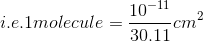
Now we want one nanoparticle to bind to one antibody such that all antibodies are covered with nanoparticles. Assuming antibodies as discs, the maximum radius of the nanoparticle is the same as the radius of the antibody discs.
 ,
where r is the radius of the nanoparticle.
,
where r is the radius of the nanoparticle.
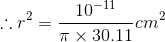
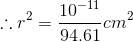




Thus the maximum radius to ensure that one antibody is covered with one nanoparticle is 3.251nm.
Beer Lambert's law states that Absorbance is proportional to the
concentration of the sample and to the path length. And the
proportionality constant is given by the molar extinction
coefficient ( )
of the sample.
)
of the sample.
Now given that  , where r is in nm.



Since Absorbance is highly instrument-specific and can vary due to various parameters across experiments, instead of reporting Absorbance values, people report the concentration values of the sample. To determine the concentration, a Beer-Lamber plot is constructed with Abosrbance as a function of the Concentration of known samples. Then a linear regression fits the plot and an unknown sample's concentration can be obtained by knowing the slope and the y-intercept of the plot. the y-intercept is basically the absorbance of a 0mM sample. That is just the solvent and no sample. This absorbance is the baseline that arises due to the absorption of light by the solvent and other instrumental errors.
Reflectance absorbance spectroscopy is based on Beer-Lambert's Law and determines the concentration of the sample. Here the pathlength is the diameter of the sample which absorbs the light. Therefore in our case, pathlength is 2r = 6.502nm.
Now Absorbance = Molar extinction coefficient * concentration of sample * pathlength. The minimum Absorbance that can be accurately measured is 0.0001AU. We have to determine the concentration of the sample that gives this absorbance.





Therefore the minimum concentration of nanoparticles required to get a signal is 66.99mM.
Now, therefore, the minimum area of sample required for the detector to collect sufficient absorbance can be obtained by solving



This is the minimum area of the sample required to be detected.
I hope this answers your question. Do feel free to provide feedback. It will help me to improve my answers.
Add Answer to:
Answer all parts of the following question, showing all workings
and reasonings/assumptions.
5. Antibodies immobilised on...
Question 12 parts a,b,c Q12. Using the information provided below on ELISA, answer the following questions...
 Question 12 parts a,b,c
Q12. Using the information provided below on ELISA, answer the following questions system to recognize an infectious and in Background While antibodies are used by the immune system to recognize scientists also use antibodies for a myriad of laboratory and the body, scientists also use antibodies for a agent in assays. If a scientist aims to identify a specific protein or mal y and clinical heterogeneous mixture such as a cell lysate or blood e such...
Question 12 parts a,b,c
Q12. Using the information provided below on ELISA, answer the following questions system to recognize an infectious and in Background While antibodies are used by the immune system to recognize scientists also use antibodies for a myriad of laboratory and the body, scientists also use antibodies for a agent in assays. If a scientist aims to identify a specific protein or mal y and clinical heterogeneous mixture such as a cell lysate or blood e such...
 Question 12 parts a,b,c
Q12. Using the information provided below on ELISA, answer the following questions system to recognize an infectious and in Background While antibodies are used by the immune system to recognize scientists also use antibodies for a myriad of laboratory and the body, scientists also use antibodies for a agent in assays. If a scientist aims to identify a specific protein or mal y and clinical heterogeneous mixture such as a cell lysate or blood e such...
Question 12 parts a,b,c
Q12. Using the information provided below on ELISA, answer the following questions system to recognize an infectious and in Background While antibodies are used by the immune system to recognize scientists also use antibodies for a myriad of laboratory and the body, scientists also use antibodies for a agent in assays. If a scientist aims to identify a specific protein or mal y and clinical heterogeneous mixture such as a cell lysate or blood e such...
Most questions answered within 3 hours.
-
Where is the error in this code sequence?
String s1 = "Hello";
String s2 = "ello";...
asked 11 months ago -
Financial data for Joel de Paris, Inc., for last year
follow:
Joel de Paris, Inc.
Balance...
asked 11 months ago -
Consider this reaction:
Al2(SO4)3 (aq)+ BaCl3
(aq) Al2Cl6 (aq)- +
3BaSO4(s) . What is the...
asked 11 months ago -
Suppose that Savneet is considering increasing her
recent random sample from 20 car rentals to 40...
asked 11 months ago -
Trucks arrive at an unloading terminal at an average rate of 120
per hour.
Trucks arrive...
asked 11 months ago -
Why are methanol and ethanol completely soluble in water while
octanol is not very little soluble....
asked 11 months ago -
A facilities manager at a university reads in a research report
that the mean amount of...
asked 11 months ago -
When the CuSO4 is rehydrated by adding water to the anhydrous
compound, is this an endothermic...
asked 11 months ago -
A ray of sunlight is passing from diamond into crown glass; the
angle of incidence is...
asked 11 months ago -
A block of mass 0.249 kg is placed on top of a light, vertical
spring of...
asked 11 months ago -
how do the kidneys compensate in the presences of acidosis
a) trigger hyperventilate
b) reserve acid...
asked 11 months ago -
Question 501 pts
The rental rate of capital to the firm increases. Which of the
following...
asked 11 months ago