1. What would you use to easily convert between gram sand moles mathematically
1. What would you use to easily convert between gram sand moles mathematically
Homework Answers

Add Answer to:
1. What would you use to easily convert between gram sand moles
mathematically
i have just that 2-metylcyclohexane has 4 gram then i have to convert to moles Date:...
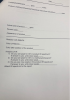 i
have just that 2-metylcyclohexane has 4 gram then i have to convert
to moles
Date: 2-methylcyclohexanol_ gram Product: (methycyclohexenes) Theoretical Yield (show calculation) moles gram Actual yield of product__ gram Percent yield Appearance of product Reaction with KMnO4 Color of KMnO4 Color after addition of the product Analysis of IR: 1) Do you see peak for OH in product IR spectrum? If answer is yes, write down peak 2) Do you see peak for OH in 2-methycyclohexanol? If answer...
i
have just that 2-metylcyclohexane has 4 gram then i have to convert
to moles
Date: 2-methylcyclohexanol_ gram Product: (methycyclohexenes) Theoretical Yield (show calculation) moles gram Actual yield of product__ gram Percent yield Appearance of product Reaction with KMnO4 Color of KMnO4 Color after addition of the product Analysis of IR: 1) Do you see peak for OH in product IR spectrum? If answer is yes, write down peak 2) Do you see peak for OH in 2-methycyclohexanol? If answer...
Next you convert grams to moles using the molar mass of the starting material in this case coal. I'm going to chang...
 Next you convert grams to moles using the molar mass of the starting material in this case coal. I'm going to change the number up slightly so that I don't give away the answers but the final answer we get will be close to the correct answer to the original question. The formula for coal is C135H96O9NS. On anxam that formula will be given to you. Calculate the molar mass from the formula and use the molar mass as a...
What would you multiply "moles of iodine" by to get the units "grams of iodine"? What...
What would you multiply "moles of iodine" by to get the units "grams of iodine"? What would you multiply "atoms of sulfur" by to get the units "moles of sulfur"? What would you multiply "moles of rubidium" by to get the units "atoms of rubidium"? How many grams of F are there in a sample of F that contains the same number of moles as a 34.0 gram sample of Al?
Create four conversion tables within one Microsoft Excel workbook that allow you to easily convert between...
Create four conversion tables within one Microsoft Excel workbook that allow you to easily convert between these options: 1. Mass/weight: bushels of corn, lb, kg, ton, tonne 2. Volume: ft3, gallon, m3, L 3. Flow rate: cfs, gpm, m3/d, L/s 4. lb/ac and kg/ha
Which reagents would you use to convert the aldehyde to the alcohol shown? Thank You!! Which reagents would you use to...
 Which reagents would you use to convert the aldehyde to the
alcohol shown? Thank You!!
Which reagents would you use to convert the aldehyde to the alcohol shown? H2. Pd/C NaBH4 in MeOH 1. CH3Li and H307 1. CH3Li in THF 2. H30+ 1. LIAIH4 2. H30+
Which reagents would you use to convert the aldehyde to the
alcohol shown? Thank You!!
Which reagents would you use to convert the aldehyde to the alcohol shown? H2. Pd/C NaBH4 in MeOH 1. CH3Li and H307 1. CH3Li in THF 2. H30+ 1. LIAIH4 2. H30+
In Part A, you explored the relationship between molarity, the number of moles, and solution volume....
In Part A, you explored the relationship between molarity, the number of moles, and solution volume. However, when you prepare a solution, you are unable to directly measure the number of moles of solute. Instead, you can mass the solute and convert between the number of moles and mass using the molar mass of a substance as a conversion factor. The molar mass of a substance can be calculated based on its molecular formula; otherwise, it can be calculated from...
Learning Goal: To understand how to use stoichiometry to convert between quantities of reactants and products...
 Learning Goal: To understand how to use stoichiometry to convert between quantities of reactants and products in chemical equations Stoichiometry describes the quantitative relationships among the reactants and products of a balanced reaction by directly comparing mole ratios Stoichiometry can be used to convert mass, number of moles or number of particles between products and reactants, as shown in the flowchart displayed in the figure Review Constants Periodic Table To convert from a given quantity of one reactant or product...
In Part A, you explored the relationship between molarity, the number of moles, and solution volume....
 In Part A, you explored the relationship between molarity, the number of moles, and solution volume. However, when you prepare a solution, you are unable to directly measure the number of moles of solute. Instead, you can mass the solute and convert between the number of moles and mass using the molar mass of a substance as a conversion factor. The molar mass of a substance can be calculated based on its molecular formula; otherwise, it can be calculated from...
The susceptibility tests included in this unit are typically used differentiate between Gram-positive cocci. Would you...
The susceptibility tests included in this unit are typically used differentiate between Gram-positive cocci. Would you predict them to be an effective differential test for Gram-negative organisms? Why or why not?
What is the change detection theory? How would you easily and briefly explain it?
What is the change detection theory? How would you easily and briefly explain it?
 i
have just that 2-metylcyclohexane has 4 gram then i have to convert
to moles
Date: 2-methylcyclohexanol_ gram Product: (methycyclohexenes) Theoretical Yield (show calculation) moles gram Actual yield of product__ gram Percent yield Appearance of product Reaction with KMnO4 Color of KMnO4 Color after addition of the product Analysis of IR: 1) Do you see peak for OH in product IR spectrum? If answer is yes, write down peak 2) Do you see peak for OH in 2-methycyclohexanol? If answer...
i
have just that 2-metylcyclohexane has 4 gram then i have to convert
to moles
Date: 2-methylcyclohexanol_ gram Product: (methycyclohexenes) Theoretical Yield (show calculation) moles gram Actual yield of product__ gram Percent yield Appearance of product Reaction with KMnO4 Color of KMnO4 Color after addition of the product Analysis of IR: 1) Do you see peak for OH in product IR spectrum? If answer is yes, write down peak 2) Do you see peak for OH in 2-methycyclohexanol? If answer...
 Next you convert grams to moles using the molar mass of the starting material in this case coal. I'm going to change the number up slightly so that I don't give away the answers but the final answer we get will be close to the correct answer to the original question. The formula for coal is C135H96O9NS. On anxam that formula will be given to you. Calculate the molar mass from the formula and use the molar mass as a...
 Which reagents would you use to convert the aldehyde to the
alcohol shown? Thank You!!
Which reagents would you use to convert the aldehyde to the alcohol shown? H2. Pd/C NaBH4 in MeOH 1. CH3Li and H307 1. CH3Li in THF 2. H30+ 1. LIAIH4 2. H30+
Which reagents would you use to convert the aldehyde to the
alcohol shown? Thank You!!
Which reagents would you use to convert the aldehyde to the alcohol shown? H2. Pd/C NaBH4 in MeOH 1. CH3Li and H307 1. CH3Li in THF 2. H30+ 1. LIAIH4 2. H30+
 Learning Goal: To understand how to use stoichiometry to convert between quantities of reactants and products in chemical equations Stoichiometry describes the quantitative relationships among the reactants and products of a balanced reaction by directly comparing mole ratios Stoichiometry can be used to convert mass, number of moles or number of particles between products and reactants, as shown in the flowchart displayed in the figure Review Constants Periodic Table To convert from a given quantity of one reactant or product...
 In Part A, you explored the relationship between molarity, the number of moles, and solution volume. However, when you prepare a solution, you are unable to directly measure the number of moles of solute. Instead, you can mass the solute and convert between the number of moles and mass using the molar mass of a substance as a conversion factor. The molar mass of a substance can be calculated based on its molecular formula; otherwise, it can be calculated from...
Most questions answered within 3 hours.
-
Where is the error in this code sequence?
String s1 = "Hello";
String s2 = "ello";...
asked 10 months ago -
Financial data for Joel de Paris, Inc., for last year
follow:
Joel de Paris, Inc.
Balance...
asked 10 months ago -
Consider this reaction:
Al2(SO4)3 (aq)+ BaCl3
(aq) Al2Cl6 (aq)- +
3BaSO4(s) . What is the...
asked 10 months ago -
Suppose that Savneet is considering increasing her
recent random sample from 20 car rentals to 40...
asked 10 months ago -
Trucks arrive at an unloading terminal at an average rate of 120
per hour.
Trucks arrive...
asked 10 months ago -
Why are methanol and ethanol completely soluble in water while
octanol is not very little soluble....
asked 10 months ago -
A facilities manager at a university reads in a research report
that the mean amount of...
asked 10 months ago -
When the CuSO4 is rehydrated by adding water to the anhydrous
compound, is this an endothermic...
asked 10 months ago -
A ray of sunlight is passing from diamond into crown glass; the
angle of incidence is...
asked 10 months ago -
A block of mass 0.249 kg is placed on top of a light, vertical
spring of...
asked 10 months ago -
how do the kidneys compensate in the presences of acidosis
a) trigger hyperventilate
b) reserve acid...
asked 10 months ago -
Question 501 pts
The rental rate of capital to the firm increases. Which of the
following...
asked 10 months ago