A space station has a large ring-like component that rotates to simulate gravity for the crew....
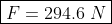
A space station has a large ring-like component that rotates to simulate gravity for the crew. This ring has a mass M = 2.1×10^5 kg and a radius of R = 86.0 m and can be modeled as a thin hoop. Before spinning up the ring section, crew members Dave and Frank dock their ships, each with mass m = 3.5×10^4 kg on two docking ports located on opposite sides of the center of the ring. The docking ports are located r = 31.0 m from the center of the ring. When the station’s computer begins to spin up the ring it has to spin both the ring and the ships. The ships can be treated as point particles. Two identical thrusters on the edge of the ring are used to spin up the ring with a constant angular acceleration. The ring-ship system takes 3 hours to reach the angular speed at which it simulates Earth’s gravity for the crew on the edge of the ring. What constant force must each of the two thrusters apply to reach this rotational speed?
Homework Answers
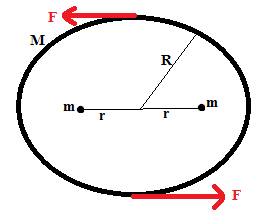
The moment of inertia of the spaceship+spacestation is


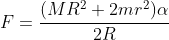
Let the force applied by each thruster is F, the torque on the system is

The applied torque will produce angular acceleration in the system



We will now determine the angular acceleration of the system.
If the spaceship is rotating at an angular speed of  ,
the centrifugal force experienced by the objects at rest relative
to the spaceship is
,
the centrifugal force experienced by the objects at rest relative
to the spaceship is

where m' is the mass of the object. This force simulates Earth's gravity



The spaceship should rotate at 0.3377s-1 angular speed in order to simulate Earth's gravity. If the angular acceleration is constant, the angular speed at time t is given by

The space ship starts from rest  and reaches
  angular speed in

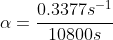

Substituting given values and angular acceleration into equation (1) we get

Add Answer to:
A space station has a large ring-like component that rotates to
simulate gravity for the crew....
Mass of station is 3.8X10⁶ Suppose once again that the space station begins at rest, not...
 Mass of station is 3.8X10⁶
Suppose once again that the space station begins at rest, not
rotating. This time, instead of using rocket engines attached to
the spherical end modules, we will have small probes periodically
launched from two points on the rod-shaped part of the station as
shown. The probes will launch in pairs in opposite directions, each
individual probe of identical mass 1287 kg and launched at a speed
of 15900 m/s with respect to the space station....
Mass of station is 3.8X10⁶
Suppose once again that the space station begins at rest, not
rotating. This time, instead of using rocket engines attached to
the spherical end modules, we will have small probes periodically
launched from two points on the rod-shaped part of the station as
shown. The probes will launch in pairs in opposite directions, each
individual probe of identical mass 1287 kg and launched at a speed
of 15900 m/s with respect to the space station....
A space station shaped like a giant wheel has a radius of 102 m and a...
 A space station shaped like a giant wheel has a radius of 102 m and a moment of inertia of 4.95. 108 kg m2. A crew of 150 lives on the rim, and the station is rotating so that the crew experiences an apparent acceleration of 1g. When 100 people move to the center of the station for a union meeting, the angular speed changes. What apparent acceleration is experienced by the managers remaining at the rim? Assume that the...
A space station shaped like a giant wheel has a radius of 127 m and a...
A space station shaped like a giant wheel has a radius of 127 m and a moment of inertia of 5.08 ✕ 108 kg · m2. A crew of 150 lives on the rim, and the station is rotating so that the crew experiences an apparent acceleration of 1g. When 100 people move to the center of the station for a union meeting, the angular speed changes. What apparent acceleration is experienced by the managers remaining at the rim? Assume...
A space station shaped like a giant wheel has a radius of 148 m and a...
A space station shaped like a giant wheel has a radius of 148 m and a moment of inertia of 4.69 ✕ 108 kg · m2. A crew of 150 lives on the rim, and the station is rotating so that the crew experiences an apparent acceleration of 1g. When 100 people move to the center of the station for a union meeting, the angular speed changes. What apparent acceleration is experienced by the managers remaining at the rim? Assume...
A space station shaped like a giant wheel has a radius of 109 m and a...
 A space station shaped like a giant wheel has a radius of 109 m and a moment of inertia of 4.96 times 10^8 kg. m^2. A crew of 150 lives on the rim, and the station is rotating so that the crew experiences an apparent acceleration of 1 g. When 100 people move to the center of the station for a union meeting, the angular speed changes. What apparent acceleration is experienced by the managers remaining at the rim? Assume...
Mass of station is 3.8X10⁶ Suppose once again that the space station begins at rest, not rotating. This time, instead of using rocket engines attached to the spherical end modules, we will have small...
 Mass of station is 3.8X10⁶
Suppose once again that the space station begins at rest, not
rotating. This time, instead of using rocket engines attached to
the spherical end modules, we will have small probes periodically
launched from two points on the rod-shaped part of the station as
shown. The probes will launch in pairs in opposite directions, each
individual probe of identical mass 1287 kg and launched at a speed
of 15900 m/s with respect to the space station....
Mass of station is 3.8X10⁶
Suppose once again that the space station begins at rest, not
rotating. This time, instead of using rocket engines attached to
the spherical end modules, we will have small probes periodically
launched from two points on the rod-shaped part of the station as
shown. The probes will launch in pairs in opposite directions, each
individual probe of identical mass 1287 kg and launched at a speed
of 15900 m/s with respect to the space station....
A) in minutes B) in launched pairs C) in rad/s All of the questions on this exam concern a space station, consisting of a long thin uniform rod of mass identical uniform hollow spheres, each o...
 A) in minutes
B) in launched pairs
C) in rad/s
All of the questions on this exam concern a space station, consisting of a long thin uniform rod of mass identical uniform hollow spheres, each of mass D E 74-meters, attached at the ends of the rod, as shown below. Note that none of the diograms shown is drawn to scale 4 4x 10° kg and length C. 4.4 x10 kg and l length C.240 meters, with two 17-'x 106kg...
A) in minutes
B) in launched pairs
C) in rad/s
All of the questions on this exam concern a space station, consisting of a long thin uniform rod of mass identical uniform hollow spheres, each of mass D E 74-meters, attached at the ends of the rod, as shown below. Note that none of the diograms shown is drawn to scale 4 4x 10° kg and length C. 4.4 x10 kg and l length C.240 meters, with two 17-'x 106kg...
PLEASE SHOW WORK AND ANSWER ALL PARTS. WHEN I ASKED THE SECTIONS SEPARATELY THE ANSWERS DID NOT MATCH, THANK YOU!!! All of the questions on this concern a space station, consisting of a long thin unif...
 PLEASE SHOW WORK AND ANSWER ALL PARTS. WHEN I ASKED THE
SECTIONS SEPARATELY THE ANSWERS DID NOT MATCH, THANK
YOU!!!
All of the questions on this concern a space station, consisting
of a long thin uniform rod of mass 4.4 x
106kg and length 171 meters,
with two identical uniform hollow spheres, each of mass 1.3
x 106 kg and radius 57 meters,
attached at the ends of the rod, as shown below. Note that none
of the diagrams shown...
PLEASE SHOW WORK AND ANSWER ALL PARTS. WHEN I ASKED THE
SECTIONS SEPARATELY THE ANSWERS DID NOT MATCH, THANK
YOU!!!
All of the questions on this concern a space station, consisting
of a long thin uniform rod of mass 4.4 x
106kg and length 171 meters,
with two identical uniform hollow spheres, each of mass 1.3
x 106 kg and radius 57 meters,
attached at the ends of the rod, as shown below. Note that none
of the diagrams shown...
These questions concern a space station, consisting of a long thin uniform rod of mass 4.3 x 10^6 kg and length 769 meters, with two identical uniform hollow spheres, each of mass 1.7 x 10^6 kg and ra...
 These questions concern a space station, consisting of a long
thin uniform rod of mass 4.3 x 10^6 kg and length 769 meters, with
two identical uniform hollow spheres, each of mass 1.7 x 10^6 kg
and radius 218 meters, attached at the ends of the rod, as shown
below. Please note that none of the diagrams shown is drawn to
scale.
A. Suppose that the station starts out at rest (not rotating).
What we want is to get it...
These questions concern a space station, consisting of a long
thin uniform rod of mass 4.3 x 10^6 kg and length 769 meters, with
two identical uniform hollow spheres, each of mass 1.7 x 10^6 kg
and radius 218 meters, attached at the ends of the rod, as shown
below. Please note that none of the diagrams shown is drawn to
scale.
A. Suppose that the station starts out at rest (not rotating).
What we want is to get it...
 Mass of station is 3.8X10⁶
Suppose once again that the space station begins at rest, not
rotating. This time, instead of using rocket engines attached to
the spherical end modules, we will have small probes periodically
launched from two points on the rod-shaped part of the station as
shown. The probes will launch in pairs in opposite directions, each
individual probe of identical mass 1287 kg and launched at a speed
of 15900 m/s with respect to the space station....
Mass of station is 3.8X10⁶
Suppose once again that the space station begins at rest, not
rotating. This time, instead of using rocket engines attached to
the spherical end modules, we will have small probes periodically
launched from two points on the rod-shaped part of the station as
shown. The probes will launch in pairs in opposite directions, each
individual probe of identical mass 1287 kg and launched at a speed
of 15900 m/s with respect to the space station....
 A space station shaped like a giant wheel has a radius of 102 m and a moment of inertia of 4.95. 108 kg m2. A crew of 150 lives on the rim, and the station is rotating so that the crew experiences an apparent acceleration of 1g. When 100 people move to the center of the station for a union meeting, the angular speed changes. What apparent acceleration is experienced by the managers remaining at the rim? Assume that the...
 A space station shaped like a giant wheel has a radius of 109 m and a moment of inertia of 4.96 times 10^8 kg. m^2. A crew of 150 lives on the rim, and the station is rotating so that the crew experiences an apparent acceleration of 1 g. When 100 people move to the center of the station for a union meeting, the angular speed changes. What apparent acceleration is experienced by the managers remaining at the rim? Assume...
 Mass of station is 3.8X10⁶
Suppose once again that the space station begins at rest, not
rotating. This time, instead of using rocket engines attached to
the spherical end modules, we will have small probes periodically
launched from two points on the rod-shaped part of the station as
shown. The probes will launch in pairs in opposite directions, each
individual probe of identical mass 1287 kg and launched at a speed
of 15900 m/s with respect to the space station....
Mass of station is 3.8X10⁶
Suppose once again that the space station begins at rest, not
rotating. This time, instead of using rocket engines attached to
the spherical end modules, we will have small probes periodically
launched from two points on the rod-shaped part of the station as
shown. The probes will launch in pairs in opposite directions, each
individual probe of identical mass 1287 kg and launched at a speed
of 15900 m/s with respect to the space station....
 A) in minutes
B) in launched pairs
C) in rad/s
All of the questions on this exam concern a space station, consisting of a long thin uniform rod of mass identical uniform hollow spheres, each of mass D E 74-meters, attached at the ends of the rod, as shown below. Note that none of the diograms shown is drawn to scale 4 4x 10° kg and length C. 4.4 x10 kg and l length C.240 meters, with two 17-'x 106kg...
A) in minutes
B) in launched pairs
C) in rad/s
All of the questions on this exam concern a space station, consisting of a long thin uniform rod of mass identical uniform hollow spheres, each of mass D E 74-meters, attached at the ends of the rod, as shown below. Note that none of the diograms shown is drawn to scale 4 4x 10° kg and length C. 4.4 x10 kg and l length C.240 meters, with two 17-'x 106kg...
 PLEASE SHOW WORK AND ANSWER ALL PARTS. WHEN I ASKED THE
SECTIONS SEPARATELY THE ANSWERS DID NOT MATCH, THANK
YOU!!!
All of the questions on this concern a space station, consisting
of a long thin uniform rod of mass 4.4 x
106kg and length 171 meters,
with two identical uniform hollow spheres, each of mass 1.3
x 106 kg and radius 57 meters,
attached at the ends of the rod, as shown below. Note that none
of the diagrams shown...
PLEASE SHOW WORK AND ANSWER ALL PARTS. WHEN I ASKED THE
SECTIONS SEPARATELY THE ANSWERS DID NOT MATCH, THANK
YOU!!!
All of the questions on this concern a space station, consisting
of a long thin uniform rod of mass 4.4 x
106kg and length 171 meters,
with two identical uniform hollow spheres, each of mass 1.3
x 106 kg and radius 57 meters,
attached at the ends of the rod, as shown below. Note that none
of the diagrams shown...
 These questions concern a space station, consisting of a long
thin uniform rod of mass 4.3 x 10^6 kg and length 769 meters, with
two identical uniform hollow spheres, each of mass 1.7 x 10^6 kg
and radius 218 meters, attached at the ends of the rod, as shown
below. Please note that none of the diagrams shown is drawn to
scale.
A. Suppose that the station starts out at rest (not rotating).
What we want is to get it...
These questions concern a space station, consisting of a long
thin uniform rod of mass 4.3 x 10^6 kg and length 769 meters, with
two identical uniform hollow spheres, each of mass 1.7 x 10^6 kg
and radius 218 meters, attached at the ends of the rod, as shown
below. Please note that none of the diagrams shown is drawn to
scale.
A. Suppose that the station starts out at rest (not rotating).
What we want is to get it...
Most questions answered within 3 hours.
-
Where is the error in this code sequence?
String s1 = "Hello";
String s2 = "ello";...
asked 10 months ago -
Financial data for Joel de Paris, Inc., for last year
follow:
Joel de Paris, Inc.
Balance...
asked 10 months ago -
Consider this reaction:
Al2(SO4)3 (aq)+ BaCl3
(aq) Al2Cl6 (aq)- +
3BaSO4(s) . What is the...
asked 10 months ago -
Suppose that Savneet is considering increasing her
recent random sample from 20 car rentals to 40...
asked 10 months ago -
Trucks arrive at an unloading terminal at an average rate of 120
per hour.
Trucks arrive...
asked 10 months ago -
Why are methanol and ethanol completely soluble in water while
octanol is not very little soluble....
asked 10 months ago -
A facilities manager at a university reads in a research report
that the mean amount of...
asked 10 months ago -
When the CuSO4 is rehydrated by adding water to the anhydrous
compound, is this an endothermic...
asked 10 months ago -
A ray of sunlight is passing from diamond into crown glass; the
angle of incidence is...
asked 10 months ago -
A block of mass 0.249 kg is placed on top of a light, vertical
spring of...
asked 10 months ago -
how do the kidneys compensate in the presences of acidosis
a) trigger hyperventilate
b) reserve acid...
asked 10 months ago -
Question 501 pts
The rental rate of capital to the firm increases. Which of the
following...
asked 10 months ago