H2O2(aq)⟶H2O(l) + 1/2 O2(g) a. The above chemical equation is for a first-order reaction. At 302...
H2O2(aq)⟶H2O(l) + 1/2 O2(g)
a. The above chemical equation is for a first-order reaction. At 302 K , the rate constant equals 8.5×10⁻⁴s−1. Calculate the half-life at this temperature. Express your answer to two significant figures and include the appropriate units.
b. If the activation energy for this reaction is 75 kJ/mol, at what temperature would the reaction rate be doubled? Express your answer as an integer and include the appropriate units.
Homework Answers
a)
half life = 0.693 /rate constant
= 0.693 / 8.5 x 10^-4
= 815.3 sec
half life = 8.2 x 10^2 sec
b)
ln (k2 / k1) = Ea / R [1 / T1 - 1 / T2 ]
ln 2 = 75 / 8.314 x 10^-3 [1 / 302 - 1 / T2 ]
7.68 x 10^-5 = 3.31 x 10^-3 - 1/ T2
T2 = 309 K
temperature = 309 K
Add Answer to:
H2O2(aq)⟶H2O(l) + 1/2 O2(g)
a. The above chemical equation is for a first-order reaction. At
302...
Consider the balanced chemical equation. H2O2(aq)+3I−(aq)+2H+(aq)→I3−(aq)+2H2O(l) In the first 14.0 s of the reaction, the concentration...
Consider the balanced chemical equation. H2O2(aq)+3I−(aq)+2H+(aq)→I3−(aq)+2H2O(l) In the first 14.0 s of the reaction, the concentration of I− drops from 1.000 M to 0.817 M Predict the rate of change in the concentration of H2O2 (Δ[H2O2]/Δt). Express the rate to three significant figures and include the appropriate units. (I understand the arithmetic, but I'm having a tough time with the units)
2 H2O2(aq) + 2 H2O(l) + O2(g) 5. Hydrogen peroxide decomposes according to the equation above. a. An aqueous solutio...
 2 H2O2(aq) + 2 H2O(l) + O2(g) 5. Hydrogen peroxide decomposes according to the equation above. a. An aqueous solution of H2O, that is 6.00 percent H,O, by mass has a density of 1.03 g ml. Calculate each of the following. (i) The original number of moles of H2O, in a 125 ml sample of the 6.00 percent H2O2 solution (ii) The number of moles of O,(g) that are produced when all of the H2O2 in the 125 mL sample...
1) Hydrogen peroxide, H2O2(aq), decomposes to H2O(l) and O2(g) in a reaction that is first order...
1) Hydrogen peroxide, H2O2(aq), decomposes to H2O(l) and O2(g) in a reaction that is first order in H2O2 and has a rate constant k = 1.06×10⁻³ min−1 at a given temperature. How long will it take for 15% of a sample of H2O2 to decompose? 2)The decomposition of nitrogen dioxide, NO2, into nitrogen monoxide and oxygen at a high temperature is second-order in NO2. The rate constant for this reaction is 3.40 L/mol×min. Determine the time needed for the concentration...
In the chemical equation H2O2(aq) → H2O() + O2(g), the O2 is a _ O reactant...
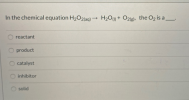 In the chemical equation H2O2(aq) → H2O() + O2(g), the O2 is a _ O reactant O product catalyst inhibitor solid
1) The reaction of hydrogen peroxide with iodine, H2O2(aq)+I2(aq)⇌OH−(aq)+HIO(aq) is first order in H2O2 and first...
1) The reaction of hydrogen peroxide with iodine, H2O2(aq)+I2(aq)⇌OH−(aq)+HIO(aq) is first order in H2O2 and first order in I2. If the concentration of H2O2 was increased by half and the concentration of I2 was quadrupled, by what factor would the reaction rate increase? 2) Consider the following reaction: O3(g)→O2(g)+O(g) Using the results of the Arrhenius analysis (Ea=93.1kJ/mol and A=4.36×10¹¹M⋅s−1), predict the rate constant at 298 K . 3. The rate constant of a chemical reaction increased from 0.100 s−1 to...
Consider this balanced chemical equation: H2O2(aq)+3I−(aq)+2H+(aq)→I3−(aq)+2H2O(l)H2O2(aq)+3I−(aq)+2H+(aq)→I3−(aq)+2H2O(l) In the first 10.0 seconds of the reaction, the concentration...
Consider this balanced chemical equation: H2O2(aq)+3I−(aq)+2H+(aq)→I3−(aq)+2H2O(l)H2O2(aq)+3I−(aq)+2H+(aq)→I3−(aq)+2H2O(l) In the first 10.0 seconds of the reaction, the concentration of I−I− drops from 1.260 MM to 0.877 MM. Calculate the average rate of this reaction in this time interval. Express your answer with the appropriate units.
Hydrogen peroxide decomposes spontaneously to yield water and oxygen gas according to the reaction equation 2H2O2(aq)⟶2H2O(l)+O2(g)2H2O2(aq)⟶2H2O(l)+O2(g)...
Hydrogen peroxide decomposes spontaneously to yield water and oxygen gas according to the reaction equation 2H2O2(aq)⟶2H2O(l)+O2(g)2H2O2(aq)⟶2H2O(l)+O2(g) The activation energy for this reaction is 75 kJ⋅mol−1.75 kJ⋅mol−1. In the presence of a metal catalyst, the activation energy is lowered to 49 kJ⋅mol−1.49 kJ⋅mol−1. At what temperature would the non‑catalyzed reaction need to be run to have a rate equal to that of the metal‑catalyzed reaction at 25 ∘C? T= K
Consider the following chemical reaction. NH3(g) + 2 O2(g) → HNO3(aq) + H2O(l) Calculate the change...
Consider the following chemical reaction. NH3(g) + 2 O2(g) → HNO3(aq) + H2O(l) Calculate the change in enthalpy (ΔH) for this reaction, using Hess' law and the enthalpy changes for the reactions given below. (1a) 4 NH3(g) + 5 O2(g) → 4 NO(g) + 6 H2O(l); ΔH = −1166.0 kJ/mol (2a) 2 NO(g) + O2(g) → 2 NO2(g); ΔH = −116.2 kJ/mol (3a) 3 NO2(g) + H2O(l) → 2 HNO3(aq) + NO(g); ΔH = −137.3 kJ/mol
Calculate Gibbs free energy for this reaction (in kJ): 2 H2O2(l) → 2 H2O(l) + O2(g)...
Calculate Gibbs free energy for this reaction (in kJ): 2 H2O2(l) → 2 H2O(l) + O2(g) what is the answer?
H2O2(aq) --> H2O(l) + O2(g) 1. identify half rxns and overall balanced equation. 2. what is E° of the cell? 3. [H2O2]...
H2O2(aq) --> H2O(l) + O2(g) 1. identify half rxns and overall balanced equation. 2. what is E° of the cell? 3. [H2O2] = 0.2 M, Po=0.21 atm, other species still have concentration of 1.0 M. What is cell potential?
 2 H2O2(aq) + 2 H2O(l) + O2(g) 5. Hydrogen peroxide decomposes according to the equation above. a. An aqueous solution of H2O, that is 6.00 percent H,O, by mass has a density of 1.03 g ml. Calculate each of the following. (i) The original number of moles of H2O, in a 125 ml sample of the 6.00 percent H2O2 solution (ii) The number of moles of O,(g) that are produced when all of the H2O2 in the 125 mL sample...
 In the chemical equation H2O2(aq) → H2O() + O2(g), the O2 is a _ O reactant O product catalyst inhibitor solid
Most questions answered within 3 hours.
-
Where is the error in this code sequence?
String s1 = "Hello";
String s2 = "ello";...
asked 11 months ago -
Financial data for Joel de Paris, Inc., for last year
follow:
Joel de Paris, Inc.
Balance...
asked 11 months ago -
Consider this reaction:
Al2(SO4)3 (aq)+ BaCl3
(aq) Al2Cl6 (aq)- +
3BaSO4(s) . What is the...
asked 11 months ago -
Suppose that Savneet is considering increasing her
recent random sample from 20 car rentals to 40...
asked 11 months ago -
Trucks arrive at an unloading terminal at an average rate of 120
per hour.
Trucks arrive...
asked 11 months ago -
Why are methanol and ethanol completely soluble in water while
octanol is not very little soluble....
asked 11 months ago -
A facilities manager at a university reads in a research report
that the mean amount of...
asked 11 months ago -
When the CuSO4 is rehydrated by adding water to the anhydrous
compound, is this an endothermic...
asked 11 months ago -
A ray of sunlight is passing from diamond into crown glass; the
angle of incidence is...
asked 11 months ago -
A block of mass 0.249 kg is placed on top of a light, vertical
spring of...
asked 11 months ago -
how do the kidneys compensate in the presences of acidosis
a) trigger hyperventilate
b) reserve acid...
asked 11 months ago -
Question 501 pts
The rental rate of capital to the firm increases. Which of the
following...
asked 11 months ago