The amount of current in the battery that connects a circuit depends on the Group of...
The amount of current in the battery that connects a circuit depends on the
Group of answer choices
whether it is ac or dc.
surrounding electric fields.
charges present in the circuit.
resistance in the circuit.
Homework Answers
correct answers are .............. resistance in the circuit
surrounding electricfields
from ohms law current is inversly proportional to resistance and directly proportional to voltage .
Add Answer to:
The amount of current in the battery that connects a circuit
depends on the
Group of...
You build an electric circuit with a resistance of 10Ω and battery that can supply a...
You build an electric circuit with a resistance of 10Ω and battery that can supply a potential difference of 12 V across the resistor. If you now connect an ammeter between the cell and the resistor, what will be the reading on the ammeter? Group of answer choices 4.8 A 1.2 A 0.83 A 2.2 A Question Which of the following is likely to happen when a conductor is connected between the poles of a cell? Group of answer choices...
Consider the electric circuit shown in the figure. Assume that the voltage of the battery is...
 Consider the electric circuit shown in the figure. Assume that
the voltage of the battery is V = 23.5 V, and the resistors are
R1 = R2 = R3 = R4 =
R5 = 2.00 Ω.
What is the equivalent resistance of the circuit?
What is the electric current flowing through resistor
R3?
Consider the electri = R4 = R5 = 2.00 2 circuit shown in the figure. Assume that the voltage of the battery is V = 23.5 V,...
Consider the electric circuit shown in the figure. Assume that
the voltage of the battery is V = 23.5 V, and the resistors are
R1 = R2 = R3 = R4 =
R5 = 2.00 Ω.
What is the equivalent resistance of the circuit?
What is the electric current flowing through resistor
R3?
Consider the electri = R4 = R5 = 2.00 2 circuit shown in the figure. Assume that the voltage of the battery is V = 23.5 V,...
An electric circuit consists of six resistors and a real battery with Emf = 9 V...
 An electric circuit consists of six resistors and a real battery
with Emf = 9 V and an internal resistance r = 0.5ohm . Find the
battery current and the terminal voltage of the battery
An electric circuit consists of six resistors and a real battery with Emf = 9 V and an internal resistance r = 0.5ohm . Find the battery current and the terminal voltage of the battery
An electric circuit consists of six resistors and a real battery
with Emf = 9 V and an internal resistance r = 0.5ohm . Find the
battery current and the terminal voltage of the battery
An electric circuit consists of six resistors and a real battery with Emf = 9 V and an internal resistance r = 0.5ohm . Find the battery current and the terminal voltage of the battery
8) A resistor is put in a circuit to control the amount of charge that flows...
 8) A resistor is put in a circuit to control the amount of charge that flows through it. In the process of controlling the charge, what will happen to the body of the Resistor? a) It will get hot b) It will remain unchanged (invariant) c) It depends on how much charge is going through the circuit 9) In a RLC circuit, if the value of the capacitor is changed (to a higher value), what will happen to the resonance...
8) A resistor is put in a circuit to control the amount of charge that flows...
 8) A resistor is put in a circuit to control the amount of charge that flows through it. In the process of controlling the charge, what will happen to the body of the Resistor? a) It will get hot b) It will remain unchanged (invariant) c) It depends on how much charge is going through the circuit 9) In a RLC circuit, if the value of the capacitor is changed (to a higher value), what will happen to the resonance...
8) A resistor is put in a circuit to control the amount of charge that flows...
 8) A resistor is put in a circuit to control the amount of charge that flows through it. In the process of controlling the charge, what will happen to the body of the Resistor? a) It will get hot b) It will remain unchanged (invariant) c) It depends on how much charge is going through the circuit 2 9) In a RLC circuit, if the value of the inductor is changed (down to a lower value), what will happen to...
A 9.5 V battery supplies a 3.5 mA current to a circuit for 7.0 h ....
A 9.5 V battery supplies a 3.5 mA current to a circuit for 7.0 h . Part A: How much charge has been transferred from the negative to the positive terminal? Part B: How much electric potential energy has been gained by the charges that passed through the battery?
1. Which of these statements is correct? to. The current flows through a circuit. b. The...
1. Which of these statements is correct? to. The current flows through a circuit. b. The voltage flows through a circuit. c. The current causes the voltage in the circuit. 2. The electric potential, measured in volts, is the electric power per unit of to. current. b. resistance. c. load. d. voltage. 7. Comparing with a single bulb connected to a battery, two equal bulbs connected in series to that same battery will use current. to. plus b. less and....
For the following circuit what is the current (in A) supplied by the battery? The battery...
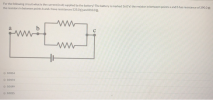 For the following circuit what is the current (in A) supplied by the battery? The battery is marked 16.0V, the resistor in between points a and b has resistance of 390.00 the resistors in between points b and chave resistances 525.0 and 810.00 www a b www HH 0.0314 0.0174 0.0199 0.0225
1. A 9.0 V battery supplies a 3.5 mA current to a circuit for 6.0 h....
1. A 9.0 V battery supplies a 3.5 mA current to a circuit for 6.0 h. A. How much charge has been transferred from the negative to the positive terminal? B. How much electric potential energy has been gained by the charges that passed through the battery? 2. How much electric potential energy does 1.4 μC of charge gain as it moves from the negative terminal to the positive terminal of a 1.6 V battery?
 Consider the electric circuit shown in the figure. Assume that
the voltage of the battery is V = 23.5 V, and the resistors are
R1 = R2 = R3 = R4 =
R5 = 2.00 Ω.
What is the equivalent resistance of the circuit?
What is the electric current flowing through resistor
R3?
Consider the electri = R4 = R5 = 2.00 2 circuit shown in the figure. Assume that the voltage of the battery is V = 23.5 V,...
Consider the electric circuit shown in the figure. Assume that
the voltage of the battery is V = 23.5 V, and the resistors are
R1 = R2 = R3 = R4 =
R5 = 2.00 Ω.
What is the equivalent resistance of the circuit?
What is the electric current flowing through resistor
R3?
Consider the electri = R4 = R5 = 2.00 2 circuit shown in the figure. Assume that the voltage of the battery is V = 23.5 V,...
 An electric circuit consists of six resistors and a real battery
with Emf = 9 V and an internal resistance r = 0.5ohm . Find the
battery current and the terminal voltage of the battery
An electric circuit consists of six resistors and a real battery with Emf = 9 V and an internal resistance r = 0.5ohm . Find the battery current and the terminal voltage of the battery
An electric circuit consists of six resistors and a real battery
with Emf = 9 V and an internal resistance r = 0.5ohm . Find the
battery current and the terminal voltage of the battery
An electric circuit consists of six resistors and a real battery with Emf = 9 V and an internal resistance r = 0.5ohm . Find the battery current and the terminal voltage of the battery
 8) A resistor is put in a circuit to control the amount of charge that flows through it. In the process of controlling the charge, what will happen to the body of the Resistor? a) It will get hot b) It will remain unchanged (invariant) c) It depends on how much charge is going through the circuit 9) In a RLC circuit, if the value of the capacitor is changed (to a higher value), what will happen to the resonance...
 8) A resistor is put in a circuit to control the amount of charge that flows through it. In the process of controlling the charge, what will happen to the body of the Resistor? a) It will get hot b) It will remain unchanged (invariant) c) It depends on how much charge is going through the circuit 9) In a RLC circuit, if the value of the capacitor is changed (to a higher value), what will happen to the resonance...
 8) A resistor is put in a circuit to control the amount of charge that flows through it. In the process of controlling the charge, what will happen to the body of the Resistor? a) It will get hot b) It will remain unchanged (invariant) c) It depends on how much charge is going through the circuit 2 9) In a RLC circuit, if the value of the inductor is changed (down to a lower value), what will happen to...
 For the following circuit what is the current (in A) supplied by the battery? The battery is marked 16.0V, the resistor in between points a and b has resistance of 390.00 the resistors in between points b and chave resistances 525.0 and 810.00 www a b www HH 0.0314 0.0174 0.0199 0.0225
Most questions answered within 3 hours.
-
Where is the error in this code sequence?
String s1 = "Hello";
String s2 = "ello";...
asked 10 months ago -
Financial data for Joel de Paris, Inc., for last year
follow:
Joel de Paris, Inc.
Balance...
asked 10 months ago -
Consider this reaction:
Al2(SO4)3 (aq)+ BaCl3
(aq) Al2Cl6 (aq)- +
3BaSO4(s) . What is the...
asked 10 months ago -
Suppose that Savneet is considering increasing her
recent random sample from 20 car rentals to 40...
asked 10 months ago -
Trucks arrive at an unloading terminal at an average rate of 120
per hour.
Trucks arrive...
asked 10 months ago -
Why are methanol and ethanol completely soluble in water while
octanol is not very little soluble....
asked 10 months ago -
A facilities manager at a university reads in a research report
that the mean amount of...
asked 10 months ago -
When the CuSO4 is rehydrated by adding water to the anhydrous
compound, is this an endothermic...
asked 10 months ago -
A ray of sunlight is passing from diamond into crown glass; the
angle of incidence is...
asked 10 months ago -
A block of mass 0.249 kg is placed on top of a light, vertical
spring of...
asked 10 months ago -
how do the kidneys compensate in the presences of acidosis
a) trigger hyperventilate
b) reserve acid...
asked 10 months ago -
Question 501 pts
The rental rate of capital to the firm increases. Which of the
following...
asked 10 months ago