The size of the _____ is regulated by the _____. iris; pupil pupil; iris cornea; pupil...
| The size of the _____ is regulated by the _____. | |||||||||
|
Homework Answers
Right answer- Pupil; iris
Explanation-Whenever a light comes into our eyes by the Pupil, our Iris always controls the intensity of that light by controlling our Pupil’s size. Whenever the bright light comes into our eyes this iris tries to close our pupils or tries to decrease the size of pupil so that the Pupil faces less amount of light.
Add Answer to:
The size of the _____ is regulated by the _____.
iris; pupil
pupil; iris
cornea; pupil...
Draw a lateral view of the Eye Showing the following structures: Sclera Cornea Choroid Ciliary body Ora Serrata Iris Lens Pupil Aqueous humor Vitreous humor Retina Optic nerve Optic disc Fovea central...
Draw a lateral view of the Eye Showing the following structures: Sclera Cornea Choroid Ciliary body Ora Serrata Iris Lens Pupil Aqueous humor Vitreous humor Retina Optic nerve Optic disc Fovea centralis
Help with part a, please! Problem 4 In problem set 9, we briefly looked at how the intensity of light reaching the retina is strongly influenced by the pupil. In front of the pupil is the cornea and...
 Help with part a, please!
Problem 4 In problem set 9, we briefly looked at how the intensity of light reaching the retina is strongly influenced by the pupil. In front of the pupil is the cornea and just behind is the lens, both of which work together to direct and focus light in the eye. Light first enters the eye through the cornea, is bent through the pupil, and then moves through the lens which is controlled by muscles...
Help with part a, please!
Problem 4 In problem set 9, we briefly looked at how the intensity of light reaching the retina is strongly influenced by the pupil. In front of the pupil is the cornea and just behind is the lens, both of which work together to direct and focus light in the eye. Light first enters the eye through the cornea, is bent through the pupil, and then moves through the lens which is controlled by muscles...
14. The amount of light entering the eye is regulated by the: a) lens b) iris c) cornea d) conjun...
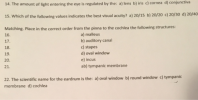 14. The amount of light entering the eye is regulated by the: a) lens b) iris c) cornea d) conjunctiva 15. Which of the following values indicates the best visual acuity? a) 20/15 b) 20/20 c) 20/30 d) 20/40 Matching. Place in the correct order from the pinna to the cochlea the following structures 16. 17 18. 19. 20. 21. a) malleus b) auditory canal c) stapes d) oval window e) incus ab) tympanic membrane 22. The scientific name for...
The amount of light that gets into the eye is controlled by muscles in the the...
 The amount of light that gets into the eye is controlled by muscles in the the part of the eye that gives it colour where it surrounds the round opening of the eye. The visual receptors are located in the back of the eye.___and the sharpest vision is at the Select one: a. Cornea, pupil, fovea, retina b. Lens, cornea, retina, fovea o.clris, pupil, retina, fovea d. Iris, retina, comea, pupil
AAAAAAAAAAAMAMAMAAAAAAAAAAANANAAAN Name and ID General Physies 2 Final Date: 5/10/2018 A. İris C. cornea B. lens...
 AAAAAAAAAAAMAMAMAAAAAAAAAAANANAAAN Name and ID General Physies 2 Final Date: 5/10/2018 A. İris C. cornea B. lens D. retina 36. In a farsighted eye the light rays reach the retina. they converge to forms an image and a lens is needed to fix the problem A. before, converging C. after, converging B before, diverging D. after, diverging lens is needed to correct it. 37, In a nearsighted eye the light rays A. before, converging C. after, converging they reach retina and...
An object is placed 9.10 cm in front of the cornea. (The cornea is thin ans...
An object is placed 9.10 cm in front of the cornea. (The cornea is thin ans has approximately parallel sides so that the reflection that occurs as light travels from air to cornea to aqueous humor is essentially the same as though the aqueous humor were directly in contact with the air. The aqueous humor has index of refraction n = 1.34 and the radius of curvature of cornea is 7.8 mm.) (a) What is the image distance for the...
An object is placed 10.6 cm in front of the cornea. (The cornea is thin ans...
An object is placed 10.6 cm in front of the cornea. (The cornea is thin ans has approximately parallel sides so that the reflection that occurs as light travels from air to cornea to aqueous humor is essentially the same as though the aqueous humor were directly in contact with the air. The aqueous humor has index of refraction n = 1.34 and the radius of curvature of cornea is 7.8 mm.) (a) What is the image distance for the...
In humans, the presence of a fissure in the iris is regulated by a recessive gene...
In humans, the presence of a fissure in the iris is regulated by a recessive gene tied to sex. From a couple between two normal people a daughter was born with the mentioned character. The husband files for divorce on the grounds of his wife's infidelity. Explain the mode of inheritance of character and the conditions under which the lawyer of the husband can use the birth of the affected daughter as proof of infidelity.
Part A Measurements on the cornea of a person's eye reveal that the magnitude of the...
 Part A Measurements on the cornea of a person's eye reveal that the magnitude of the front surface radius of curvature is 7.78 mm while the magnitude of the rear surface radius of curvature is 7.26 mm (see (Figure 1)), and that the index of refraction of the cornea is 138 If the cornea were simply a thin lens in air, what would be its focal length? Express your answer in millimeters to three significant figures. -286 mm Previous Answers...
Why do we need the cornea and the lens, if both serve to refract light ?...
Why do we need the cornea and the lens, if both serve to refract light ? A) because refraction is only effective when light travels between media of equal density, such as the aqueous and vitreous humors B) Because light must be bent twice in order to flip the image C) While the cornea has greater refractive power, the lens can adjust the degree of secondary refraction according to where objects appear relative to the viewer D) While the lens...
 Help with part a, please!
Problem 4 In problem set 9, we briefly looked at how the intensity of light reaching the retina is strongly influenced by the pupil. In front of the pupil is the cornea and just behind is the lens, both of which work together to direct and focus light in the eye. Light first enters the eye through the cornea, is bent through the pupil, and then moves through the lens which is controlled by muscles...
Help with part a, please!
Problem 4 In problem set 9, we briefly looked at how the intensity of light reaching the retina is strongly influenced by the pupil. In front of the pupil is the cornea and just behind is the lens, both of which work together to direct and focus light in the eye. Light first enters the eye through the cornea, is bent through the pupil, and then moves through the lens which is controlled by muscles...
 14. The amount of light entering the eye is regulated by the: a) lens b) iris c) cornea d) conjunctiva 15. Which of the following values indicates the best visual acuity? a) 20/15 b) 20/20 c) 20/30 d) 20/40 Matching. Place in the correct order from the pinna to the cochlea the following structures 16. 17 18. 19. 20. 21. a) malleus b) auditory canal c) stapes d) oval window e) incus ab) tympanic membrane 22. The scientific name for...
 The amount of light that gets into the eye is controlled by muscles in the the part of the eye that gives it colour where it surrounds the round opening of the eye. The visual receptors are located in the back of the eye.___and the sharpest vision is at the Select one: a. Cornea, pupil, fovea, retina b. Lens, cornea, retina, fovea o.clris, pupil, retina, fovea d. Iris, retina, comea, pupil
 AAAAAAAAAAAMAMAMAAAAAAAAAAANANAAAN Name and ID General Physies 2 Final Date: 5/10/2018 A. İris C. cornea B. lens D. retina 36. In a farsighted eye the light rays reach the retina. they converge to forms an image and a lens is needed to fix the problem A. before, converging C. after, converging B before, diverging D. after, diverging lens is needed to correct it. 37, In a nearsighted eye the light rays A. before, converging C. after, converging they reach retina and...
 Part A Measurements on the cornea of a person's eye reveal that the magnitude of the front surface radius of curvature is 7.78 mm while the magnitude of the rear surface radius of curvature is 7.26 mm (see (Figure 1)), and that the index of refraction of the cornea is 138 If the cornea were simply a thin lens in air, what would be its focal length? Express your answer in millimeters to three significant figures. -286 mm Previous Answers...
Most questions answered within 3 hours.
-
Where is the error in this code sequence?
String s1 = "Hello";
String s2 = "ello";...
asked 11 months ago -
Financial data for Joel de Paris, Inc., for last year
follow:
Joel de Paris, Inc.
Balance...
asked 11 months ago -
Consider this reaction:
Al2(SO4)3 (aq)+ BaCl3
(aq) Al2Cl6 (aq)- +
3BaSO4(s) . What is the...
asked 11 months ago -
Suppose that Savneet is considering increasing her
recent random sample from 20 car rentals to 40...
asked 11 months ago -
Trucks arrive at an unloading terminal at an average rate of 120
per hour.
Trucks arrive...
asked 11 months ago -
Why are methanol and ethanol completely soluble in water while
octanol is not very little soluble....
asked 11 months ago -
A facilities manager at a university reads in a research report
that the mean amount of...
asked 11 months ago -
When the CuSO4 is rehydrated by adding water to the anhydrous
compound, is this an endothermic...
asked 11 months ago -
A ray of sunlight is passing from diamond into crown glass; the
angle of incidence is...
asked 11 months ago -
A block of mass 0.249 kg is placed on top of a light, vertical
spring of...
asked 11 months ago -
how do the kidneys compensate in the presences of acidosis
a) trigger hyperventilate
b) reserve acid...
asked 11 months ago -
Question 501 pts
The rental rate of capital to the firm increases. Which of the
following...
asked 11 months ago