In a transformer load test (Resistive and at a unity power factor), what should be the...
In a transformer load test (Resistive and at a unity power factor), what should be the relationship of the primary power to the secondary load power and what should be the relationship of the primary current to the secondary current.
Homework Answers


Add Answer to:
In a transformer load test (Resistive and at a unity power
factor), what should be the...
In a transformer load test (Resistive and at a unity power factor), what should be the...
In a transformer load test (Resistive and at a unity power factor), what should be the expected voltage regulation and primary power factor?
The S.C. test on a 1-phase transformer, with the primary winding short-circuited and 30 V applied...
The S.C. test on a 1-phase transformer, with the primary winding short-circuited and 30 V applied to the secondary gave a wattmeter reading of 60 W and secondary current of 10 A. II the normal applied primary voltage is 200 V, the transformation ratio 1:2 and the full-load secondary current 10 A, calculate the secondary p.d. at full-load current for (a) unity power factor (b) power factor 0.8 lagging. these are the answers [ 394 V; 377.6 V ]
Q.2) A transformer has its maximum efficiency of 0.98 at 15 kVA at unity power factor....
 Q.2) A transformer has its maximum efficiency of 0.98 at 15 kVA at unity power factor. Compare its all-day efficiencies for the following load cycles: (a) Full load of 20 kVA 12 hours/day and no-load rest of the day. (b) Full load 4 hours/day and 0.4 full-load rest of the day. Assume the load to operate on unity power factor all day. (14 marks)
A single-phase transformer is rated at 10 kVA, 240/100 V. When the secondary terminals are open-circuited...
 A single-phase transformer is rated at 10 kVA, 240/100 V. When the secondary terminals are open-circuited and the primary winding is supplied at normal voltage, the input current is 2.6 A at a power factor of 0.3 lag. When the secondary terminals are short-circuited, a voltage of 18 V applied to the primary causes the full-load current to flow in the secondary, the power input to the primary being 240 W. Calculate (a) the regulation (b) the efficiency of the...
A single-phase 400V/200V transformer is supplying a load of 4 kW at 200 volts, 0.9 power...
A single-phase 400V/200V transformer is supplying a load of 4 kW at 200 volts, 0.9 power factor lagging. Considering the transformer to be ideal, answer the following questions The output (secondary) current of this transformer 20.00/_25.84 A 20.00/_-25.84 A 22.22/_-25.84 A 22.22/_25.84 A 12.83/_-25.84 A 12.83/_23.28 A Load impedance in ohms. 8.10+j3.92 9.00-j4.36 3.62-j1.47 9.00+j4.36 4.50+j2.18 8.10-j3.92 The primary current 10.00/_25.84 A 10.00/_-25.84 A 40.00/_-25.84 A 44.44/_-25.84 A 11.11/_25.84 A 11.11/_-25.84 A The load impedance referred to the primary in...
Q1) The no-load current of a single phase transformer is 5.0 A at 0.4 power factor,...
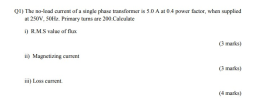 Q1) The no-load current of a single phase transformer is 5.0 A at 0.4 power factor, when supplied at 250V, 50Hz. Primary turns are 200.Calculate i) R.M.S value of flux (3 marks) ii) Magnetizing current (3 marks) iii) Loss current (4 marks)
Q1) The no-load current of a single phase transformer is 5.0 A at 0.4 power factor,...
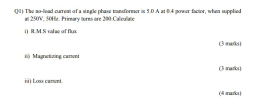 Q1) The no-load current of a single phase transformer is 5.0 A at 0.4 power factor, when supplied at 250V, 50Hz. Primary turns are 200.Calculate i) R.M.S value of flux (3 marks) ii) Magnetizing current (3 marks) iii) Loss current (4 marks)
1kVA ideal single phase step-up transformer
Q1 A 1kVA ideal single phase step-up transformer is supplied by a 24 V ac power source and is delivering power to a 10 Ω resistive load connected to the secondary side. If the transformer is operated at full load (1kVA), determine, a) the secondary current IS; (3 marks) b) the secondary voltage VS; (2 marks) c) the primary current IP; (2 marks) d) the turn ratio of primary winding to secondary winding; and (2 marks) e) the number of...
ECET 212 ELECTRICAL POWER &MOTORS QUESTIONS 1. Transformer regulation can be determined with the formula a....
 ECET 212 ELECTRICAL POWER &MOTORS QUESTIONS 1. Transformer regulation can be determined with the formula a. (EPRI-ESEc) / EPRI x100% b. (ENL- EFL)/ EFL x100% c. (IPRI-ESEC) / IPRI×100% d. (INL-IFL) / INL X 100% 2. What is the transformer regulation if the no-load and full-load voltages are 100 V and 95 v respectively? a. 105% b. 10.5% C. 95% d. 5.3% 3. The secondary voltage can rise above its rated value when the load is a. resistive b. capacitive...
Relationship of per unit efficiency and per unit regulation in a transformer with load at a...
Relationship of per unit efficiency and per unit regulation in a transformer with load at a unity power factor?
 Q.2) A transformer has its maximum efficiency of 0.98 at 15 kVA at unity power factor. Compare its all-day efficiencies for the following load cycles: (a) Full load of 20 kVA 12 hours/day and no-load rest of the day. (b) Full load 4 hours/day and 0.4 full-load rest of the day. Assume the load to operate on unity power factor all day. (14 marks)
 A single-phase transformer is rated at 10 kVA, 240/100 V. When the secondary terminals are open-circuited and the primary winding is supplied at normal voltage, the input current is 2.6 A at a power factor of 0.3 lag. When the secondary terminals are short-circuited, a voltage of 18 V applied to the primary causes the full-load current to flow in the secondary, the power input to the primary being 240 W. Calculate (a) the regulation (b) the efficiency of the...
 Q1) The no-load current of a single phase transformer is 5.0 A at 0.4 power factor, when supplied at 250V, 50Hz. Primary turns are 200.Calculate i) R.M.S value of flux (3 marks) ii) Magnetizing current (3 marks) iii) Loss current (4 marks)
 Q1) The no-load current of a single phase transformer is 5.0 A at 0.4 power factor, when supplied at 250V, 50Hz. Primary turns are 200.Calculate i) R.M.S value of flux (3 marks) ii) Magnetizing current (3 marks) iii) Loss current (4 marks)
 ECET 212 ELECTRICAL POWER &MOTORS QUESTIONS 1. Transformer regulation can be determined with the formula a. (EPRI-ESEc) / EPRI x100% b. (ENL- EFL)/ EFL x100% c. (IPRI-ESEC) / IPRI×100% d. (INL-IFL) / INL X 100% 2. What is the transformer regulation if the no-load and full-load voltages are 100 V and 95 v respectively? a. 105% b. 10.5% C. 95% d. 5.3% 3. The secondary voltage can rise above its rated value when the load is a. resistive b. capacitive...
Most questions answered within 3 hours.
-
Where is the error in this code sequence?
String s1 = "Hello";
String s2 = "ello";...
asked 10 months ago -
Financial data for Joel de Paris, Inc., for last year
follow:
Joel de Paris, Inc.
Balance...
asked 10 months ago -
Consider this reaction:
Al2(SO4)3 (aq)+ BaCl3
(aq) Al2Cl6 (aq)- +
3BaSO4(s) . What is the...
asked 10 months ago -
Suppose that Savneet is considering increasing her
recent random sample from 20 car rentals to 40...
asked 10 months ago -
Trucks arrive at an unloading terminal at an average rate of 120
per hour.
Trucks arrive...
asked 10 months ago -
Why are methanol and ethanol completely soluble in water while
octanol is not very little soluble....
asked 10 months ago -
A facilities manager at a university reads in a research report
that the mean amount of...
asked 10 months ago -
When the CuSO4 is rehydrated by adding water to the anhydrous
compound, is this an endothermic...
asked 10 months ago -
A ray of sunlight is passing from diamond into crown glass; the
angle of incidence is...
asked 10 months ago -
A block of mass 0.249 kg is placed on top of a light, vertical
spring of...
asked 10 months ago -
how do the kidneys compensate in the presences of acidosis
a) trigger hyperventilate
b) reserve acid...
asked 10 months ago -
Question 501 pts
The rental rate of capital to the firm increases. Which of the
following...
asked 10 months ago