Write a full C++ program Assignment4_SequenceSum that prints terms of the following mathematical sequence: &n
Write a full C++ program Assignment4_SequenceSum that prints terms of the following mathematical sequence:
( also written as )
Your program should accept a real number from the user representing a limit, and should add and print terms of the sequence until the sum of terms meets or exceeds that limit. For example, if your user enters 2.0, program prints terms until the sum of those terms is at ≥ 2.0. You should round your answer to 3 digits past the decimal point
The following is the output from the program execution when 2.0 is entered by the user (2.0);
1 + 1/2 + 1/3 + 1/4 = 2.083
(Despite the fact that the terms keep getting smaller, the sequence can actually produce an arbitrarily large sum if enough terms are added.) If your program reads a value less than 1.0, no output should be produced. You must match the output format shown exactly; note the spaces and pluses separating neighboring terms. Other sample calls:
|
Input |
0.0 |
1.0 |
1.5 |
|
Output |
1 = 1.000 |
1 + 1/2 = 1.500 |
|
Input |
2.7 |
|
Output |
1 + 1/2 + 1/3 + 1/4 + 1/5 + 1/6 + 1/7 + 1/8 = 2.718 |
Homework Answers
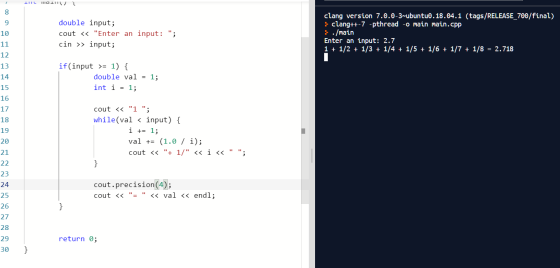
#include <iostream>
#include <iomanip>

using namespace std;


int main() {

        double input;
        cout << "Enter an input: ";
        cin >> input;

        if(input >= 1) {
                double val = 1;
                int i = 1;

                cout << "1 ";
                while(val < input) {
                        i += 1;
                        val += (1.0 / i);
                        cout << "+ 1/" << i << " ";
                }

                cout << fixed << setprecision(3);
                cout << "= " << val << endl;
        }


        return 0;
}
**************************************************

Thanks for your question. We try our best to help you with detailed answers, But in any case, if you need any modification or have a query/issue with respect to above answer, Please ask that in the comment section. We will surely try to address your query ASAP and resolve the issue.
Please consider providing a thumbs up to this question if it helps you. by Doing that, You will help other students, who are facing similar issue.
Add Answer to:
Write a full C++ program Assignment4_SequenceSum that prints
terms of the following mathematical sequence:
&n
C programming! Write a program that reads integers until 0 and prints the sum of values...
C programming! Write a program that reads integers until 0 and prints the sum of values on odd positions minus the sum of values on even positions. Let ?1, ?2, … , ??, 0 be the input sequence. Then the program prints the value of ?1 − ?2 + ?3 − ?4 + ⋯ ??. The input is a sequence of integers that always contains at least 0 and the output will be a single number. For example, for input...
Write a program that reads an integer greater or equal to 2, n, and prints a...
Write a program that reads an integer greater or equal to 2, n, and prints a shape of a nline hollow inverted pyramid of stars. Your program should interact with the user exactly as it shows in the following two executions: Execution example 1: Please enter an integer, greater or equal to 2: 5 ********* -*----- * --*--- * ---*--* ----* Execution example 2: Please enter an integer, greater or equal to 2: 3 ***** -* * --*
C++ Write a program that asks for a number and then prints as many lines as...
 C++
Write a program that asks for a number and then prints as many
lines as the user inputs. Each line contains as many pairs of
characters ("*#") as the number of this line. It should look like
the right half of a pyramid. Your version of the program must print
the same result as the expected output. To to this lab, you must
use two do-while loops.
Two exceptions:
When the user inputs a number less than 1, then...
C++
Write a program that asks for a number and then prints as many
lines as the user inputs. Each line contains as many pairs of
characters ("*#") as the number of this line. It should look like
the right half of a pyramid. Your version of the program must print
the same result as the expected output. To to this lab, you must
use two do-while loops.
Two exceptions:
When the user inputs a number less than 1, then...
Write a program that reads a positive integer N, where N is greater than 1 and...
Write a program that reads a positive integer N, where N is greater than 1 and prints the value of the floating-point value SUM where SUM is the results of the following series. SUM = 1/1! + 2/2! + 3/3! + 4/4! + ... N/N! Note that your program should print the message “Sorry, bad N”” if N is <=1, and keep reading user input until the user enters a valid value for N. Also, note that all division operations...
Python 3 Write a program that reads a sequence of words and prints every word whose...
Python 3 Write a program that reads a sequence of words and prints every word whose frequency is equal to its length. You can assume that there will always be a word that meets this condition. If more than one word have this condition, you must print first the most frequent one. If two or more words with equal frequencies meet this condition, print them from the smallest to the largest in alphabetical order. Sample Input lee john lee peter...
C++ assignment Write a program that reads a sequence of integers and prints the following: 1....
C++ assignment Write a program that reads a sequence of integers and prints the following: 1. The number of odd and even numbers of inputs Use a sentinel value to signal the end of inputs. If the sentinel value is the first you enter, give a message “NO input is entered!”. Input Validation: Do not accept a negative number.
Following should be done in C++: Create a program that reads a text file and prints...
Following should be done in C++: Create a program that reads a text file and prints out the contents of the file but with all letters converted to uppercase. The name of the file to be read by the program will be provided by the user. Here are some example session: Contents of "data.txt": Hello, World! User input: data.txt Program output: HELLO, WORLD! Contents of "data.txt": tHiS FiLe HaS mIxEd CaSeS User input: data.txt Program output: THIS FILE HAS MIXED...
with explanation Write a C++ program that calculates and prints the average of several integers. Assume...
 with explanation
Write a C++ program that calculates and prints the average of several integers. Assume that the last value read with cin >> is the number 9999. For example, for an input sequence: 10 8 11 7 9 9999 The output should be 9.00
with explanation
Write a C++ program that calculates and prints the average of several integers. Assume that the last value read with cin >> is the number 9999. For example, for an input sequence: 10 8 11 7 9 9999 The output should be 9.00
Write a C program that takes a positive integer n as input and prints all the...
Write a C program that takes a positive integer n as input and prints all the prime numbers from 1 to n. Sample Input/Output 1: Enter your n: 20 Prime number(s) from 1 to 20 : 2 3 5 7 11 13 17 19 Sample Input/Output 2: Enter your n:2Prime number(s) from 1 to 2 : 2
3. Write a complete C++ program that finds and prints the sum of values from 1...
 3. Write a complete C++ program that finds and prints the sum of values from 1 to N where N is a positive value > 10 entered by the user. If the user inputs a value less the 10 ask him to re-enter the value again and again until the value is valid. (20 Points)
 C++
Write a program that asks for a number and then prints as many
lines as the user inputs. Each line contains as many pairs of
characters ("*#") as the number of this line. It should look like
the right half of a pyramid. Your version of the program must print
the same result as the expected output. To to this lab, you must
use two do-while loops.
Two exceptions:
When the user inputs a number less than 1, then...
C++
Write a program that asks for a number and then prints as many
lines as the user inputs. Each line contains as many pairs of
characters ("*#") as the number of this line. It should look like
the right half of a pyramid. Your version of the program must print
the same result as the expected output. To to this lab, you must
use two do-while loops.
Two exceptions:
When the user inputs a number less than 1, then...
 with explanation
Write a C++ program that calculates and prints the average of several integers. Assume that the last value read with cin >> is the number 9999. For example, for an input sequence: 10 8 11 7 9 9999 The output should be 9.00
with explanation
Write a C++ program that calculates and prints the average of several integers. Assume that the last value read with cin >> is the number 9999. For example, for an input sequence: 10 8 11 7 9 9999 The output should be 9.00
 3. Write a complete C++ program that finds and prints the sum of values from 1 to N where N is a positive value > 10 entered by the user. If the user inputs a value less the 10 ask him to re-enter the value again and again until the value is valid. (20 Points)
Most questions answered within 3 hours.
-
Where is the error in this code sequence?
String s1 = "Hello";
String s2 = "ello";...
asked 11 months ago -
Financial data for Joel de Paris, Inc., for last year
follow:
Joel de Paris, Inc.
Balance...
asked 11 months ago -
Consider this reaction:
Al2(SO4)3 (aq)+ BaCl3
(aq) Al2Cl6 (aq)- +
3BaSO4(s) . What is the...
asked 11 months ago -
Suppose that Savneet is considering increasing her
recent random sample from 20 car rentals to 40...
asked 11 months ago -
Trucks arrive at an unloading terminal at an average rate of 120
per hour.
Trucks arrive...
asked 11 months ago -
Why are methanol and ethanol completely soluble in water while
octanol is not very little soluble....
asked 11 months ago -
A facilities manager at a university reads in a research report
that the mean amount of...
asked 11 months ago -
When the CuSO4 is rehydrated by adding water to the anhydrous
compound, is this an endothermic...
asked 11 months ago -
A ray of sunlight is passing from diamond into crown glass; the
angle of incidence is...
asked 11 months ago -
A block of mass 0.249 kg is placed on top of a light, vertical
spring of...
asked 11 months ago -
how do the kidneys compensate in the presences of acidosis
a) trigger hyperventilate
b) reserve acid...
asked 11 months ago -
Question 501 pts
The rental rate of capital to the firm increases. Which of the
following...
asked 11 months ago