C programming! Write a program that reads integers until 0 and prints the sum of values...
C programming!
Write a program that reads integers until 0 and prints the sum of values on odd positions minus the sum of values on even positions. Let ?1, ?2, … , ??, 0 be the input sequence. Then the program prints the value of ?1 − ?2 + ?3 − ?4 + ⋯ ??. The input is a sequence of integers that always contains at least 0 and the output will be a single number. For example, for input 2 5 7 0, the program will print 4 because 2-5+7=4. If the input is only 0, the program will print 0.
Example of input: 5 19 12 0
Corresponding output: -2
Example of input: 10 8 9 11 24 0
Corresponding output: 24
Homework Answers
#include <stdio.h>

int main()
{
    int sum = 0, n, count = 0;

    printf("Enter input: ");
    scanf("%d",&n);

    while(n!=0){
        if(count%2==0){
            sum += n;
        }
        else{
            sum -= n;
        }
        scanf("%d",&n);
        count++;
    }

    printf("Sum: %d\n",sum);
    return 0;
}
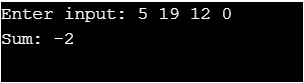

Add Answer to:
C programming!
Write a program that reads integers until 0 and prints the sum
of values...
Write a program that reads a set of integers and then finds and prints the sum...
Write a program that reads a set of integers and then finds and prints the sum of the even and odd integers
using C programming Date Write a program that reads a month and a day in that...
 using C programming
Date Write a program that reads a month and a day in that month and prints the date in format "month day". The input is two integers, one between 1 and 12 (inclusive) and one between 1 and 31 (inclusive) and the output is a single line in format "month day". For example, for input 2 10 the program will print "February 10th". The day will always have the ordinal indicator, e.g. 1st, 2nd, 3rd, 4th. Example...
using C programming
Date Write a program that reads a month and a day in that month and prints the date in format "month day". The input is two integers, one between 1 and 12 (inclusive) and one between 1 and 31 (inclusive) and the output is a single line in format "month day". For example, for input 2 10 the program will print "February 10th". The day will always have the ordinal indicator, e.g. 1st, 2nd, 3rd, 4th. Example...
C++ assignment Write a program that reads a sequence of integers and prints the following: 1....
C++ assignment Write a program that reads a sequence of integers and prints the following: 1. The number of odd and even numbers of inputs Use a sentinel value to signal the end of inputs. If the sentinel value is the first you enter, give a message “NO input is entered!”. Input Validation: Do not accept a negative number.
Write a program that reads a list of integers in the range (0 – 49) and prints out the numbers that does not repeat twice
IN PYTHONWrite a program that reads a list of integers in the range (0 – 49) and prints out the numbers that does not repeat twice.The first input of the program is the number of integers contained in this list, followed by the integers contained in the list. Print the numbers in in ascending order.Case 1:INPUT: 5 2 2 3 3 1OUTPUT:1Case 2:INPUT:6 1 2 1 2 2 2OUTPUT:2Case 3:INPUT:4 3 2 1 2OUTPUT: 1 3343 2 1 213
C programming question! Write a program that reads two numbers and finds the greater one. The...
C programming question! Write a program that reads two numbers and finds the greater one. The input is two integers and the output will be a single line “The maximum of ? and ? is ?.”, where ? and ? are the input values and ? is the maximum of ? and ?. If ? and ? are equal, ? will be equal to both of them. Example of input: 10 20 Corresponding output: The maximum of 10 and 20...
Programming in C: Write a program that accepts an integer and two floating-point values and prints...
Programming in C: Write a program that accepts an integer and two floating-point values and prints the sum of these values. Example: Input:12,13.14,6.7; Output:31.84. Use formatted I/O
In Python 3 - Write a program that reads a sequence of integer inputs from the...
In Python 3 - Write a program that reads a sequence of integer inputs from the user. When the user is finished entering the integers, they will enter a 'q'. There is no need to check if the entry is a valid integer. All integers in the test data (input) will be between -255 and 255. The program should then print: The smallest and largest of the inputs. The number of even and odd inputs (0 should be considered even)...
Write a program that reads 2 doubles, 2 float, and 4 integers and prints them four...
Write a program that reads 2 doubles, 2 float, and 4 integers and prints them four in a line separated by tabs or spaces. The user should be prompted for input with a suitable instruction and the output should line up to the right. The numerical output should also have a minimum width of 5 and a precision of 2 decimal places to the right of the decimal. In C programming
using c++ write a program that reads numbers from the user until the user enters a...
using c++ write a program that reads numbers from the user until the user enters a Sentinel. Use a Sentinel of -999. Ignore all negative numbers from the user input. Do the following: must use loops and numbers to do this 1. Output the sum of all even numbers 2. Output the sum of all odd numbers 3. Output the count of all even numbers 4. Output the count of all odd numbers
Write a full C++ program Assignment4_SequenceSum that prints terms of the following mathematical sequence: &n
Write a full C++ program Assignment4_SequenceSum that prints terms of the following mathematical sequence: ( also written as ) Your program should accept a real number from the user representing a limit, and should add and print terms of the sequence until the sum of terms meets or exceeds that limit. For example, if your user enters 2.0, program prints terms until the sum of those terms is at ≥ 2.0. You should round your answer to...
 using C programming
Date Write a program that reads a month and a day in that month and prints the date in format "month day". The input is two integers, one between 1 and 12 (inclusive) and one between 1 and 31 (inclusive) and the output is a single line in format "month day". For example, for input 2 10 the program will print "February 10th". The day will always have the ordinal indicator, e.g. 1st, 2nd, 3rd, 4th. Example...
using C programming
Date Write a program that reads a month and a day in that month and prints the date in format "month day". The input is two integers, one between 1 and 12 (inclusive) and one between 1 and 31 (inclusive) and the output is a single line in format "month day". For example, for input 2 10 the program will print "February 10th". The day will always have the ordinal indicator, e.g. 1st, 2nd, 3rd, 4th. Example...
Most questions answered within 3 hours.
-
Where is the error in this code sequence?
String s1 = "Hello";
String s2 = "ello";...
asked 11 months ago -
Financial data for Joel de Paris, Inc., for last year
follow:
Joel de Paris, Inc.
Balance...
asked 11 months ago -
Consider this reaction:
Al2(SO4)3 (aq)+ BaCl3
(aq) Al2Cl6 (aq)- +
3BaSO4(s) . What is the...
asked 11 months ago -
Suppose that Savneet is considering increasing her
recent random sample from 20 car rentals to 40...
asked 11 months ago -
Trucks arrive at an unloading terminal at an average rate of 120
per hour.
Trucks arrive...
asked 11 months ago -
Why are methanol and ethanol completely soluble in water while
octanol is not very little soluble....
asked 11 months ago -
A facilities manager at a university reads in a research report
that the mean amount of...
asked 11 months ago -
When the CuSO4 is rehydrated by adding water to the anhydrous
compound, is this an endothermic...
asked 11 months ago -
A ray of sunlight is passing from diamond into crown glass; the
angle of incidence is...
asked 11 months ago -
A block of mass 0.249 kg is placed on top of a light, vertical
spring of...
asked 11 months ago -
how do the kidneys compensate in the presences of acidosis
a) trigger hyperventilate
b) reserve acid...
asked 11 months ago -
Question 501 pts
The rental rate of capital to the firm increases. Which of the
following...
asked 11 months ago