Draw the structure of a 3-mer containing leucine, histidine, and glutamic acid in the ionic form...
Draw the structure of a 3-mer containing leucine, histidine, and glutamic acid in the ionic form that predominates at pH 7.
Please explain all the steps and so I can read it :)
Homework Answers
3-mer is formed by the formation of peptide bond between carboxyl group of one Amino acid and Amino group of another Amino acid. Thus, two peptide bonds (CO-NH linkages) are formed in 3 mer. There is more than one sequence of these Amino acids are possible. Structure of 3-mer is :
All groups whose pKa is less than pH will exist in deprotonated form and groups whose pKa is greater than pH will exist in protonated form. Thus all Carboxylic group and histidine side chain exist in deprotonated form because their pKa is less than 7.

So net charge is -1
Add Answer to:
Draw the structure of a 3-mer containing leucine, histidine, and
glutamic acid in the ionic form...
1. (a) Draw the structure of L-glutamic acid and show its one letter and three letter...
1. (a) Draw the structure of L-glutamic acid and show its one letter and three letter code. (1 pt) (b) Show the calculation for its isoelectric point. (HINT: Check the pKa of the R group also.) (2 pt) (c) Draw the forms of glutamic acid at pH 1, 6 and 10. (3 pt) (d) To which electrode would glutamic acid migrate in electrophoresis at pH 7 buffer, the anode (+) or cathode (-)? (1 pt) (e) MSG (monosodium glutamate) is...
Draw the structure of glutamic acid at physiological pH, 7.4
Draw the structure of glutamic acid at physiological pH, 7.4
Calculate the concentrations of all ionic species in a 0.25 M solution of histidine at pH...
Calculate the concentrations of all ionic species in a 0.25 M solution of histidine at pH 2, pH 6.4, and pH 9.3. I have zero idea how to do this so can someone thoroughly explain. My book just gives the the pka of histidine as 6. What do i do to solve this, please help!
(6 pts) Considering that the isoelectric point of leucine is 6.0, draw the structure of the...
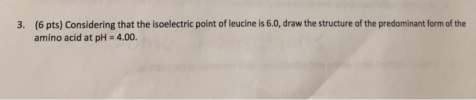 (6 pts) Considering that the isoelectric point of leucine is 6.0, draw the structure of the predominant form of the amino acid at pH 4.00. 3.
please answer all q's the amino acids are :histidine- glycine-and glutamic acid slution 1. Construct titration...
 please answer all q's
the amino acids are :histidine- glycine-and glutamic acid
slution
1. Construct titration curves for the amino acids titrated by plotting 2. Determine the pI and the pKo values for each amino acid analyzed and 3. Identify each ionic state of the amino acid during the titration. added o acid analyzed and record the values on your titration curves 4. Determine the moles of amino acid present in each amino acid solution.
please answer all q's
the amino acids are :histidine- glycine-and glutamic acid
slution
1. Construct titration curves for the amino acids titrated by plotting 2. Determine the pI and the pKo values for each amino acid analyzed and 3. Identify each ionic state of the amino acid during the titration. added o acid analyzed and record the values on your titration curves 4. Determine the moles of amino acid present in each amino acid solution.
Draw the structure of Glutamic Acid at each pka (ex. which group is deprotonated at each...
Draw the structure of Glutamic Acid at each pka (ex. which group is deprotonated at each pH).
please explain thoroughly and show all work If you applied an amino acid mixture containing Histidine...
 please explain thoroughly and show all work
If you applied an amino acid mixture containing Histidine and Lysine onto ion exchange chromatography, at what pH should the chromatography be performed? Explain your reasoning. Lysine: pKa1-2.2, pKa2-9.1 and pKaR- 10.5 Histidine: pKa1=1.8, pKa2-9.3 and pKaR-6.0
If you applied an amino acid mixture containing Histidine and Lysine onto ion exchange chromatography, at what pH should the chromatography be performed? Explain your reasoning. Lysine: pKa1-2.2, pKa2-9.1 and pKaR- 10.5 Histidine: pKa1=1.8, pKa2-9.3 and...
please explain thoroughly and show all work
If you applied an amino acid mixture containing Histidine and Lysine onto ion exchange chromatography, at what pH should the chromatography be performed? Explain your reasoning. Lysine: pKa1-2.2, pKa2-9.1 and pKaR- 10.5 Histidine: pKa1=1.8, pKa2-9.3 and pKaR-6.0
If you applied an amino acid mixture containing Histidine and Lysine onto ion exchange chromatography, at what pH should the chromatography be performed? Explain your reasoning. Lysine: pKa1-2.2, pKa2-9.1 and pKaR- 10.5 Histidine: pKa1=1.8, pKa2-9.3 and...
Draw an approximation for the titration curve of glutamic acid which is the non-ionized or protonated...
Draw an approximation for the titration curve of glutamic acid which is the non-ionized or protonated form of glutamate. Make sure to label the axis. Clearly label each pKa on the graph (Hint: it may help you to connect the pK to the x and y axis, but not required). What is the Isoelectric point? Define the term isoelectric point, calculate and label the point on the graph. Draw the major species of glutamic acid with appropriate formal charges at...
Histidine can be treated as a polyprotic acid for the purpose of making a buffer solution....
 Histidine can be treated as a polyprotic acid for the purpose of making a buffer solution. The molecular weight histidine is 155.2 g/mol. You are asked to make 200 mL of a buffer solution containing 50 mM L-histidine. How much histidine do you add to the solution? Show your work. You adjust the pH of this solution to pH 5.0. Please draw the structures of the two primary histidine species at this pH. Circle the structure that is most prevalent...
Thank you so much!! Draw the structure of the major organic product of the reaction. N1 You do not have to consider...
 Thank you so much!!
Draw the structure of the major organic product of the reaction. N1 You do not have to consider stereochemistry All carboxyl and amino groups should be drawn in the neutral fora Draw one structure per sketcher. Add additional sketchers using the drop-down menu in the bottom right comer Separate multiple products using the + sign from the drop-down menu. Draw a structural formula for the major ionic form of the amino acid shown below when in...
Thank you so much!!
Draw the structure of the major organic product of the reaction. N1 You do not have to consider stereochemistry All carboxyl and amino groups should be drawn in the neutral fora Draw one structure per sketcher. Add additional sketchers using the drop-down menu in the bottom right comer Separate multiple products using the + sign from the drop-down menu. Draw a structural formula for the major ionic form of the amino acid shown below when in...
 (6 pts) Considering that the isoelectric point of leucine is 6.0, draw the structure of the predominant form of the amino acid at pH 4.00. 3.
 please answer all q's
the amino acids are :histidine- glycine-and glutamic acid
slution
1. Construct titration curves for the amino acids titrated by plotting 2. Determine the pI and the pKo values for each amino acid analyzed and 3. Identify each ionic state of the amino acid during the titration. added o acid analyzed and record the values on your titration curves 4. Determine the moles of amino acid present in each amino acid solution.
please answer all q's
the amino acids are :histidine- glycine-and glutamic acid
slution
1. Construct titration curves for the amino acids titrated by plotting 2. Determine the pI and the pKo values for each amino acid analyzed and 3. Identify each ionic state of the amino acid during the titration. added o acid analyzed and record the values on your titration curves 4. Determine the moles of amino acid present in each amino acid solution.
 please explain thoroughly and show all work
If you applied an amino acid mixture containing Histidine and Lysine onto ion exchange chromatography, at what pH should the chromatography be performed? Explain your reasoning. Lysine: pKa1-2.2, pKa2-9.1 and pKaR- 10.5 Histidine: pKa1=1.8, pKa2-9.3 and pKaR-6.0
If you applied an amino acid mixture containing Histidine and Lysine onto ion exchange chromatography, at what pH should the chromatography be performed? Explain your reasoning. Lysine: pKa1-2.2, pKa2-9.1 and pKaR- 10.5 Histidine: pKa1=1.8, pKa2-9.3 and...
please explain thoroughly and show all work
If you applied an amino acid mixture containing Histidine and Lysine onto ion exchange chromatography, at what pH should the chromatography be performed? Explain your reasoning. Lysine: pKa1-2.2, pKa2-9.1 and pKaR- 10.5 Histidine: pKa1=1.8, pKa2-9.3 and pKaR-6.0
If you applied an amino acid mixture containing Histidine and Lysine onto ion exchange chromatography, at what pH should the chromatography be performed? Explain your reasoning. Lysine: pKa1-2.2, pKa2-9.1 and pKaR- 10.5 Histidine: pKa1=1.8, pKa2-9.3 and...
 Histidine can be treated as a polyprotic acid for the purpose of making a buffer solution. The molecular weight histidine is 155.2 g/mol. You are asked to make 200 mL of a buffer solution containing 50 mM L-histidine. How much histidine do you add to the solution? Show your work. You adjust the pH of this solution to pH 5.0. Please draw the structures of the two primary histidine species at this pH. Circle the structure that is most prevalent...
 Thank you so much!!
Draw the structure of the major organic product of the reaction. N1 You do not have to consider stereochemistry All carboxyl and amino groups should be drawn in the neutral fora Draw one structure per sketcher. Add additional sketchers using the drop-down menu in the bottom right comer Separate multiple products using the + sign from the drop-down menu. Draw a structural formula for the major ionic form of the amino acid shown below when in...
Thank you so much!!
Draw the structure of the major organic product of the reaction. N1 You do not have to consider stereochemistry All carboxyl and amino groups should be drawn in the neutral fora Draw one structure per sketcher. Add additional sketchers using the drop-down menu in the bottom right comer Separate multiple products using the + sign from the drop-down menu. Draw a structural formula for the major ionic form of the amino acid shown below when in...
Most questions answered within 3 hours.
-
Where is the error in this code sequence?
String s1 = "Hello";
String s2 = "ello";...
asked 11 months ago -
Financial data for Joel de Paris, Inc., for last year
follow:
Joel de Paris, Inc.
Balance...
asked 11 months ago -
Consider this reaction:
Al2(SO4)3 (aq)+ BaCl3
(aq) Al2Cl6 (aq)- +
3BaSO4(s) . What is the...
asked 11 months ago -
Suppose that Savneet is considering increasing her
recent random sample from 20 car rentals to 40...
asked 11 months ago -
Trucks arrive at an unloading terminal at an average rate of 120
per hour.
Trucks arrive...
asked 11 months ago -
Why are methanol and ethanol completely soluble in water while
octanol is not very little soluble....
asked 11 months ago -
A facilities manager at a university reads in a research report
that the mean amount of...
asked 11 months ago -
When the CuSO4 is rehydrated by adding water to the anhydrous
compound, is this an endothermic...
asked 11 months ago -
A ray of sunlight is passing from diamond into crown glass; the
angle of incidence is...
asked 11 months ago -
A block of mass 0.249 kg is placed on top of a light, vertical
spring of...
asked 11 months ago -
how do the kidneys compensate in the presences of acidosis
a) trigger hyperventilate
b) reserve acid...
asked 11 months ago -
Question 501 pts
The rental rate of capital to the firm increases. Which of the
following...
asked 11 months ago