Why is the protozoan phylogeny comb-shaped?
Why is the protozoan phylogeny comb-shaped?
Homework Answers
Protozoa are basically single celled organisms and are present in the nature in different shape and size with its habitat mostly in moist places. They are generally between 50 to 150µm with the nucleus enclosed in a membrane. The reason the prokaryotes look like comb or it is comb shaped is because of the presence of ciliates on its body. The cilia consist both of micronucleus and macronucleus and this tends to give a comb like shape and appearance. There are a number of locomotors or structures like pseudopodia, cilia and flagella around the plasma membrane that encloses the cytoplasm and this is what give the comb like appearance.
Explain why a phylogeny is a hypothesis
Explain why a phylogeny is a hypothesis
3. Why was the gene for the small-subunit ribosomal RNA particularly well-suited for reconstructing the phylogeny...
3. Why was the gene for the small-subunit ribosomal RNA particularly well-suited for reconstructing the phylogeny of all living things?
Discuss phylogeny and taxonomy in relation to diet, morphology, and locomotion. Why do primates look so...
Discuss phylogeny and taxonomy in relation to diet, morphology, and locomotion. Why do primates look so different and why do they eat different things? Are there any trends between diet, morphology, and locomotion? If so, why might that be? (Hint: variation, speciation, and the forces of evolution.)
Rub a comb through your hair and use it to lift pieces of paper. It may...
Rub a comb through your hair and use it to lift pieces of paper. It may help to tear the pieces of paper rather than cut them neatly. Repeat the exercise in your bathroom after you have had a long shower and the air in the bathroom is moist. Is it easier to get electrostatic effects in dry or moist air? Why would torn paper be more attractive to the comb than cut paper? Explain your observations.
I need help in creating this phylogeny tree based on the data provided. If you could...
 I need help in creating this phylogeny tree based on the data
provided. If you could please show me how it would look like and
why!
I need help in creating this phylogeny tree based on the data
provided. If you could please show me how it would look like and
why!
Why would one add buffer before removing the comb? Summarize how to first obtain a sample...
Why would one add buffer before removing the comb? Summarize how to first obtain a sample via pipette (specifically an adjustable pipette) and then load into the well Why is it necessary to use a new tip for each well? What factors affect the accuracy of liquid uptake? What is the relevance of the difference between the first and second stop? Have you pipetted before? Are you guilty of banging the pipette to “firmly” attach the tip? What are the...
9. Below is a phylogeny of tern species. This is based on mitochondrial DNA sequences and...
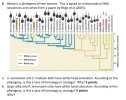 9. Below is a phylogeny of tern species. This is based on mitochondrial DNA sequences and comes from a paper by Brige et al (2005). White crown White blaze Black cap S. sumatrana and S. trudeani both have white head coloration. According to this phylogeny, is this a case of homology or analogy? Why? 5 points Gygis alba and A. tenuirostris also have white head coloration. According to this phylogeny, is this a case of homology or analogy? 5 points...
QUESTION 5 5 points Save Ans In terms of phylogeny, are the following phylogenetic trees equivalent?...
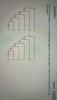 QUESTION 5 5 points Save Ans In terms of phylogeny, are the following phylogenetic trees equivalent? Why are they equivalent of not equivalent? « 0 0 o 0 o и m ш F
Explain why the signal in SWV is peak-shaped while in NPV it is sigmoidal.
Explain why the signal in SWV is peak-shaped while in NPV it is sigmoidal.
7. Consider the evolution of land plants. a. According to the phylogeny of land plants, pores...
 7. Consider the evolution of land plants. a. According to the phylogeny of land plants, pores are an ancestral trait and stomata are derived. Explain why this is logical, in terms of the mutations that had to occur for these traits to evolve. (2 sentences max) (2 pts) b. Despite the advantages of stomata, Liverworts still thrive today and only have pores. Why? (2 sentences max) (2 pts)
 I need help in creating this phylogeny tree based on the data
provided. If you could please show me how it would look like and
why!
I need help in creating this phylogeny tree based on the data
provided. If you could please show me how it would look like and
why!
 9. Below is a phylogeny of tern species. This is based on mitochondrial DNA sequences and comes from a paper by Brige et al (2005). White crown White blaze Black cap S. sumatrana and S. trudeani both have white head coloration. According to this phylogeny, is this a case of homology or analogy? Why? 5 points Gygis alba and A. tenuirostris also have white head coloration. According to this phylogeny, is this a case of homology or analogy? 5 points...
 QUESTION 5 5 points Save Ans In terms of phylogeny, are the following phylogenetic trees equivalent? Why are they equivalent of not equivalent? « 0 0 o 0 o и m ш F
 7. Consider the evolution of land plants. a. According to the phylogeny of land plants, pores are an ancestral trait and stomata are derived. Explain why this is logical, in terms of the mutations that had to occur for these traits to evolve. (2 sentences max) (2 pts) b. Despite the advantages of stomata, Liverworts still thrive today and only have pores. Why? (2 sentences max) (2 pts)
Most questions answered within 3 hours.
-
Where is the error in this code sequence?
String s1 = "Hello";
String s2 = "ello";...
asked 10 months ago -
Financial data for Joel de Paris, Inc., for last year
follow:
Joel de Paris, Inc.
Balance...
asked 10 months ago -
Consider this reaction:
Al2(SO4)3 (aq)+ BaCl3
(aq) Al2Cl6 (aq)- +
3BaSO4(s) . What is the...
asked 10 months ago -
Suppose that Savneet is considering increasing her
recent random sample from 20 car rentals to 40...
asked 10 months ago -
Trucks arrive at an unloading terminal at an average rate of 120
per hour.
Trucks arrive...
asked 10 months ago -
Why are methanol and ethanol completely soluble in water while
octanol is not very little soluble....
asked 10 months ago -
A facilities manager at a university reads in a research report
that the mean amount of...
asked 10 months ago -
When the CuSO4 is rehydrated by adding water to the anhydrous
compound, is this an endothermic...
asked 10 months ago -
A ray of sunlight is passing from diamond into crown glass; the
angle of incidence is...
asked 10 months ago -
A block of mass 0.249 kg is placed on top of a light, vertical
spring of...
asked 10 months ago -
how do the kidneys compensate in the presences of acidosis
a) trigger hyperventilate
b) reserve acid...
asked 10 months ago -
Question 501 pts
The rental rate of capital to the firm increases. Which of the
following...
asked 10 months ago